

If you count days for tax residence, whether you are establishing residence somewhere or evidencing non-residence elsewhere, you should do a few simple things before the tax year closes. Total your days in each country, check the evidence for each one, and have the figures ready to talk through with your tax advisor. Then, set yourself up for the year ahead. Confirm the day count limits that apply, take a look at the trips that already exist in the diary, and decide how you'll keep the record from day one. Getting this right matters because a day count is only as strong as the record behind it, and a day you didn’t evidence at the time will be harder to evidence later.
This end-of-year tax residence checklist works for most situations. First, we’ll close the year you’re in by explaining the differences in tax years around the world and how countries count days for tax residence. We’ll also explain how to count and check your days in terms of the evidence that sits behind them. Finally, we’ll walk you through some tips on getting ready for the year ahead, especially if you’re thinking about moving countries.
Prepare for the end-of-year tax residence review
A year-end review has four parts: knowing which year is closing, counting the days, checking the evidence and understanding what the total means. Each one depends on the one before it, and the tax residence checklist at the end of this section brings them together.
When does the tax year end?
A common misconception is to think that the calendar year equals the tax year. This is not true. The end of the calendar year does not automatically mean the end of the tax year. Countries have different established rules, and if you divide your time between several, you need to be aware of several year-ends at once.
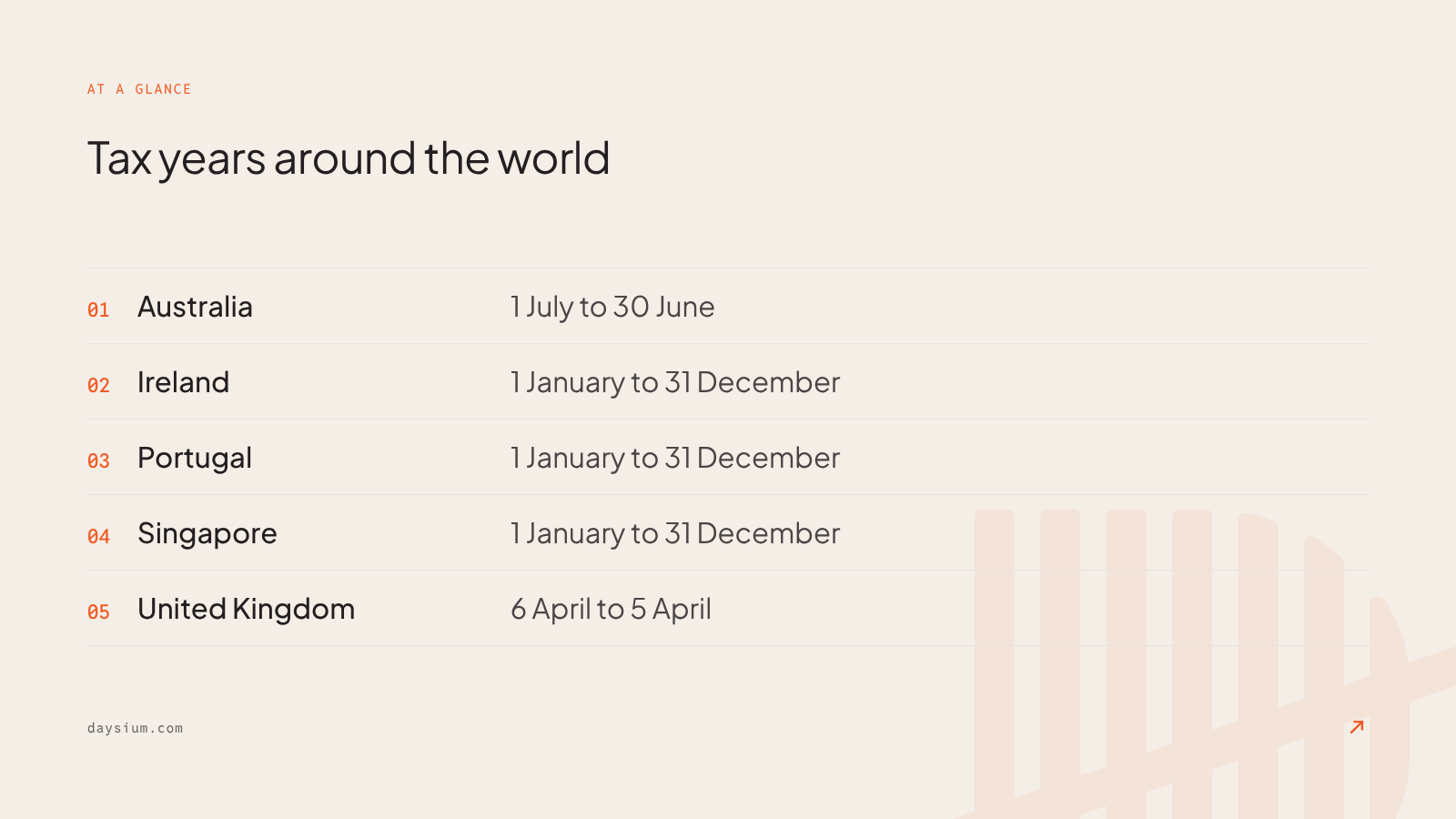
Many countries, like Ireland, Spain and Portugal, do close their tax year on 31 December. But some don’t. In the UK, the tax year runs from 6 April to 5 April. Australia also has a different tax year that runs from 1 July to 30 June.
While day counts for tax residence are usually calculated within that tax year, not every test follows a strict calendar window. For instance, Portugal looks at more than 183 days in any 12-month period that starts or ends in the year, so you aren't just focusing on a calendar year. You need to stay on top of your year count as it shifts within this rolling period.
Another example of a rolling day count that you want to remember if you’re travelling a lot is the Schengen 90/180 rule. While not a tax residence test, this border rule limits short stays to 90 days in any rolling 180-day period. The Schengen 90/180 Rule: A Complete Guide explains how the window moves.
A good place to start is with a tax residence checklist. Write down every country you spend time in, its tax year, and whether its tax residence test runs on a fixed year or a rolling window.
How do you gather and check your day counts?
Most people keep a spreadsheet, rely on the dates in their calendar or use both. A day counting app is a stronger method, because it records each day as it happens rather than after the event. Whichever you use, the aim is one timeline you can stand behind.
If you are not using a logging app, reconcile three sources against each other:
- What your spreadsheet says.
- What your calendar says.
- What your evidence says: bookings, boarding passes and statements.
Where they disagree, the evidence should guide you. Where there is no evidence, mark the day as uncertain and flag it as a talking point with your advisor.
Then apply each country’s counting rule, because a day isn't the same everywhere. For example:
- The UK counts a day if you are in the UK at midnight, subject to a deeming rule, transit days and exceptional circumstances.
- Ireland counts any part of a day, with a few exceptions.
- Portugal counts any full or partial day that includes an overnight stay.
For this reason, it's extremely important to know the exact times you leave and arrive in a specific country.
Next, total the days for each country. If you are counting before the tax year ends, keep an eye out for the trips still to come. The total should reflect the full year, not just what's already passed.
Finally, mark all the days that need a second look: transit days, gaps and any days you may treat as exceptional. In the UK, no more than 60 days a year can be claimed under exceptional circumstances, and HMRC describes that as a limit, not an allowance. Our article on exceptional days explains when a day may not count.
What evidence sits behind each day?
Tax authorities such as HMRC expect you to keep records that support what you say about your tax residence. To support tax residence, you often need things like utility bills, work contracts, and bank statements. And if you’re evidencing non-residence, that might mean documents such as boarding passes, travel bookings, card statements, and restaurant and hotel receipts.
HMRC guidance in related areas lists card statements, phone usage, and meals out among the evidence it considers. They say no single item is decisive: HMRC weighs the weight and quality of all the evidence together.
A practical way to grade what you have within your tax residence checklist is like this:
- Strong evidence is contemporaneous and independent, such as a boarding pass or geologged, timestamped photo or digital stamp.
- Supporting evidence corroborates it, such as card spending in that country on that day.
- Weak evidence is a reconstruction from memory, written after the event.
Go over each of your days and consider what evidence there is to show your position. If you feel like the evidence is hard to find or you don't have any, you should consider discussing the situation with your advisors.
Under or over: what does the number mean?
The day count you arrive at is a fact. What it means might depend on the country. Once again, tax residence is often not determined by day count alone, and different thresholds may apply depending on these other conditions.
In the UK, for example, the day count is one input among several. The Statutory Residence Test also looks at homes, work and your connections to the UK. A total that looks comfortable on its own can read differently once those are added.
What to bring your advisor:
- Your day counts for each country, for each country’s own year.
- The evidence behind each count.
- The gaps, and how you propose to treat them.
- Any assumptions you made, such as how you counted a transit day.
The earlier you discuss these with your advisor, the more time you have to act.
End of year tax residence checklist
- List every country you spent time in, the date its tax year ends, and whether it runs on a fixed year or a rolling window.
- Reconcile any uncertain dates against your spreadsheet, calendar and evidence.
- Check what evidence supports each travel event, and note the days with none.
- Mark transit days, gaps and any days you may treat as exceptional.
- Calculate your day count total for the year in each country, using that country’s rule for what counts as a day.
- Add any trips still to come before the year closes.
- Check with your advisor how your day counts fit your current strategy, taking your counts, evidence, gaps and assumptions with you.
Preparing for the new tax year
The tax year you are closing shapes the year you are starting. Next year’s limits, next year’s ties and next year’s evidence all start with decisions made now.
What is your day count threshold next year?
Day thresholds are not always fixed figures you carry from year to year. They can move with your circumstances and with your own tax residence history.
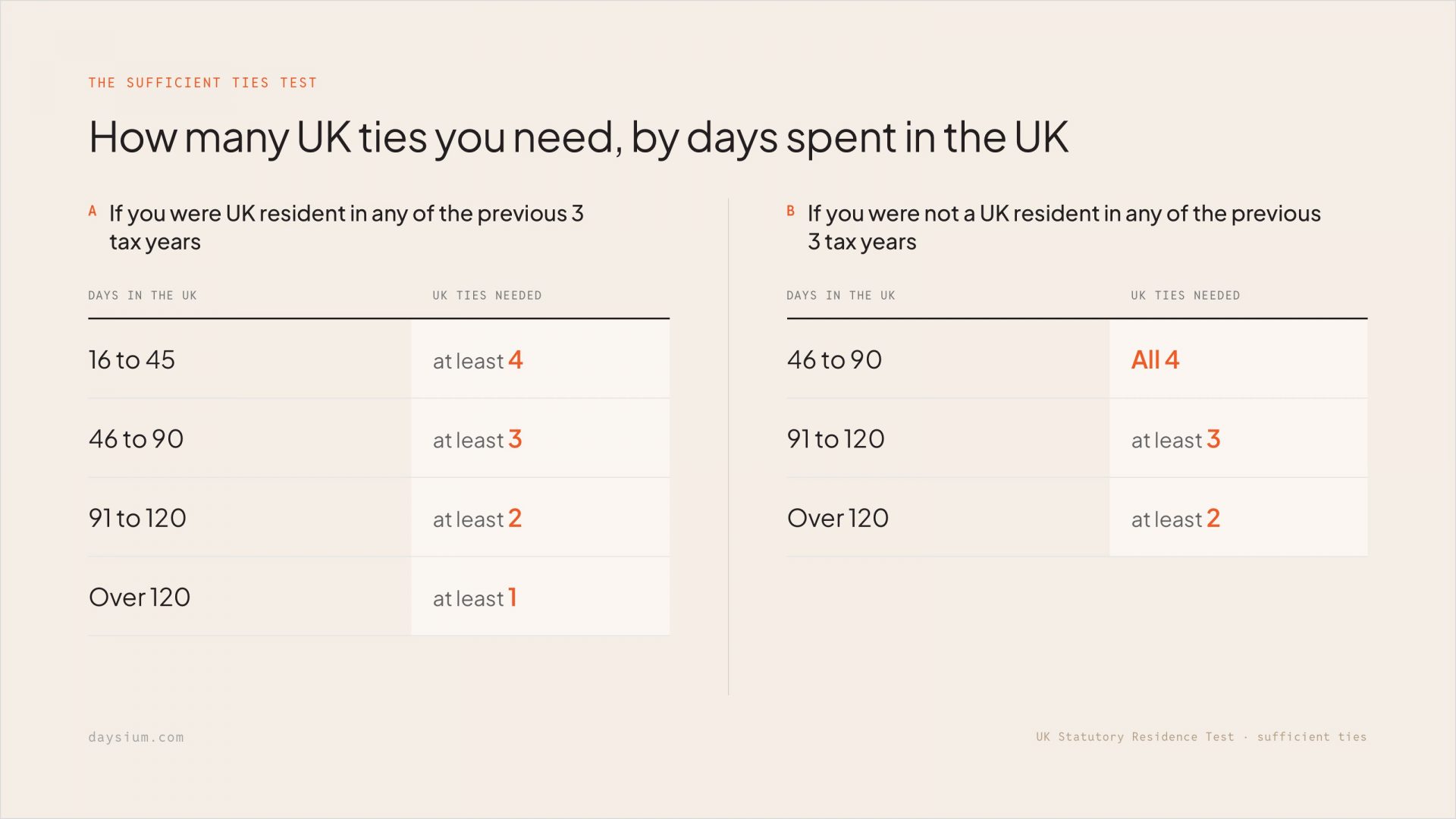
In the UK, for example, if none of the automatic tests decides the year, the sufficient ties test applies. Its day threshold depends on how many UK ties you have and on whether you were a UK resident in any of the previous three tax years, so the same number of days can give a different answer from one year to the next.
For a fuller guide to the UK rules, read How Do I Count Days for UK Tax?.
It’s not just the UK, as other countries link years too. Ireland treats you as resident if you spend 280 days or more there across the current and previous tax years together, subject to a 30-day minimum, so this year’s Irish days can carry into next year’s position.
Confirm next year’s position with your advisor before the tax year ends. It is much easier to plan within a limit you know than to explain one you discovered midway through the year.
How do trips you’ve already booked change the picture?
Start with the dates you already know: school holidays, board meetings, family events and trips already paid for. Add them to next year’s count for each country, then see how much room is left.
That remaining room is what you can actually plan with. Knowing it at the start of the tax year means you can plan within it; finding it when the year is closing means planning around it.
Remember to count each booked trip the way each country deals with days. In the UK, a day only counts if you are there at midnight, while places like Ireland generally count a day ‘present’ if you’re in the country at any point.
Planning to move countries next year?
A move could change both the threshold and the evidence you need. The departure date matters, and so do proof of where you have settled and proof of the ties you have cut.
How the year of the move is treated depends on the countries involved. In the UK, split year treatment can divide the year into a UK part and an overseas part. There are eight cases, three for leaving and five for arriving, and you must meet every condition for a case to apply.
Establishing or evidencing non-residence after a move depends on the evidence each country’s tax authority uses to determine where your home really is. That often includes utility bills, redirected post, local registrations with councils or healthcare providers, and where your card spending happens. Start accumulating supporting evidence from the day you arrive, not the day someone asks.
The problem with spreadsheet day counting and manual reviews
Take a hypothetical situation where you divide your time between the UK, Portugal and Spain. Over the year you make 40 trips, and in November your advisor asks for the figures. Done by hand, the review runs like this:
- Find the documents. Forty trips could mean up to 80 travel days, each needing a booking, a boarding pass or a statement line. Some are in an inbox, some in an airline app, some with an assistant.
- Rebuild the timeline. Put every trip into one sequence, with a departure and an arrival for each. Correct the spreadsheet wherever it disagrees with the documents.
- Apply the day counting rules. The UK typically counts midnights, Portugal counts overnight stays, and Spain can count even sporadic absence, so each travel day is assessed more than once.
- Cut it into different years. The UK count runs to 5 April; the Portuguese and Spanish counts run to 31 December. Portugal’s test can also look at any 12-month window that starts or ends in the year.
- List the gaps. Flag days with no evidence, and start looking for more information and proof.
None of these steps is difficult, but they take a lot of time —time that, let’s be honest, is much nicer to spend doing almost anything else.
Frequently asked questions
Does the tax year end when the calendar year ends?
Only in some countries. Ireland, Spain and Portugal close their tax year on 31 December, but the UK tax year runs to 5 April, Australia’s to 30 June and India’s to 31 March. Some tax residence tests, such as Portugal’s 12-month window, also look beyond a single tax year, so check each country you spend time in.
Does the calendar year end matter for UK tax residence?
Not for the UK count itself: the UK tax year runs from 6 April to 5 April, so 31 December closes nothing there. It can still matter for a UK-led strategy, because the days you spend elsewhere may fall in a country whose year closes on 31 December.
Can I fix my day counting records after the tax year has closed?
You can complete and correct them, and you should if you find an error. Note what you changed, when and on what evidence, so the record shows its own history. A record made at the time generally carries more weight than one rebuilt later. HMRC can normally assess up to four years after the end of a tax year, six where tax was lost through carelessness and 20 where it was lost deliberately.
How the year end looks in Daysium
With Daysium’s tax residence platform, most of that work is already done by year-end because the record is built as the year happens. Going through your tax residence checklist becomes easier: you look at your smartphone and desktop for confirmation of your day counts and supporting evidence.
Daysium Mobile keeps your day counts current against the rules set for your position, in every jurisdiction you count. It builds your timeline automatically as you travel, and you add receipts and boarding passes to the day they belong to with geotagged location stamps. You can see the day count as it stands now, how many days are evidenced, and a global profile showing how much time you have spent in each country.
We calculate day counts against Rule Cards built from each country’s law and reviewed before they go live. Which tests apply to you, and what they mean, stay with you and your advisor.
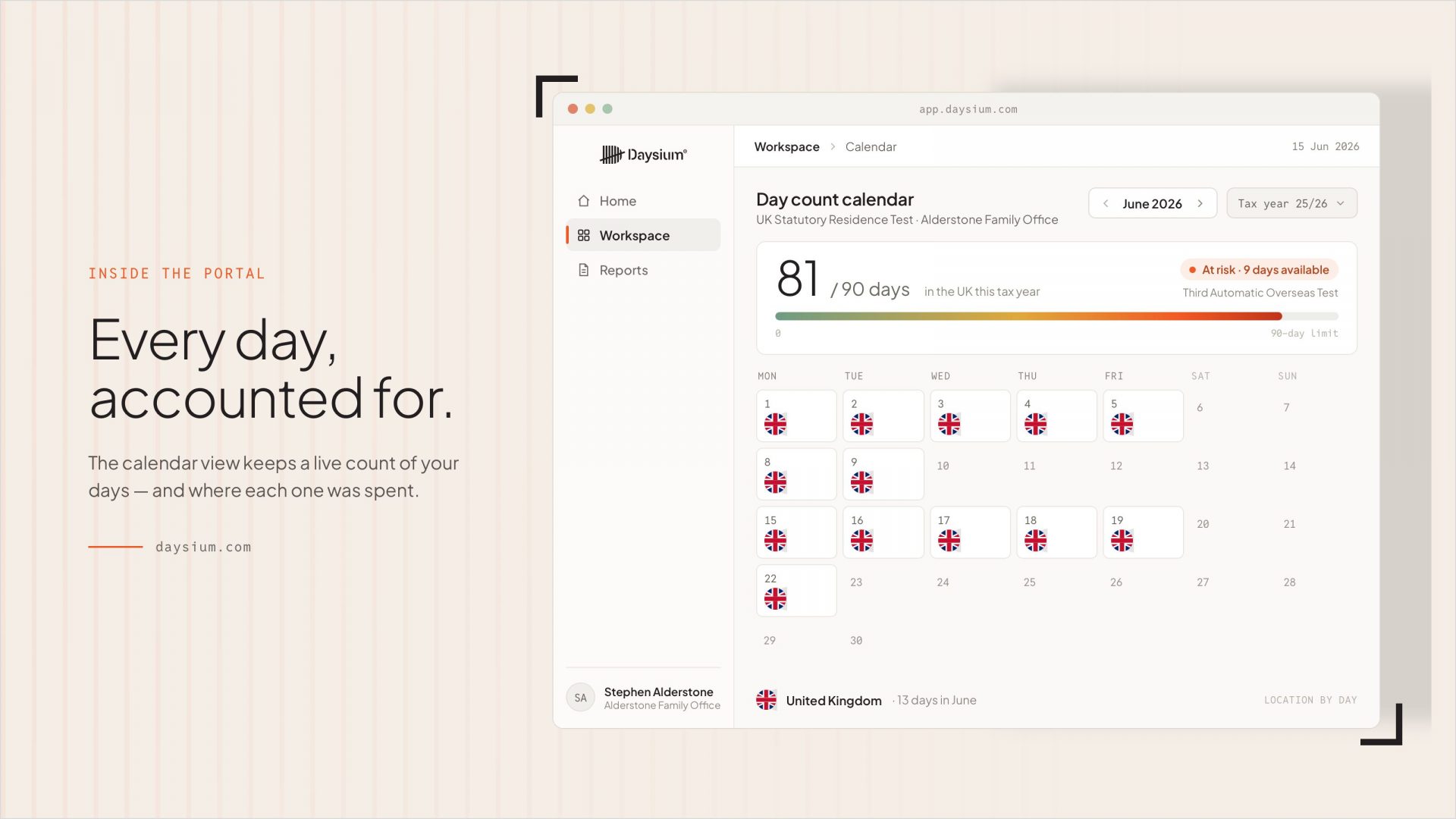
Daysium Portal is where your advisor comes in. Invite them, and they'll see your live position and day counts before the review. They see your days by country, never your detailed locations or the evidence behind them, and you decide who has access.
Finally, our reports give you a snapshot when you need one: where you were, how each day was treated under the rules set for your position and the count for the period. Export one from Daysium Mobile or Daysium Portal and share it with your advisors. This way, you can spend end-of-year reviews on strategy, not data discussions.
Still using spreadsheets for your tax residence day count? See what the year-end looks like when the record is already there. Start a 14-day trial.