



1
You set the strategy
You advise on the client’s residence position, the rules that matter and what they need to do.

You set the residence strategy. Daysium helps your client put it into practice, while Daysium Portal keeps you connected to the live position.


You give the advice. Then the client has to live it, understand it and keep the records themselves — often with little more than a spreadsheet, calendar or set of instructions.

A spreadsheet gives you a snapshot of whatever the client entered before they sent it. It does not tell you what has changed since, whether the formula is still right, or whether the client has understood the strategy correctly.

Often the next meaningful conversation is at tax-return time. If the client misunderstood the strategy, or their circumstances changed months earlier, the opportunity to deal with it while there was still room to act may already have gone.

For clients with a UK nexus, the day count ultimately becomes filing data. The professional standard around the return is not to guess, and the international information environment is becoming more connected.
The UK residence pages require the number of days spent in the UK, with specific treatment for deemed days, transit days and other exceptions.
Source: HMRC SA109 and SA109 Notes
HMRC’s Standard for Agents expects tax agents to take reasonable care, to work to prevent errors, and to avoid including figures in returns or claims that are unsubstantiated or speculative.
Source: HMRC Standard for Agents, sections 3.3, 3.4 and 4.2
Automatic Exchange of Information already moves financial-account information between tax authorities by reference to an individual’s jurisdiction of tax residence, with CRS reporting requirements continuing to develop.
Source: OECD Standard for Automatic Exchange of Financial Account Information; HMRC International Exchange of Information Manual
The better time to establish the record is while the year is happening, not when somebody asks what happened afterwards.
Applied. Counted. Evidenced.
1
You advise on the client’s residence position, the rules that matter and what they need to do.
2
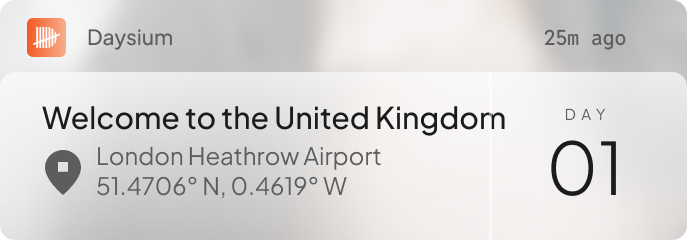
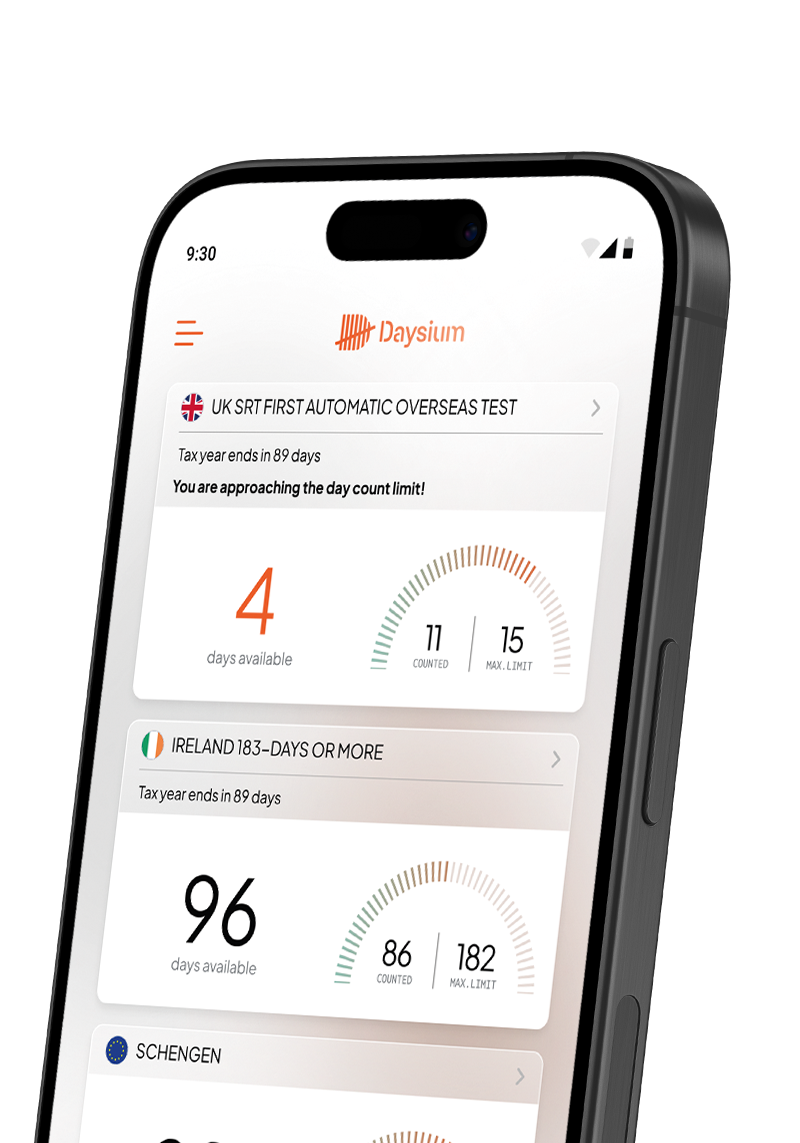
Daysium applies the rules configured for that strategy, keeps the relevant day counts current and builds the record behind them as the client travels.

3
The client can invite their advisor into Daysium Portal, giving you a shared, live view of their day counts and status when you need it. Portal provides visibility. It does not prescribe how often you review the position, and it does not turn the advisor into a day-to-day administrator.
Daysium does not give tax advice.
Professional judgement stays with the advisor.
Instead of disappearing from view until the tax return, the client can remain connected to their advisor through the year. How much involvement you offer is for you to decide.

See how the strategy is translating into real life once the client has actually moved.

A new home, work pattern, family situation or travel plan can create a legitimate reason to revisit the advice.
Where the live count matters to the strategy, you can have the conversation while the client still has choices.
Review where things stand while there may still be time to respond to changes.

Advisor and client are looking at the same position rather than beginning with an emailed spreadsheet and reconstructing the year.
Review the strategy, make any changes and begin the process again with the relationship already intact.
More useful conversations for the client. More legitimate opportunities for the advisor to advise.
Daysium Mobile is where the client puts the strategy into practice. Daysium Portal gives their advisor the shared view. Daysium handles the technology, onboarding and client support. The advisor remains the source of professional advice.
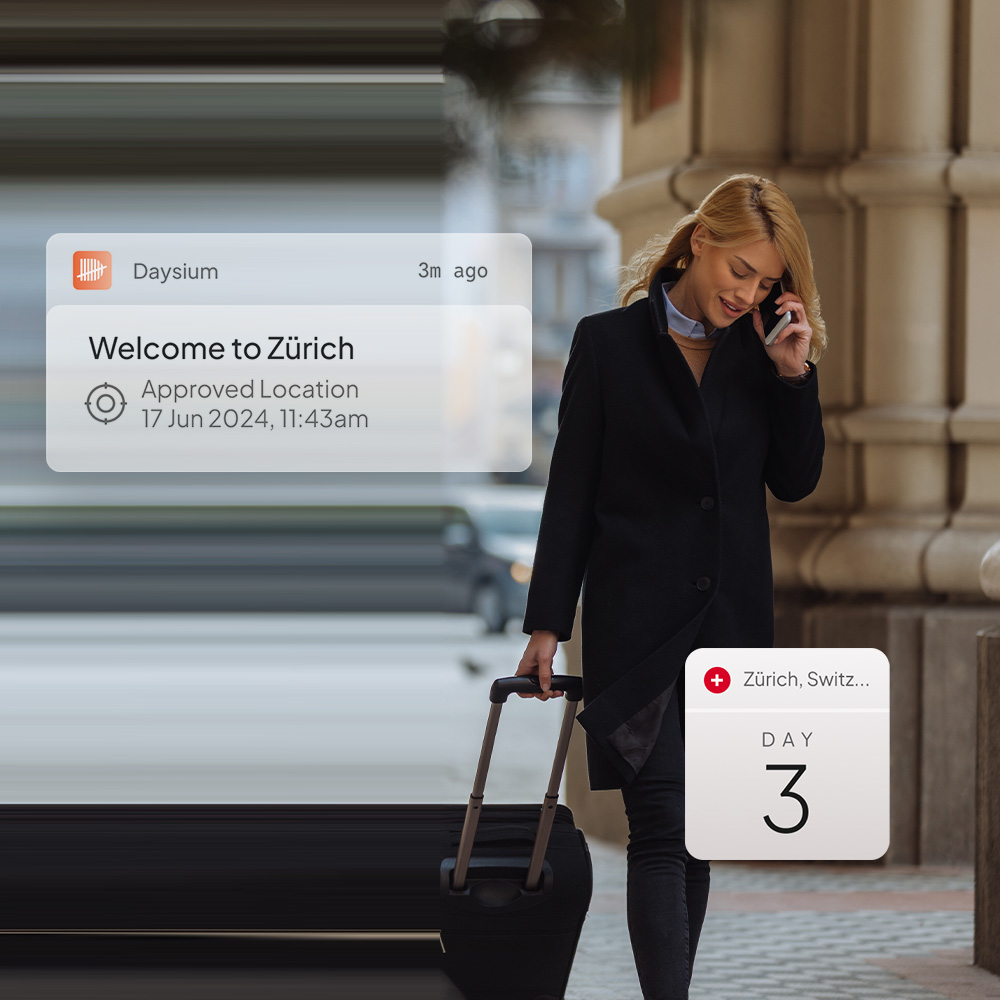

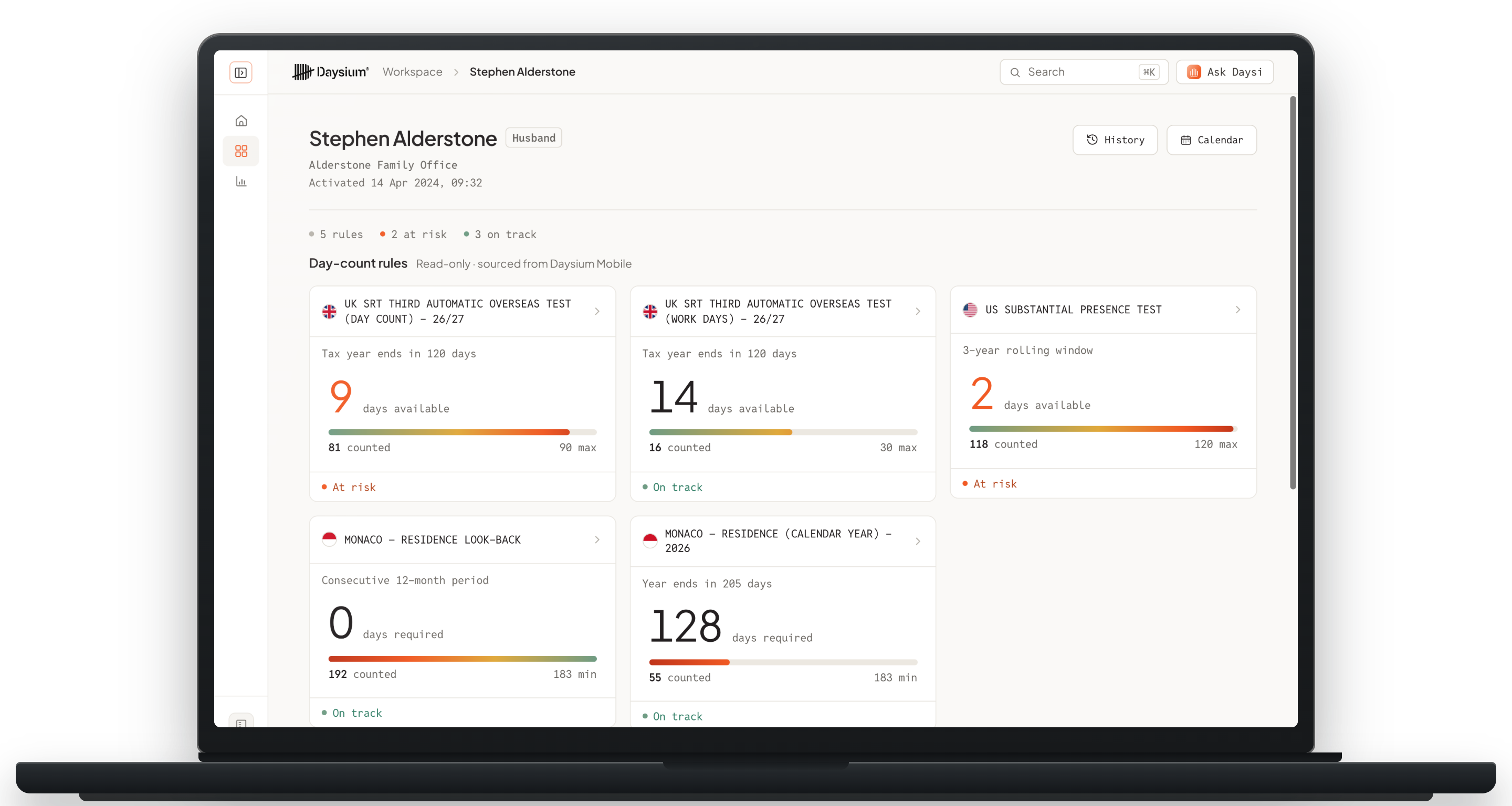
The client carries Daysium Mobile. It keeps their relevant day counts current against their rules, builds their timeline as they travel and lets them add notes and evidence as they go. Daysium handles onboarding, configuration and client support. The advisor is not expected to operate the platform for them.
The client’s record builds through the year from location data, notes and supporting evidence captured contemporaneously, with changes preserved in the audit trail. The result is not simply a number in a spreadsheet, but a record behind the number.
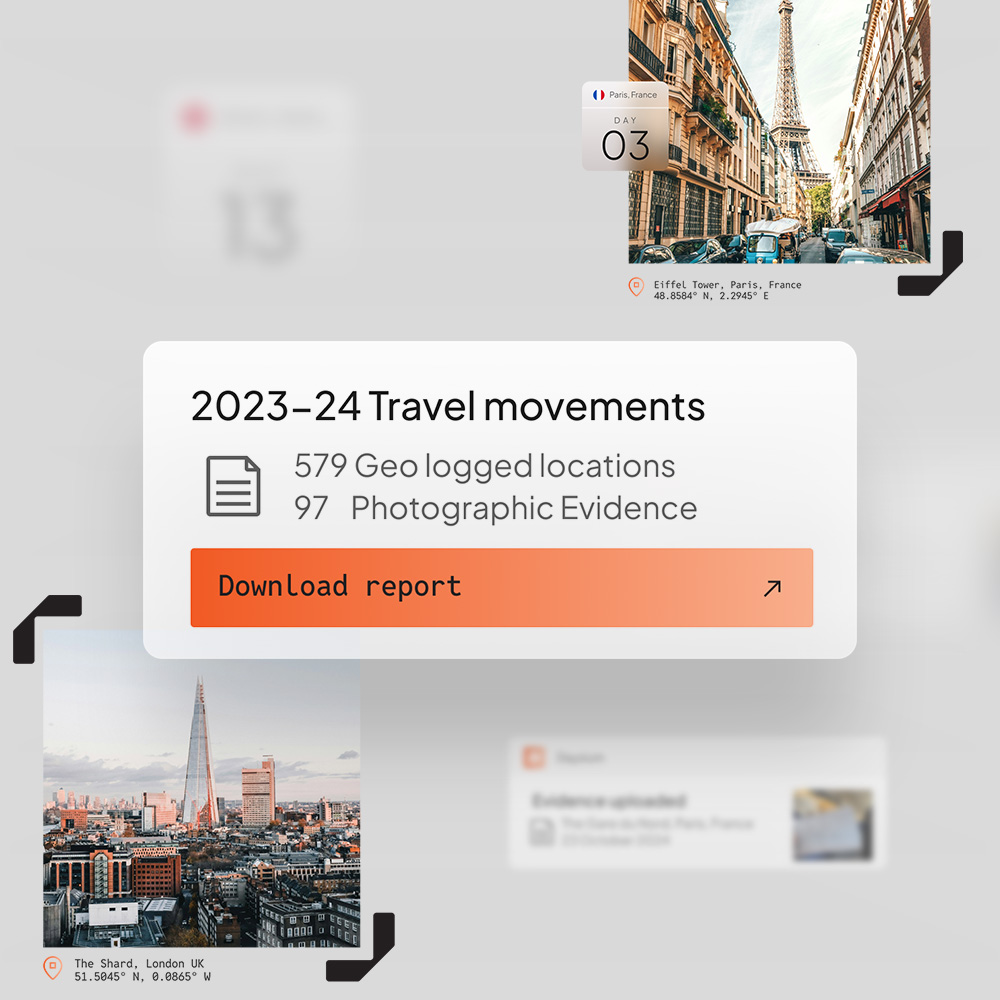
When a snapshot is needed, the client can produce a structured report showing where they were, how relevant days were treated and the resulting count for the period. That is a different starting point from an emailed spreadsheet. The advisor is looking at a structured output from the same live record, not reconstructing the year from whatever the client last sent.
A spreadsheet is already a snapshot by the time it reaches you. Daysium Portal gives the client and their advisor the same live view of day counts and status. The client controls access. Detailed locations and evidence remain private. Portal gives visibility when professional judgement is useful. It does not create a requirement to watch every client every day.

Our assurance process turns tax law into tested, signed-off rules, reviewed and kept current.
Once your client’s strategy is set, the relevant Rule Cards apply that logic to the day count automatically — giving client and advisor the same basis for the number in front of them.
Built with tax professionals
Daysium has been shaped with tax advisors, accountants, tax lawyers, ex tax inspectors and contentious-tax specialists who work with internationally mobile clients in practice.
For a close-knit profession, the people behind the product matter.
Valuable Partnerships
A pioneering company in the field of day counting and record-keeping. Their innovative tool simplifies complex date-related calculations, offering immense value to our clients. This partnership marks a significant step towards enhancing our client services with advanced solutions.

Exciting technology
The technology that Daysium has developed is incredibly exciting and I’ve really been enjoying getting under the hood of what’s in store for individuals that utilise the software! The team's passion and vision for solving the ongoing nightmare of tracking for residency status is brilliantly evident.

Protect yourself in a tax dispute
Users of Daysium will be unlikely to see any additional tax liabilities if the platform has been used correctly.
Should any additional tax liabilities arise though, I would certainly be confident to put forward arguments that the use of the software was itself a means of taking reasonable care to pay the correct amount of tax.

Simplifying international tax
The Daysium team deliver technology that makes taxes easier for expats and globally mobile individuals. What’s not to like about that? We’re really excited to work with them and offer our clients the ability to use this technology.














Getting started
Daysium does not need to begin as a firm-wide technology project. Most relationships can begin with a small number of clients for whom the problem is already obvious.
Recommend Daysium when record-keeping naturally comes up
as part of the residence advice.
We onboard and support the client and, where useful, liaise with you around the rules their advice requires.
Once the client invites their advisor into Daysium Portal, you can see the day counts and status you are discussing with them.
See whether live visibility makes reviews, changes of circumstances and year-end work better for both sides.
If the experience proves itself, Daysium can become the normal process for suitable internationally mobile clients.
As adoption develops, qualifying firms may have the opportunity to become Daysium Associate Partners and take a more active place in the wider partner community.

Typically, firms start with a handful of clients. As the value becomes clear, Daysium becomes an embedded part of the service they provide.
Your advice has a practical process behind it, your client has support through the year, and you can stay connected to the live position without operating the system. Daysium handles onboarding and client support, so the relationship stays advisor-led without creating another administrative job for the firm.
Your client controls their record and decides who sees it. Where their membership includes Daysium Portal, they can invite you to see their live day-count position and reports. You do not currently see their underlying location history or evidence files, and the client can withdraw your access.
No. Daysium produces the factual record and counts against the rules set for the client’s position. Which tests apply and what the position means remain matters for professional judgement and the client relationship.
Each Rule Card is built from identified legal sources and reviewed before it goes live. The source, review and sign-off process is recorded, and the legal sources are re-checked as rules change. How we build rules explains the assurance method in full.
Daysium supports 20+ tax jurisdictions, listed on Supported tax jurisdictions with the legal sources behind the rules. New jurisdictions are continually being added. If the one you need is not listed, ask us.
No. Most firms start by introducing Daysium client by client. If adoption develops and a closer working relationship makes sense, qualifying firms can explore Associate Partner status later. There is no requirement to become a partner before introducing a client.

Finalist two years running at theDigital Jersey TechAwards2024 – Startup Category2025 – Fintech, Startup

#2 Most Recommended StartupOut of 3,000+ companies, Daysium was ranked 2ndin a live, AI-powered scoring of Europe’s topstartups by global VCs & investors
In essence
Your client puts the strategy into practice, their advisors stay connected, and the factual record continues with them wherever the relationship goes next.