

A UK day, for tax residency purposes, is any day you're in the UK at midnight. Spend enough of them according to the threshold rules set in the Statutory Residence Test (SRT), and you'll become a UK tax resident. On the surface, answering the question 'How do I count days for UK tax’ may seem straightforward.
But this framework is a bit more complex than just tallying the days, not least because the thresholds themselves can vary widely. There's no single safe number of days that applies to everyone. Your threshold depends on your residence history and the connections, or "ties," you hold to the UK. For some people, that threshold is as low as 16 days a year, while others could spend up to 91 days without worry.
Here's how the rules actually work, and what you need in place to stay confidently within them.
This article is for general information and doesn't constitute tax or legal advice. Day counting rules are jurisdiction- and situation-specific, and we always recommend speaking with a qualified tax advisor about your own position.
Why "just count the days" isn't enough
The Statutory Residence Test applies three sets of tests, in a fixed order, to work out your residence status for a tax year (which runs 6 April to 5 April, not the calendar year):
- Automatic overseas tests: if you meet any of these, you're a non-UK resident. Full stop.
- Automatic UK tests: if you meet any of these, you're a UK resident, no further tests needed.
- Sufficient ties test: if neither of the above gives a clear answer, this test weighs your day count against your UK ties.
You work through them in order, and you stop at the first one that gives a definitive result.
Most people asking "how do I count days for UK tax" are really asking where they land in the sufficient ties test. And that's the part that catches people out, because the answer depends on your personal history, not just your calendar.
How to determine if you're a UK tax resident or not?
The day counting thresholds you need to know about to avoid accidental UK tax residency rest on looking at the three tests. But first, you must check when you arrived in or left the UK.
Arriving or leaving the UK?
The key distinction HMRC draws is between:
- Arrivers: not UK resident in any of the 3 tax years before the one in question
- Leavers: UK resident in one or more of the 3 tax years before the one in question
Those leaving the UK face tighter thresholds. This is by design: the rules are built to stop someone from claiming they've left the UK while keeping most of their life here.
The automatic tests: your first checkpoint
The time you spend outside of the UK, the automatic overseas test, is your first stop. If any of these apply to you, then you are automatically non-resident and no further tests are required:
- You spend fewer than 16 days in the UK in the tax year, and you were a UK resident in any of the previous 3 tax years.
- You spend fewer than 46 days in the UK in the tax year, and you weren't a UK tax resident in any of the previous 3 tax years.
- You spend fewer than 91 days in the UK, and you work full-time overseas, and you have fewer than 31 UK workdays, and no 'significant break' from overseas work.
If none of the above applies, then you move on to the automatic UK tests. Any of these makes you a UK tax resident, with no further tests needed:
- 183 days or more in the UK in the tax year — no exceptions, no mitigating ties
- A UK home for at least 91 consecutive days, with at least 30 days present in it during the tax year, and (if you also have an overseas home) fewer than 30 days spent there
- Full-time work in the UK across a 365-day period that falls within the tax year, meeting specific workday thresholds
If you fall between these — not caught by the overseas tests, not caught by the UK tests — the sufficient ties test decides your position.
The sufficient ties test: where day counts and connections meet
HMRC recognises four main ties to the UK:
- Family tie: spouse, civil partner, or minor child who is a UK resident
- Accommodation tie: UK accommodation available to you for 91+ consecutive days, where you spend at least one night (or 16+ nights if it belongs to a close relative)
- Work tie: 40 or more UK workdays (more than 3 hours' work counts as a workday)
- 90-day tie: more than 90 days spent in the UK in either of the previous two tax years
There is also the ‘country tie’, which is only relevant for UK leavers and requires that the UK is the country where you spent the most days in the tax year.
The more ties you hold, the fewer days you can spend in the UK before becoming resident. HMRC's own tables set this out:
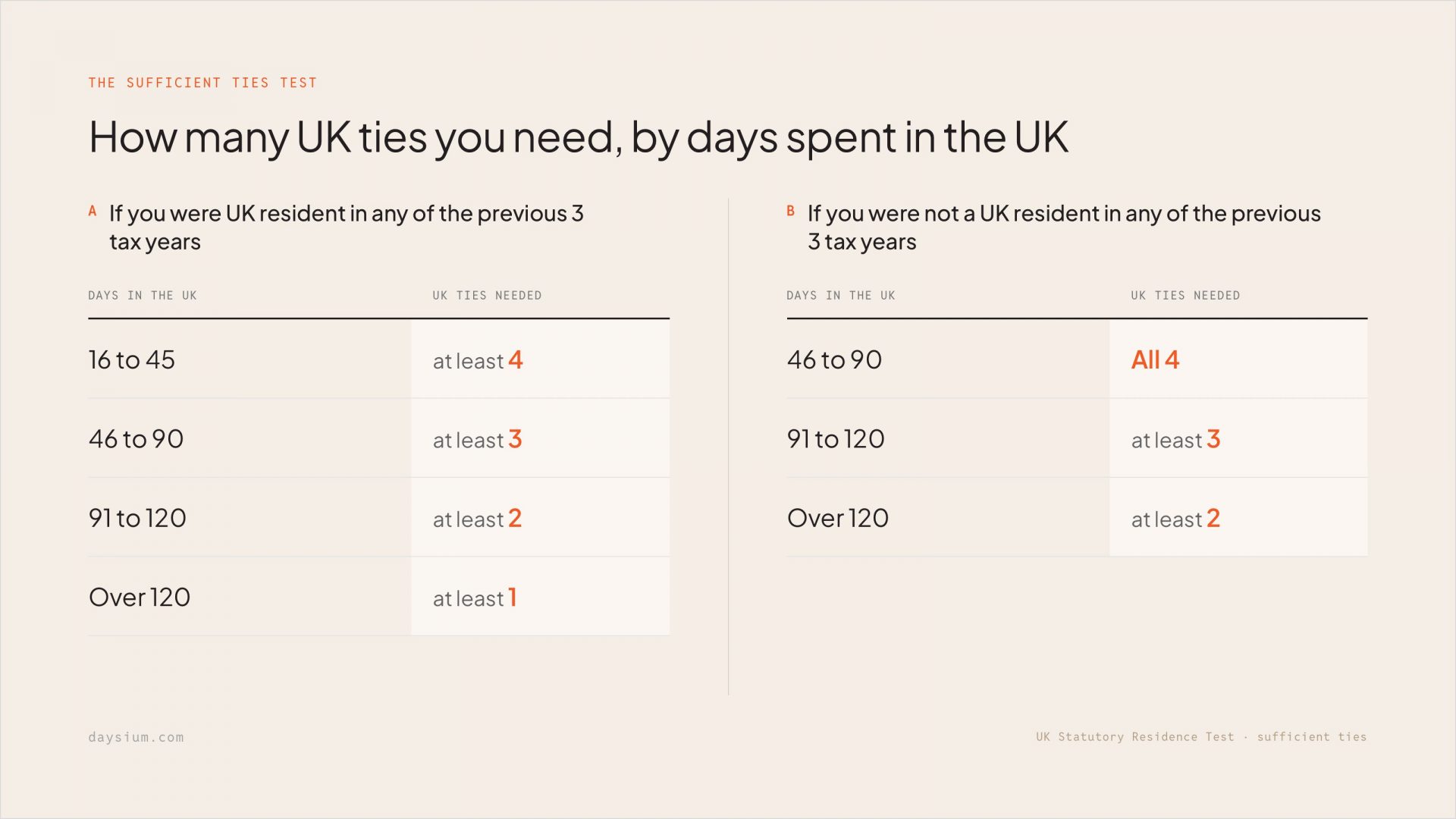
This is why two people with identical travel patterns can end up in different places. Someone with a UK spouse, a London flat, and a business that pulls them back for meetings could become tax resident on far fewer days than someone with none of those ties.
What actually counts as a "day"
The final piece of the puzzle for answering the question 'how do I count days for UK tax’ rests on the core idea of a 'present' day. Countries have different ways of determining presence for tax residency compliance; here's what the UK says:
The midnight rule is the baseline. That means any day you are in the UK at midnight would count towards your total tally. If you leave by 11pm, then it doesn't count.
Of course, the UK having one of the most complex tax codes in the world, the situation isn't quite as simple. There are several edge cases, including:
- Transit days: passing through the UK between two international flights, without engaging with the UK beyond the airport, generally doesn't count. But the moment you step outside that narrow definition, it can.
- Exceptional circumstances: limited relief exists for days you're in the UK due to genuinely exceptional events, such as sudden serious illness.
- The deeming rule: if you were a UK resident in one of the previous 3 tax years and have at least 3 UK ties, HMRC can count some days you were in the UK during the day but left before midnight. Untracked daytime visits, calls taken from a UK office, half-day meetings — these can be pulled back into your day count if they exceed a 30-day allowance for such visits.
That last point is where a lot of people get caught. It's not enough to know your overnight stays. If you're a leaver with several ties, your daytime presence in the UK matters too.
How people usually try to count their days
There are three main ways people start counting UK days to avoid triggering accidental tax residency:
Memory. People who might spend only a limited number of days in the UK often believe they'll remember their tally. The problem is that, as we've seen, you might have as few as 16 days available to spend in the UK. If your travel patterns are even a bit more frequent and include various other tax jurisdictions, relying on memory alone becomes dangerous. Estimates tend to drift, and drift in the wrong direction is expensive.
Spreadsheets. As travel increases, many start tracking travel days in a spreadsheet. An improvement, but manual entry still has many risks. The spreadsheet doesn't account for jurisdictional logic. It won't separate a transit day from a work day. The entries you make rely on your interpretation of the rules. Furthermore, spreadsheets often get filled retrospectively, meaning you're still partially relying on your memory to remember to log and to log accurately. And if HMRC asks you to justify your position, a spreadsheet with no corroborating evidence behind it is a thin defence.
General travel or expense apps. These log locations or spend, not tax-relevant presence. They rarely distinguish a transit day from a UK day, and they weren't designed to reflect SRT logic at all. They are built to count days, but any globally mobile HNWI knows that you need a compliance tool that supports your tax residency position. There's a marked difference.
Why the evidence matters as much as the count
If HMRC wants to review the tax residency position you claim to have, they aren't reaching out just to see the day count. Of course, this needs to be calculated and provided. Still, the more vital question is the evidence to support that figure. Day count on its own isn't enough. You need contemporaneous, dated evidence to back it up: travel records, calendars, accommodation details, work schedules.
This is the gap Daysium is built to close. Our comprehensive compliance platform offers you two solutions:
With Daysium Mobile, you track your days automatically against jurisdiction-specific rules like the SRT, attaching corroborating evidence at the point of travel. You'll see all the essential information in the palm of your hand, leading to more confident travel decisions.
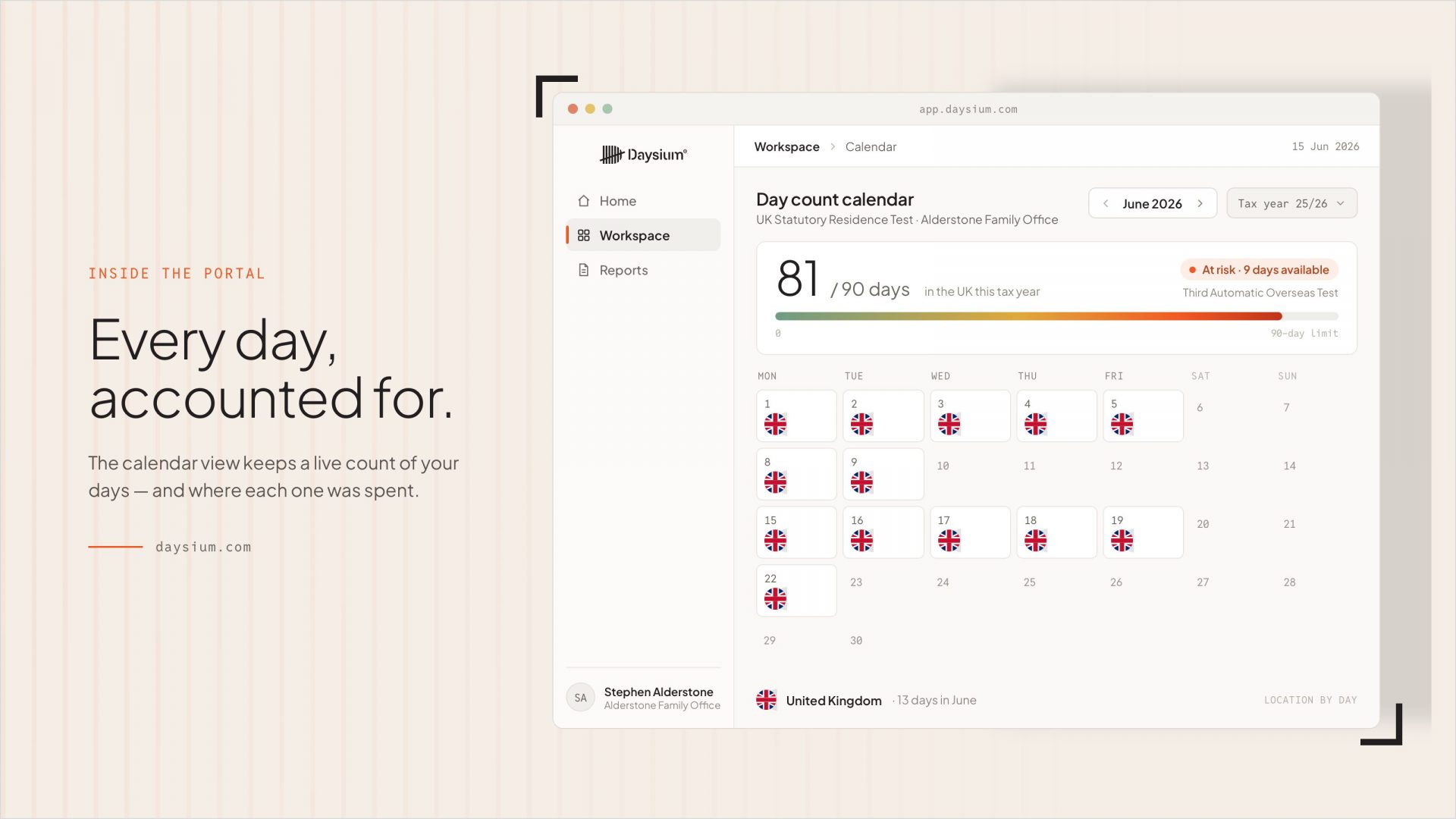
Our latest product offering, Daysium Portal, pushes this visibility and strategy further. You can invite your family members, assistants, and advisors to get a real-time view of where the line is. They won't see your location data or evidence, but can better advise or plan travel knowing your current day counts.
Together, you create a reliable and secure proof of your UK tax residency status. If HMRC asks, you'll have the confidence to say, "There's nothing to see here; everything is in order".
You can try Daysium for free for 14 days.
Frequently asked questions
What counts as a UK day for tax residency?
Generally, any day you're in the UK at midnight. Transit days between two international flights are usually excluded, and a deeming rule can pull some daytime-only visits back into your count if you have several UK ties.
How many days can I spend in the UK without becoming a tax resident?
It depends on your residence history and your UK ties. As a starting point, fewer than 16 days keep you a non-resident if you were a UK resident in any of the previous 3 tax years; fewer than 46 days do the same if you weren't. Beyond those thresholds, your ties determine the answer — see the tables above.
Do previous years' UK days affect this year's tax residency?
Yes. Your residence status in the previous 3 tax years determines whether you're treated as an "arriver" or a "leaver," which changes your thresholds. The 90-day tie also looks specifically at the previous two tax years. Please also note the UK Long-Term Resident rules, which are especially important for matters such as Inheritance Tax.
What happens if I get my day count wrong?
An incorrect day count can shift your entire tax position, since UK residents are taxed on worldwide income and gains, and non-residents generally aren't. If HMRC reviews your position and your records don't hold up, this can lead to reassessment and penalties.
Counting UK tax residency days with confidence
To answer the question 'how do I count days for UK tax’, you need to examine your specific circumstances. The rules are detailed because your circumstances are individual.
But that doesn't mean staying compliant has to be stressful. Once you know which tests apply to you and which ties you hold, day counting becomes a matter of keeping accurate, defensible records as you go, rather than reconstructing a year of travel under pressure. That's the difference between a rough estimate and a position you can stand behind with confidence.
Confident about your current approach to counting UK tax residency days?
Take our 2-minute Day Count Confidence Check.
You'll receive a personal confidence score along with actionable tips on how to improve your day counting — with or without technology.