

If you split your time across Europe, the Schengen 90/180 rule is probably the single most consequential piece of travel arithmetic you're dealing with. Simple in theory, but when you're in the midst of booking a flight or considering extending your travel days, the rolling calculation can become a chore.
This guide covers how the rule works, who it applies to, and how border control has changed. We'll also cover the common mistakes that globally mobile individuals make and the simple solution to your day counting woes.
How does the Schengen 90/180 rule work?
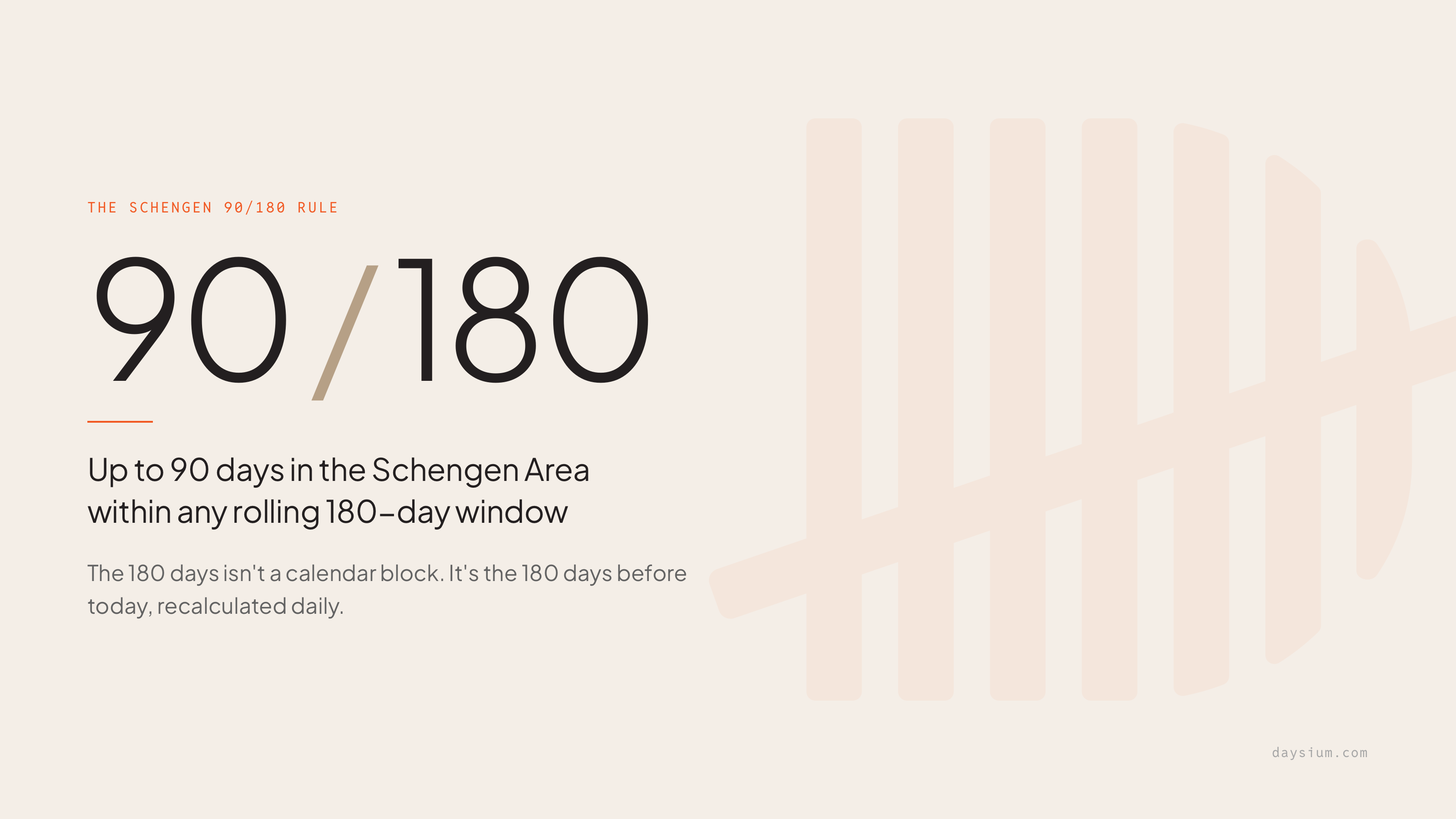
The rule allows non-EU, non-Schengen nationals to spend up to 90 days within any rolling 180-day period across the Schengen Area. Every calendar day counts, so weekends, holidays, and business travel are treated identically.
The tricky part comes from the 'rolling basis' of the 180-day window. These days aren't a fixed block like a calendar quarter. Instead, on any given day, you look back exactly 180 days and count how many of them you spent inside the Schengen area. If that total is 90 or more, you've overstayed and risk penalties.
In a nutshell, the Schengen 90/180-day rule means that:
- The clock runs on presence, not intent. Both your entry day and your exit day count as full days in the Schengen Area. Whether you leave at 10 pm or 4 am on the 10th doesn't matter; the day counts as a full day in both cases.
- Days don't need to be consecutive. The 90 days don't need to be spent in a row to count. The calculation looks at the 180-day window and checks how many of those were spent in the Schengen Area, regardless of them being divided into short or long stays.
- The window moves every day. A day that pushes you over the line at the start of the week drops out of the calculations by the end. The window is always calculated from the present day. Therefore, you need to always consider the past 180 days from today, not from a week ago.
A Schengen Rule example
Say your travel looks like this:
- Family Christmas in France, 10–29 December (20 days).
- Winter getaway in Spain, 15 January–13 February (30 days).
- Business travel in Germany, 1–20 March (20 days).
- Romantic getaway with your spouse inItaly, 10–19 April (10 days).
By 20 April, that's 80 of your 90 permitted days used within the rolling 180-day window — compliant, with 10 days still in hand.
Now a business trip comes up that requires you to be in the Netherlands between 10–25 May (15 days). You're still within the limit on entry, but the rolling window means you'd need to leave by 19 May at the latest. Stay to the 25th and your total hits 96 — six days over.
The only way to know for certain is to count backwards from your intended travel dates, not from today.
Who the rule applies to
The 90/180 rule applies to nationals of countries that don't require a visa for short stays in the Schengen area. This includes UK nationals, following the end of free movement rights when the Brexit transition period expired on 31 December 2020, as well as nationals of a long list of other visa-exempt countries.
For these travellers, no visa application is required for stays that are:
- 90 days or fewer within the rolling 180-day period
- For tourism, visiting family, attending business meetings or conferences, or media activities
Certain work activities may still require a visa depending on the destination country and the nature of the work. This varies by member state and is best checked directly with the relevant consulate rather than assumed.
If you intend to stay longer than 90 days within any 180 days, whether for work, study, or relocation, you'll need a long-stay (Type D) national visa or a residence permit issued by the relevant Schengen country, with requirements varying by destination.
What counts as the Schengen Area
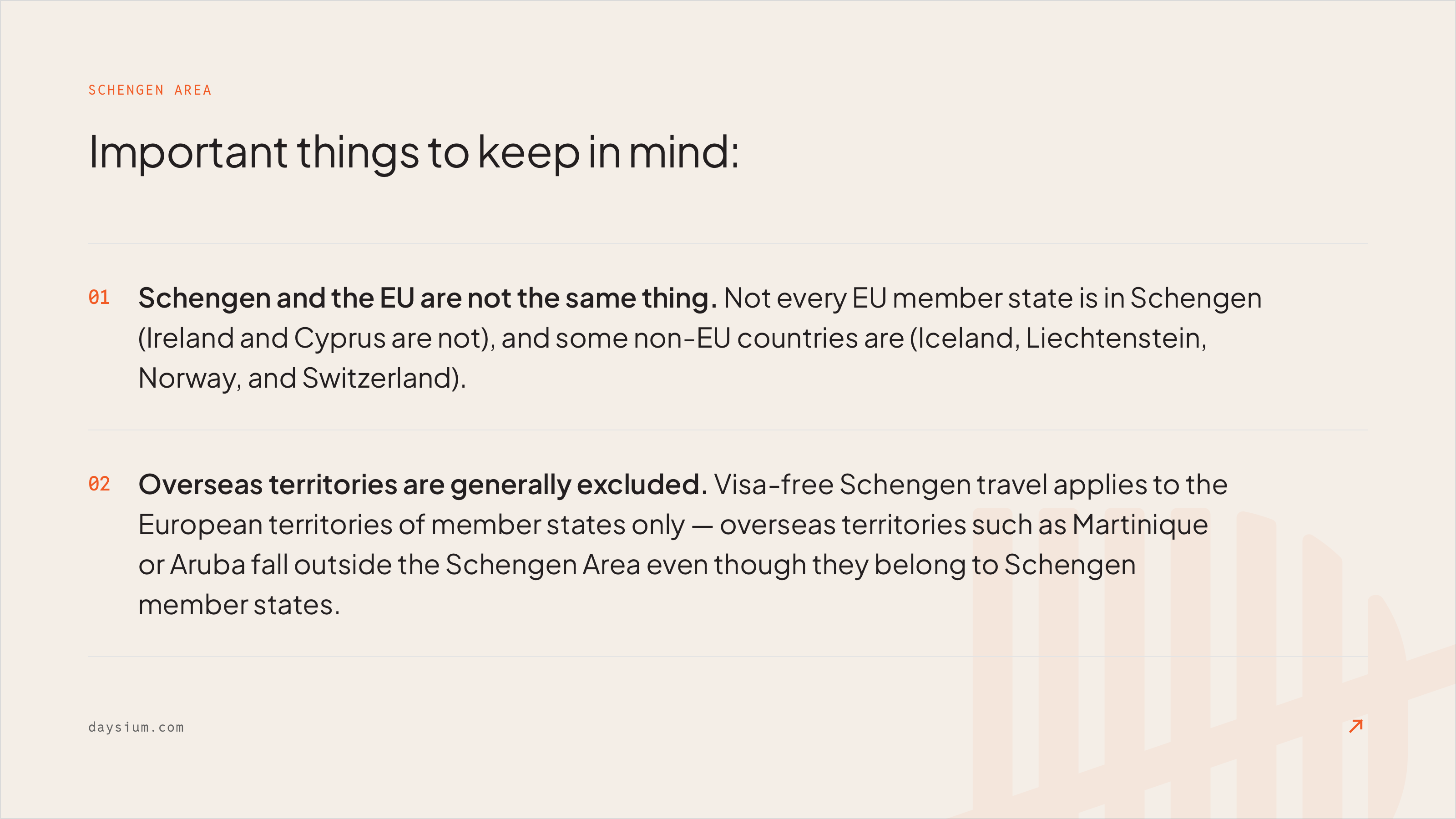
The Schengen Area currently comprises 29 countries. Following a Council decision in December 2024, Bulgaria and Romania became full members on 1 January 2025, with internal land border checks lifted at that point — air and sea border checks between those two countries and the rest of Schengen had already been removed in March 2024.
Enforcement has changed: EES and ETIAS
The most significant shift in recent years has been in how the rule is enforced and monitored at the border. Two EU systems are key to understanding and approaching Schengen travel.
The Entry/Exit System (EES) is now fully operational
The EES began a phased rollout in October 2025 and reached full operational status across all 29 Schengen countries in April 2026. It replaced manual passport stamping with a digital record of each entry and exit, including biometric data (facial image and fingerprints), for non-EU nationals crossing external Schengen borders on short stays.
In practical terms, this means your day count is now a running digital tally, checked automatically against the 90/180 limit at each border crossing. The European Commission has reported that the system has already been used to identify overstayers and cases of document fraud that would previously have gone unnoticed.
Some flexibility remains: EU rules permit member states to temporarily ease EES checks during exceptionally high-traffic periods.
ETIAS is still to come
A separate system, ETIAS (European Travel Information and Authorisation System), is not yet operational. It's a pre-travel authorisation — comparable to the US ESTA — rather than a visa. It will apply to visa-exempt non-EU travellers heading to most Schengen and associated countries.
The official launch date is still unknown, although reports suggest it will become operational by the end of 2026. Once live, it will require travellers to apply online in advance, provide personal and travel details, pay a fee, and pass an automated screening. A prior history of overstaying under the 90/180 rule may be relevant to that screening.
Penalties for overstaying
Individual Schengen countries set their own specific penalty regimes, but the common consequences of breaching the 90/180 rule include:
- Fines, which vary by country
- An order to leave the country if you're caught while still within the Schengen Area
- Entry bans of varying length
- Complications with future visa, residency, or entry decisions
There can also be tax consequences arising from time spent in a jurisdiction beyond what was planned or permitted, which is a separate question from the immigration penalty itself and depends on the specific tax rules of the country in question.
Where day count mistakes tend to happen
A few patterns show up repeatedly in how people miscalculate their Schengen days:
- Treating the 180-day window as fixed. It resets continuously, not on 1 January or at the start of a new calendar quarter.
- Checking only the start of your travel. This rolling window also means you can be under the 90-day limit at the start of your new trip but exceed it during the trip. You need to check the window for the whole duration, not just the start.
- Forgetting to count for transit and short trips. A weekend city break or a stopover with an overnight stay still counts as full days.
Generic day counting calculators and travel apps can help with the basic arithmetic, but most rely on manually entered travel dates and don't retain supporting evidence of where you actually were on a given day. This type of evidence matters if a border authority or tax authority later asks for records substantiating your count.
Family travel: a common misconception
A frequent assumption is that travelling with a family member who holds an EU passport exempts the whole party from the 90/180 rule. That's not automatically true, and the actual position depends on EU free-movement law rather than the short-stay rules — specifically, the EU Citizens' Rights Directive (2004/38/EC), which allows certain non-EU family members to accompany an EU citizen who is genuinely exercising free movement rights, subject to conditions around dependency and documentation.
Because this is a genuinely nuanced area, and one where border authorities can interpret the position differently, we've covered it in detail separately: Schengen Rule for Family Travel: What HNWIs Need to Know.
Staying on top of your Schengen day count
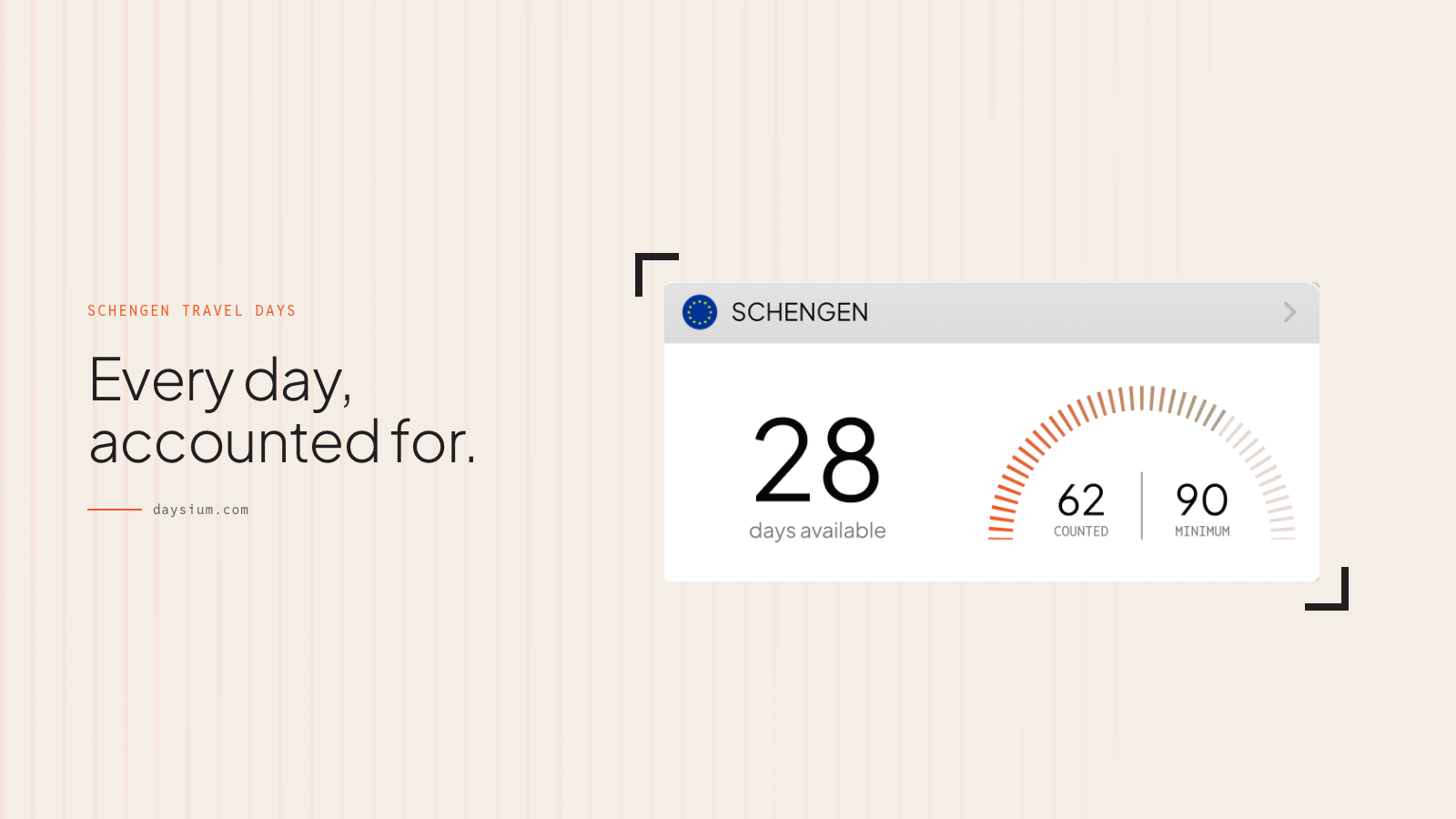
Because the calculation is a continuously rolling one and now sits behind a digital enforcement system at the border, the margin for error in manual tracking has narrowed. Daysium's platform logs your travel automatically against the Schengen 90/180 window, alongside supporting evidence — location data, notes, and documents — so your day count is backed by a record rather than a recollection if it's ever questioned.