

Ask people what it takes to stop being a UK tax resident, and the answer might be: move out of the country. That is one of the most dangerous day counting assumptions to make when leaving the UK, especially if you know you'll be visiting the UK regularly for friends, family, or work.
The danger comes from the complexity of the UK system. While day counting in many other tax jurisdictions may be a simple case of staying under a single fixed tally, the UK is different. The threshold isn't just one or two options, but many, with each giving a wildly different day counting figure and all dependent on your other ties to the country.
We've previously looked at dangerous day counting assumptions that can lead to HMRC enquiry. Today, we're examining the real consequences, not hypotheticals, of leaving the UK. These case studies show just how costly it might be to leave your day counting and record-keeping to chance.
None of the people in these cases is shown to have acted improperly, and HMRC's role here isn't the point either. In fact, in two of the four cases below, the taxpayer ultimately won. Our aim is to highlight the complexities of the UK tax residency, and how important it is to combine strong tax advice and strategy with robust execution.
Assumption #1: "I don't spend much time in the UK, so I can't be resident"
Under the SRT's sufficient ties test, the number of days you can spend in the UK before becoming a tax resident depends on how many connections or "ties" you still have here. The more ties, the fewer days it takes.
The ties, and the thresholds
The ties are:
- A family tie (a UK-resident spouse, partner or minor child),
- An accommodation tie (UK accommodation available to you that you use),
- A work tie (40+ days a year doing 3+ hours' work in the UK),
- A 90-day tie (90+ days in the UK in either of the previous two tax years), and
- A country tie used only if you've been a UK resident in the past three years.
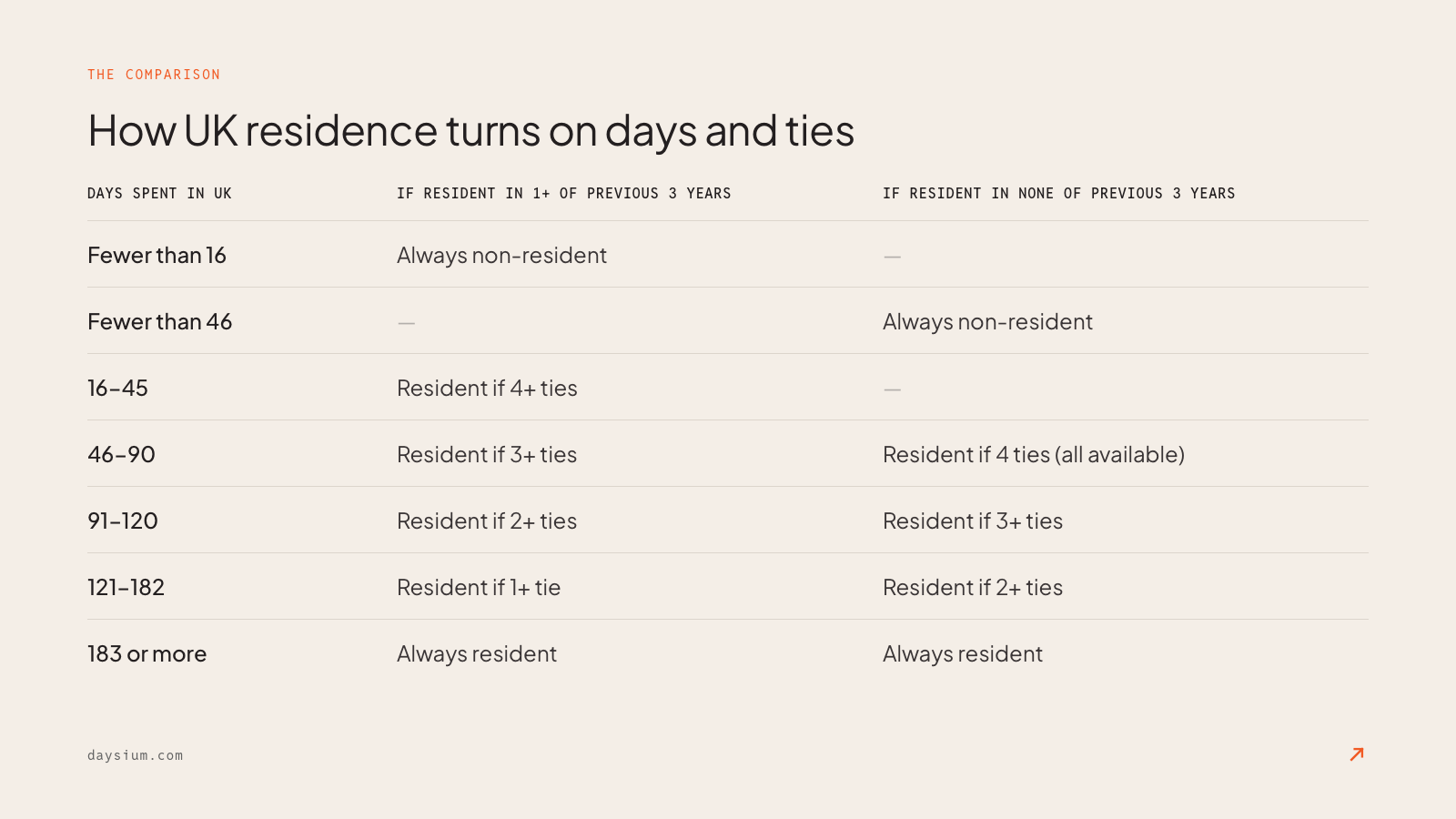
If you were a UK resident last year, you have a spouse and a house still in the UK, and you occasionally travel to the UK to work, you could be deemed a UK tax resident in as few as 16 days. That's just a little over two weeks.
Spending a lot of time elsewhere isn't enough alone and can be a dangerous assumption to make. The test isn't just asking where you spent most of your time; it's asking whether your ties plus your UK days cross a specific line.
A case study in UK ties: R Gaines-Cooper v HMRC
R Gaines-Cooper v HMRC [2011] UKSC 47 is the clearest illustration. Robert Gaines-Cooper moved to the Seychelles in the 1970s, and his UK day counts averaged under the 91-day-a-year threshold HMRC's own guidance set out at the time.
The Special Commissioners had already found, on unchallenged facts, that his settled home remained in England throughout, pointing to his Berkshire/Oxfordshire home and his wife and son living there. The Supreme Court held that satisfying the day-count guidance alone didn't override that: the guidance required a "distinct break" in the pattern of his life before the day-count even applied, and on the facts already found, he hadn't made one.
His case predates the current ties test, but the logic is the same one now written directly into the SRT: connections can outweigh a day count that looks, on paper, comfortably low.
Assumption #2: "My home is elsewhere and I don't stay overnight in the UK, so I'm not resident"
The SRT counts a "day" using the midnight rule: you're only treated as having spent a day in the UK if you're present at the end of it. It's easy to read that as "if I leave before midnight, that day doesn't exist for tax purposes".
Why the midnight rule isn't the whole story
There are two key concepts at play here:
A "UK workday" is a separate concept from a "UK day." It's any day you do three or more hours of work while physically in the UK. This is regardless of whether you're still here at midnight. Someone who flies in for meetings and leaves the same evening can build up a UK work tie without a single one of those days counting under the midnight rule.
The deeming rule exists to catch exactly this. If you have three or more UK ties and you're present in the UK during the day (not at midnight) on more than 30 days a year, every day past that 30 is treated as a full UK day.
A case study in overnight days: McCabe v HMRC
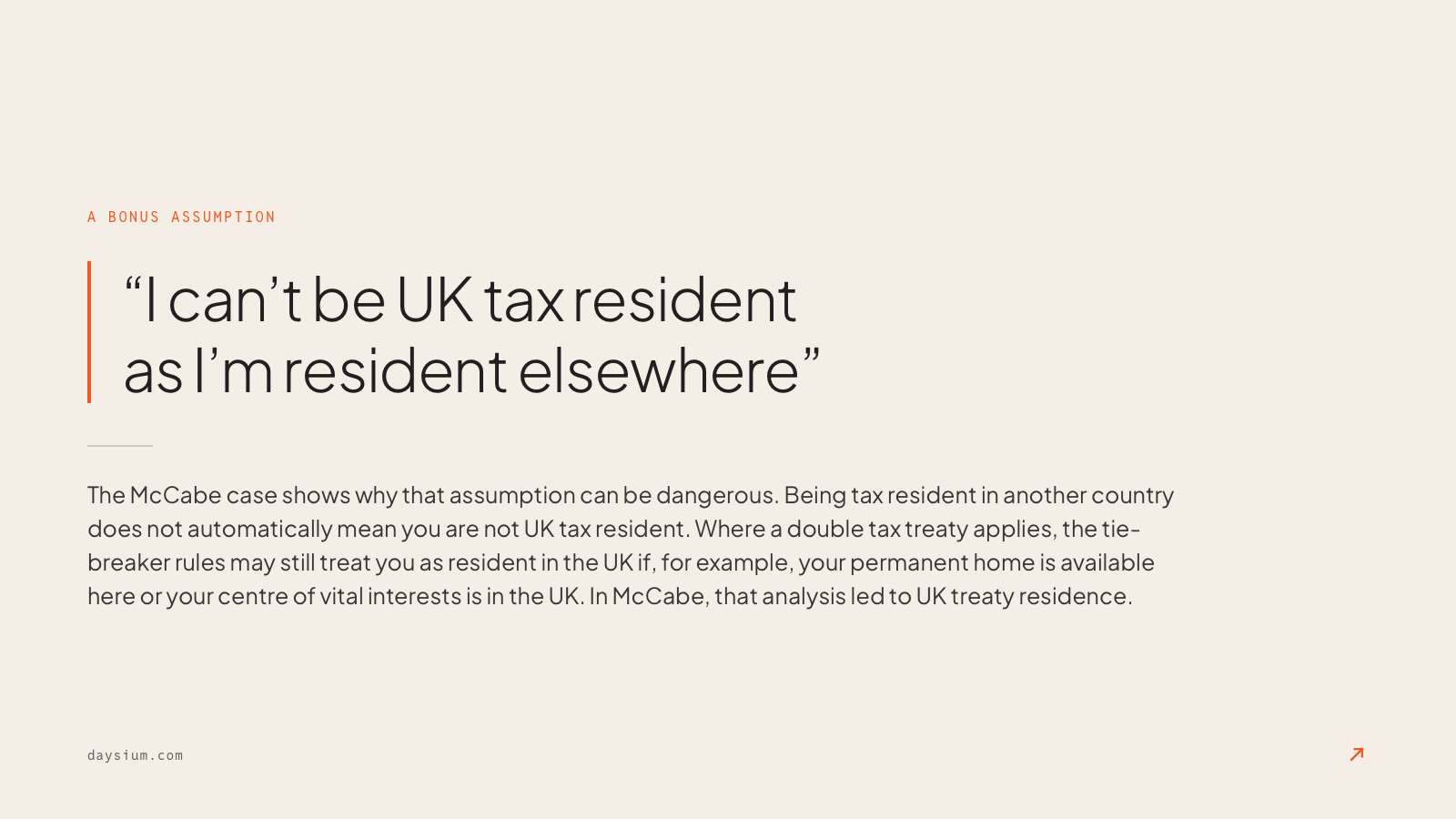
McCabe v HMRC [2022] UKFTT 356 (TC), upheld on appeal at [2024] UKUT 280 (TCC), shows the same underlying assumption failing under the older common-law test. Kevin McCabe, founder of the Scarborough Property Group and former Sheffield United chairman, moved to Brussels in April 2006 to grow the group's European business.
Over the two tax years in dispute, he made 98 visits back to the UK. Out of these, 53 were with no overnight stay at all, flying in for board meetings, business and family commitments and flying out the same day. His counsel argued those day trips shouldn't count for much, since he wasn't staying overnight.
Both tribunals rejected that: the Upper Tribunal noted the logic would let someone visit the UK every day and, provided they always flew home to sleep, be treated as having no UK presence at all. Separately, of the 98 board meetings McCabe attended during this period, almost a quarter took place in the UK — evidence the tribunals treated as relevant to his ongoing connection to the country regardless of where he slept at night. McCabe was held to be a UK tax resident.
Assumption #3: "Exceptional circumstances will excuse the extra days I might spend in the UK"
The SRT lets certain UK days be disregarded if "exceptional circumstances beyond your control" prevented you leaving. You typically have up to 60 of these 'exceptional days' in a year. It's tempting to assume a genuine, serious reason is enough. In practice, HMRC has contested these, and the outcome often depends on the quality of evidence.
Two case studies around exceptional circumstances
We've previously written extensively on a case study where a taxpayer who'd moved to Ireland in 2015 needed to stay at or under 45 UK days. However, in this specific year in question, she spent 50. She argued that six of those were exceptional, as she spent them caring for her twin sister through a crisis, and therefore should be disregarded.
The case went through three rounds:
- The FTT found for her in 2022.
- The Upper Tribunal overturned that in 2023, upholding HMRC's assessment of just over £3.1m in additional tax.
- The Court of Appeal restored her initial win in 2025, holding that a sufficiently compelling moral obligation can count towards "exceptional circumstances".
This case isn't the only such example. Parker v HMRC [2026] UKFTT 00652 (TC) shows the same principle. A chartered engineer needed to stay under 91 UK days; he was present at midnight on 100, with 7 disregarded for Covid, leaving 93. He argued three more should fall under the "transit" exception and one under exceptional circumstances (a flight to Dublin cancelled mid-boarding by Storm Jorge) — bringing him to 89, under the line.
HMRC contested both. Ultimately, the tribunal argued in favour, stating that the supporting documentary evidence was strong and included boarding passes, bank statements and cancellation notices. Similar to the above case, which ran for almost a decade, the decision was handed down in May 2026 even though the events took place in 2020. That is a lot of time to live with uncertainty.
Across both cases, the outcome tracked the strength and detail of the documentary record as closely as it tracked the underlying circumstances themselves. These claims are decided years later, from whatever record still exists by then.
What this means in practice
This is general information, not legal or tax advice, and nothing here substitutes for advice tailored to individual circumstances. These cases were fact-specific even at the highest levels. But they show that simply assuming that leaving the UK is enough to cut tax ties to the country is a dangerous one to make.
- Day counts and ties are assessed together. A day count that looks safe alone may not be, once ties are factored in.
- Not every UK day looks like a "day" under the midnight rule. Work presence can build toward a tie, and repeated short trips can be deemed into full UK days.
- Genuine emergencies are argued over, not simply accepted. The exemption can succeed, but HMRC can and has contested it, and the outcome depends on your evidence.
Daysium Founding Partner, Richard Paul, suggests clients use a conservative strategy. In our interview, he said to go “one level below” what day counting thresholds suggest.

From dangerous day counting assumptions to clarity
What also helps is to have a clear, automated account of where you've actually been, and why. That's the part people control most directly and the hardest to reconstruct years later, when a tribunal finally asks for it.
Daysium Mobile's day count log exists for exactly that reason: an ongoing, dated record of UK day counts as they happen, rather than one pieced together retrospectively. And with Daysium Portal, tax advisors can gain visibility that helps them advise accurately, providing assistance around your actual travel days and not estimations.
Book a call to talk to our team or try Daysium free for 14 days.