

The abolition of the non-dom regime in April 2025 was one of the most significant shifts in UK tax policy in a generation. Rather than simply closing the door on the remittance basis and leaving former users to navigate years of accumulated offshore income and gains under the old rules, the government created a transitional exit: the Temporary Repatriation Facility.
The TRF is open from 6 April 2025 to 5 April 2028. Qualifying individuals can elect to pay a flat reduced tax rate on their pre-April 2025 foreign income and gains. Once that election is made and the charge paid, no further UK Income Tax or Capital Gains Tax should arise on remittance of a validly designated amount.
The catch is timing. The rate rises in the final year, and the window closes entirely on 5 April 2028. For HNWIs with significant offshore holdings, the cost of moving too slowly can be substantial.
This article is intended as a general overview and does not constitute tax advice. Always discuss your specific circumstances with a qualified tax advisor before making any decisions in relation to the TRF.
Key takeaways
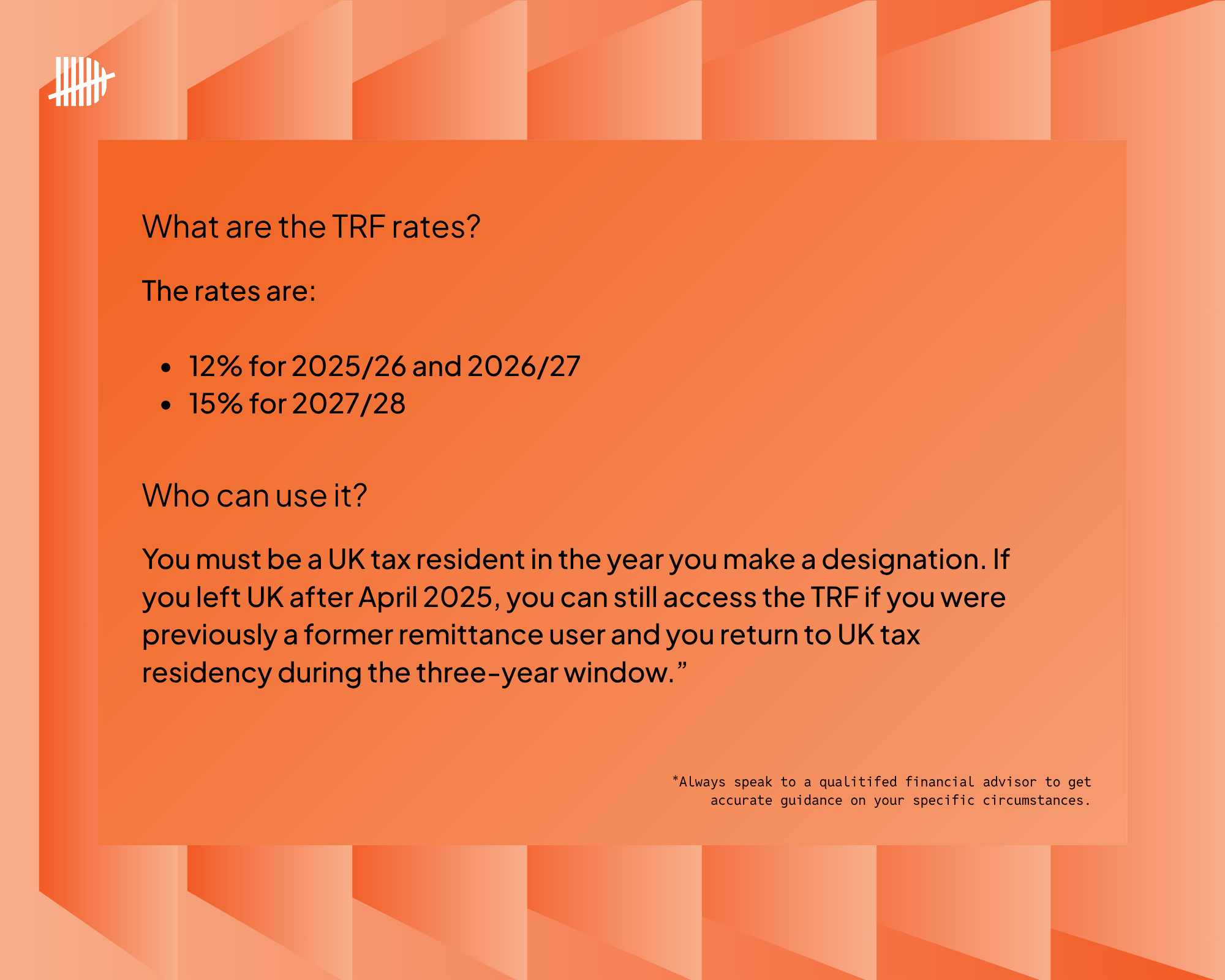
- The TRF is a three-year window allowing former remittance basis users to pay a flat reduced rate on pre-April 2025 foreign income and gains: 12% in 2025/26 and 2026/27, rising to 15% in 2027/28.
- Undesignated pre-6 April 2025 foreign income and gains generally remain taxable under the legacy remittance rules if remitted later.
- You must be a UK tax resident in the year you make a designation, and non-residents cannot use the TRF, even if they were former remittance basis users.
- Historic residence and remittance-basis evidence may be critical in supporting a designation, especially for globally mobile individuals.
- Weak or incomplete historical records leave TRF designations exposed to HMRC scrutiny.
- Acting in 2025/26 or 2026/27 saves three percentage points compared to waiting until the final year.
What is the Temporary Repatriation Facility?
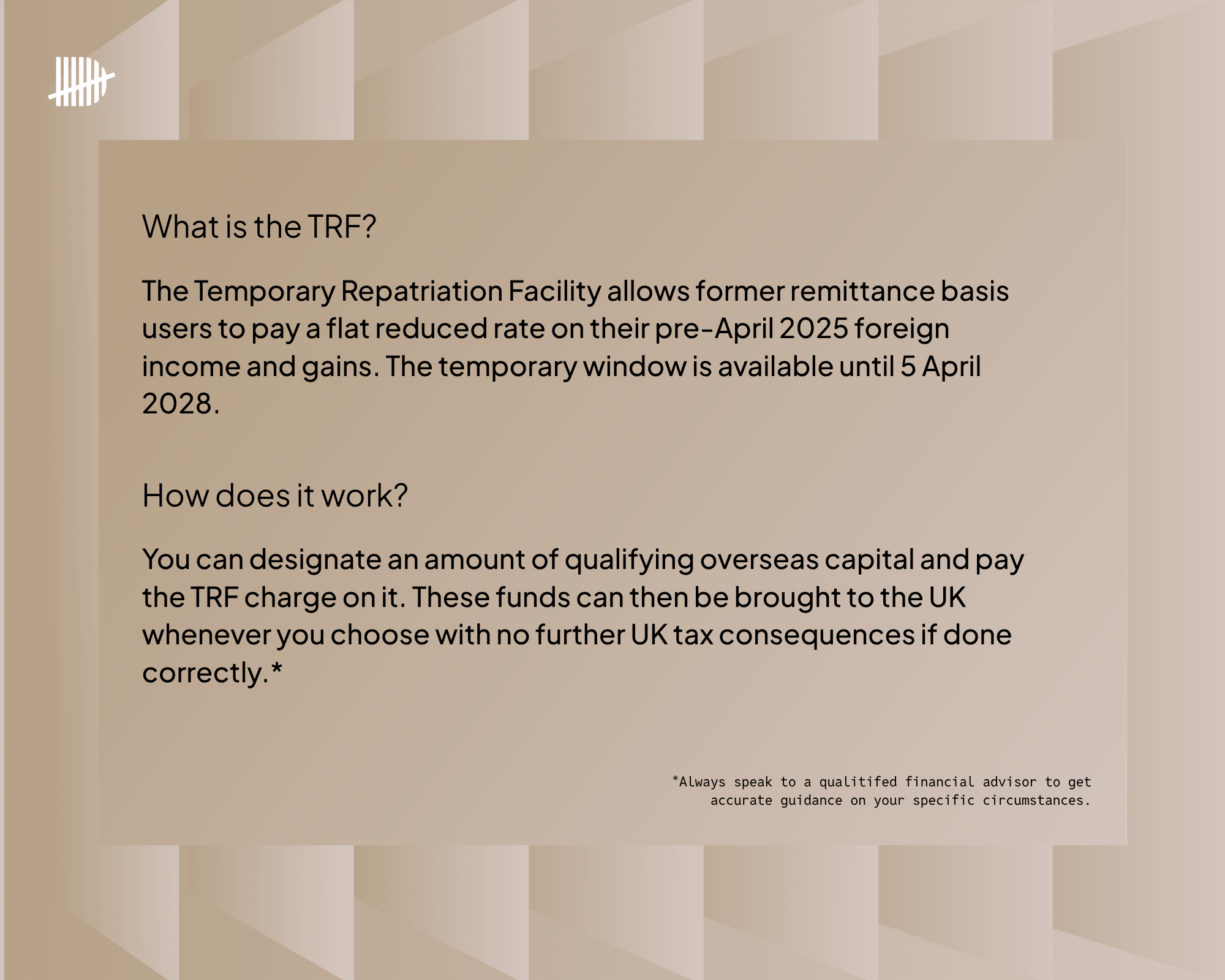
The Temporary Repatriation Facility (TRF) works through a process called designation. Rather than waiting until you physically bring offshore funds to the UK, at which point standard tax rates would apply, you elect to designate an amount of qualifying overseas capital in your self-assessment return and pay the TRF charge on that amount. A validly designated amount can then be remitted to the UK without further remittance tax arising on it.
This is an important distinction. The TRF is not a remittance tax. You do not have to transfer the money to the UK to benefit from it.
What qualifies for the TRF?
Qualifying overseas capital broadly captures foreign income and gains that arose before 6 April 2025 in years when you were subject to the remittance basis. This includes:
- Investment income in overseas accounts,
- Capital gains from offshore asset disposals,
- Foreign employment income earned before April 2025, and
- Assets, including property or artwork, acquired with pre-April 2025 foreign income or gains.
Income and gains held within offshore trust structures may also qualify where they are attributed to you under anti-avoidance rules.
What does the TRF not cover?
The TRF is only available to former remittance basis users who are UK tax residents in the year they make a designation. It cannot be used for income or gains arising after 6 April 2025.
What is the TRF rate?
The TRF charge is a flat rate applied to the designated amount. No foreign tax credit is available against the TRF charge. Where foreign tax has already been paid on the relevant income or gains, the TRF rate applies to the net amount after that foreign tax has been deducted. For assets that have already borne significant overseas taxation, it may, in some cases, be more efficient not to designate those funds.
Who is eligible for the TRF?
The most obvious group are long-term remittance basis users who remained in the UK after the regime ended. For them, the TRF is a direct financial calculation: paying 12% now versus up to 45% on income, or up to 24% on gains, every time those funds are moved to the UK in future. The larger the offshore pool, the more significant the decision.
Those who left the UK after April 2025 but still hold offshore structures with pre-April 2025 income and gains are also within scope, provided they are UK residents in the year of designation. Non-residents cannot use the TRF. However, a return to UK residency during the window unlocks access, and a return in 2025/26 or 2026/27 while the 12% rate applies may be considerably more efficient than waiting.
Individuals considering a return should factor this window into their timing, though the interaction with IHT residency rules requires careful advice. Note also that individuals returning after a short absence should be aware that the temporary non-residence anti-avoidance rules may affect which amounts are eligible.
Certain trust-related amounts may be designated by the relevant UK-resident individual, depending on the trust matching and attribution rules. Given the complexity of trust matching rules, early engagement with advisors is strongly recommended.
Indeed, speaking with a qualified tax advisor is the correct call when considering using the TRF, no matter your circumstances.
The Temporary Repatriation Facility deadline pressure is real
The three percentage point increase from 12% to 15% is easy to understate in the abstract. On a £1 million designation, the difference between acting in 2026/27 and waiting until 2027/28 is £30,000. On a £5 million designation, it is £150,000. On a £10 million pool, the cost of waiting until the final year is £300,000. And that assumes you act at all.
Any undesignated funds remaining offshore after 5 April 2028 that are later remitted will be taxed at the full standard rates applicable at the time.
Key dates and rates at a glance
| Tax year | TRF charge | Key deadline |
|---|---|---|
| 2025/26 | 12% | Designation on self-assessment return |
| 2026/27 | 12% | Last year of lower rate |
| 2027/28 | 15% | Final year — window closes 5 April 2028 |
| 31 January 2028 | - | Last date to amend 2025/26 return for a TRF designation |
| 31 January 2029 | - | Last date to amend 2026/27 return for a TRF designation |
| 31 January 2030 | - | Last date to amend 2027/28 return for a TRF designation |
One detail worth noting: the amendment deadline for the 2025/26 return runs until 31 January 2028, which is later than most people assume. A 2025/26 designation is not entirely lost if a return has already been filed without one, but it does require taking action rather than deferring.
Why your tax residency records are central to the TRF
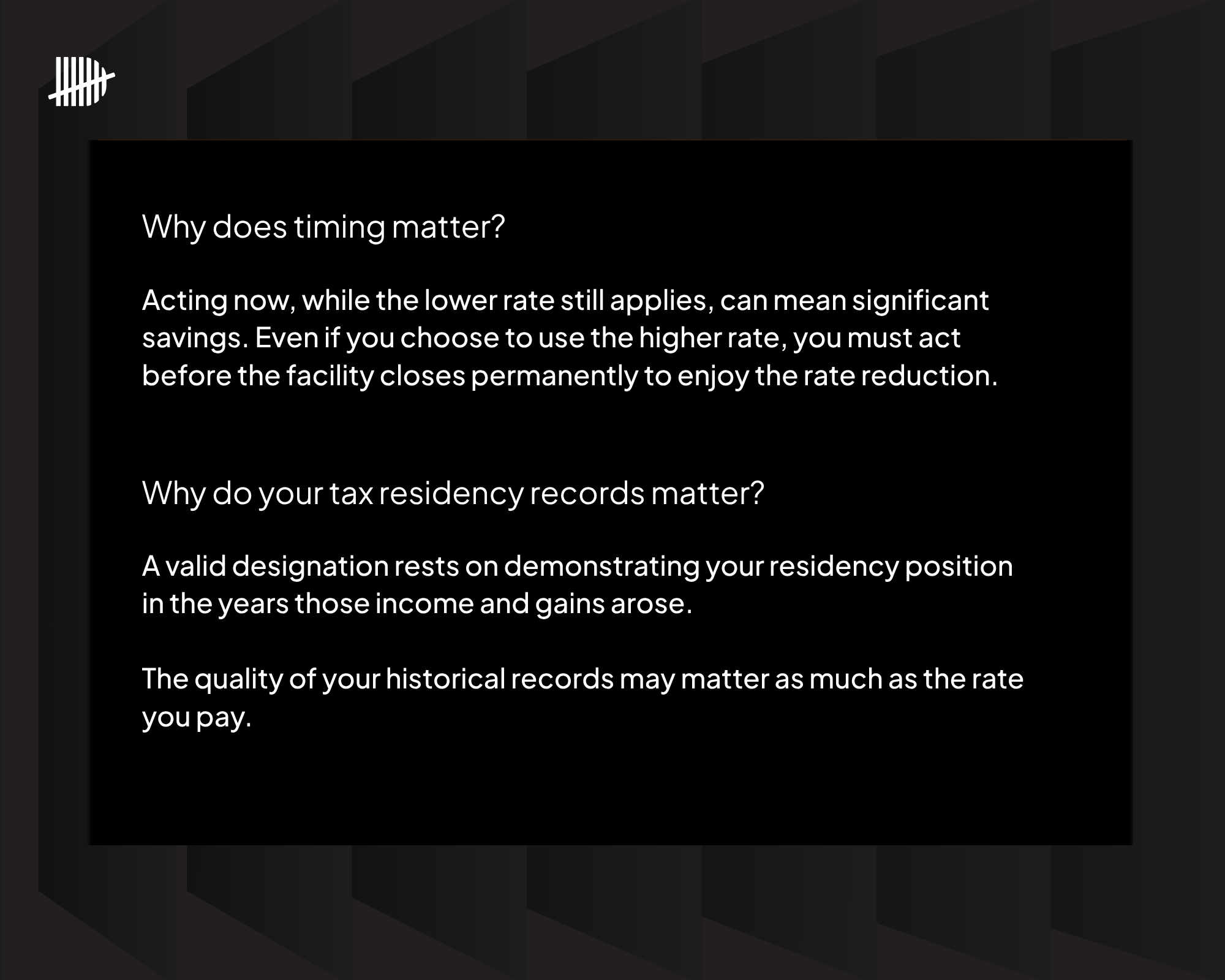
This is where the TRF intersects with something many HNWIs have underestimated for years. The quality of your historical residency records may be the single most important factor in determining whether your designation holds up under scrutiny.
The evidence requirement is retrospective
To make a valid TRF designation, you are electing to pay a reduced rate on foreign income and gains that arose in specific prior years when you were subject to the remittance basis. HMRC will scrutinise that basis. The question is simple: were you actually subject to the remittance basis in the years those income and gains arose? The answer depends on your residency status in those years, which depends on your day counts.
For continuously UK resident individuals, this is straightforward. But for globally mobile individuals, those who split their time between jurisdictions, had split years, or whose residency in particular years was anything other than clear-cut, the historic residency position is precisely what HMRC will examine.
What weak records actually risk
A TRF designation of £3 million of pre-April 2025 foreign gains is not a trivial filing. Weak historical records do not just create inconvenience. They can turn a designation into a tax investigation. And these investigations are expensive, time-consuming, and stressful even when the underlying position is compliant and correct.
Demonstrating residency status for prior tax years requires evidence that many HNWIs have not maintained in a structured way: day-by-day travel records with corroborating documentation, location data confirming physical presence on particular days, contemporaneous records such as boarding passes, hotel receipts, and geo-tagged entries. A reconstruction assembled after the fact does not carry the same weight as a record built in real time.
What strong records make possible
HNWIs who have maintained rigorous, contemporaneous residency records are in a fundamentally different position. Their historic positions are defensible. An enquiry, if it comes, can be resolved quickly and with confidence. For individuals who have used Daysium to log and evidence their movements over prior years, this position is already in good shape.
For those who have not, the period before a TRF designation is filed is the time to review existing records, identify any gaps, and work with an advisor to assess whether the evidential foundation is sufficient.
Conclusion
The Temporary Repatriation Facility offers a clean, permanent resolution to decades of stranded offshore income and gains at a rate that bears no comparison to what would otherwise apply. But it is a gift with an expiry date.
The financial case for acting in the lower-rate years is straightforward. The less obvious, but perhaps more important, case is the evidential one.
For globally mobile individuals whose historic movements were complex, the quality of their historical residency record is not an administrative detail. It is the difference between a designation that withstands scrutiny and one that invites an investigation. The time to get that evidence in order is before the designation is filed, not after HMRC asks why.
If you are a former remittance basis user considering a TRF designation, or an advisor supporting clients through this process, speak to the Daysium team about how structured residency records can support your position.
This article is intended for general information purposes only and does not constitute legal or tax advice. Always consult a qualified tax advisor in relation to your personal circumstances.