

You’re moving to Monaco. You find an apartment, open a bank account, attend the police interview and collect your residence permit (the carte de séjour). On paper, that might look like a job well done. But a crucial part might still be unsolved: your tax residence.
Simply moving to Monaco doesn’t automatically make you a tax resident there or a non-resident elsewhere, like the UK. Often, the first few years around the move are especially crucial and scrutinised. This is when authorities in Monaco and the UK will look at your calendar and ask opposite questions. Monaco wants to know whether you really live there. The UK, or any other country you left for that matter, wants to know whether you’ve really left. To answer, you’ll need clear day counts and supporting evidence to prove your whereabouts.
Let’s look at what moving to Monaco means, what authorities look for, where people get caught out, and how to keep one record that helps you if authorities come looking.
This article is general information, not tax or legal advice. It reflects our understanding of the rules at the date of publication; rules and their interpretation change, and we make no representation that it is complete or applies to your circumstances. Tax residence depends on individual facts, so speak to a qualified tax adviser about your position.
Monaco residence: a status, not a tax result
Monaco has no personal income tax for most residents. That is why it attracts people. When you’re moving to Monaco, you have to show the Principality’s authorities that you spend enough time there to be considered a Monaco resident. But a Monaco residence card is permission to live in the Principality, not a tax residency ruling. It does not automatically end your tax residence anywhere else.
Two documents are easily confused:
- The residence permit (carte de séjour). Renewal expects evidence that the home is lived in: up-to-date accommodation proof, utility bills and a pattern of presence.
- The tax residence certificate. This is issued separately. It is the document advisers and foreign tax authorities ask for, and it generally expects a stronger link to Monaco, often described as spending most of the year there.
In practice, Monaco wants proof you are there: bills, a lease or title deed, and a pattern of presence that matches a real home rather than a pied-à-terre. But their approval doesn’t automatically end questions from the country you left, which also wants proof.
For example, your UK position is decided entirely under UK rules. If you meet the UK's conditions set in the UK Statutory Residence Test (SRT), you are UK resident, whatever card is in your wallet. The same applies to France if you spend time or keep interests there.
What the UK looks for
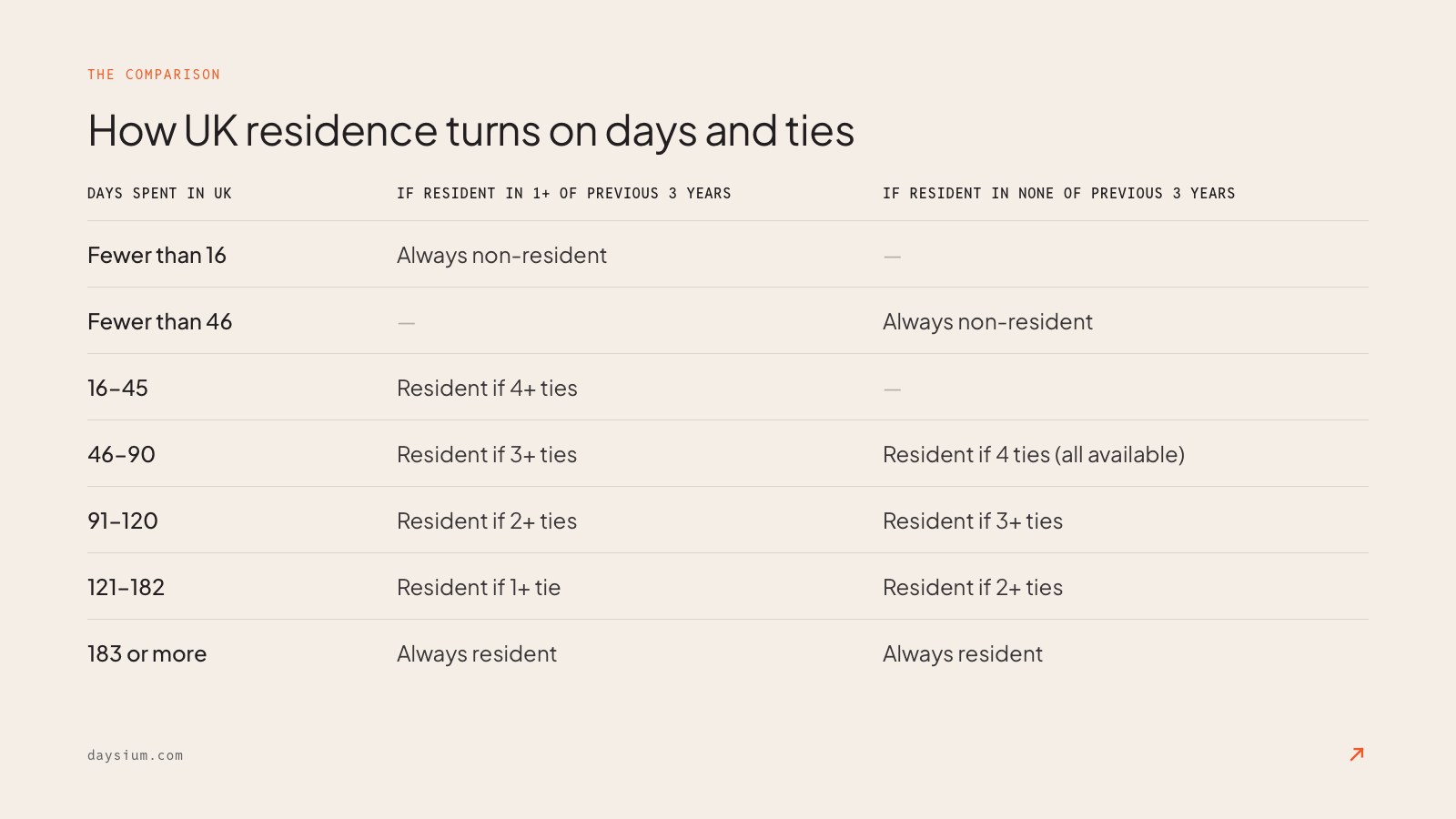
The UK applies SRT to every tax year. For someone leaving, the questions are roughly these.
- Do you meet an automatic overseas test? If you were a UK resident in any of the previous three tax years, you are automatically non-resident only if you spend fewer than 16 days in the UK. Working full-time abroad can give more room.
- If not, how many ties do you keep? Leavers are counted against five ties: family, accommodation, work, 90 days in either of the two previous tax years, and the country tie. The more ties you keep, the fewer UK days you can spend before becoming resident.
- Does split-year treatment apply? In the year you move, split-year treatment can divide the tax year into a UK part and an overseas part. The conditions are strict. They depend on exactly when you stopped having a UK home and whether your only home, or your tax residence, is now abroad.
The UK also has a long tail that can play a role in strategic tax planning. If you return within five years, temporary non-residence rules can bring some income and gains back into charge. And under the long-term residence rules for inheritance tax, someone resident for many years can stay in scope for several years after leaving.
What about France?
Monaco is two square kilometres, and France starts at the end of the street. Many residents' lives spill across the border without much thought: a second flat in Beausoleil, an office in Cap-d'Ail, a cottage in Menton, a child at school in Nice.
France has no statutory day count. French tax residence depends on where your main home or principal place of stay is, where you mainly work, and where your centre of economic interests lies. Six months is often used as a working benchmark, but it isn't a safe harbour. Nights in France add up quietly, and a French address with a utility bill in your name tells its own story.
French nationals also need to remember that under the France–Monaco tax agreement, most French nationals who move to Monaco continue to fall under the taxable scope in France.
Why first year day counting records matter
The years around moving to a different country are often the ‘messiest’. You are trying to launch a new life elsewhere while saying goodbye to another. Selling a house in one place while buying another in Monaco. Interviewing assistants, prepping children for the new school, and all the while, work commitments might keep ticking along.
These moves also attract the interest of tax authorities. They want to ensure you’re actually moving and establishing your life in the new country. Monaco's period on the FATF grey list since June 2024 has sharpened scrutiny. The effect filters through to banks, advisers and structures: arrangements are now judged on whether they are real, not just whether the paperwork is correct.
Yet, because it’s such an emotionally challenging time, day counting and record-keeping aren’t high on the to-do list. Even when tax advisors tell you to do so, the default solution is often the one with the least initial friction: a spreadsheet.
We’ve talked extensively about the problems with spreadsheets before. Ultimately, they introduce much more risk to tax residency compliance because they rely on memory and manual inputs. If authorities ask questions, a single day counted incorrectly can cause major issues.
More importantly, a spreadsheet doesn't solve the record-keeping dilemma. Your records continue live somewhere else, separately and out of sight. Piecing everything together during an investigation costs both time and money.
One record, two audiences
Monaco and the UK are asking different questions, but they read the same evidence. A good record serves both:
- Log every day from the day you start planning a move to Monaco. Build your records to make future reviews easier. Include transit days and any days you believe qualify as exceptional, with the reason noted at the time.
- Keep the supporting evidence as you go. Boarding passes, card payments, utility bills, and diary entries are worth far more when collected on the day than when searched for years later.
- Record your UK ties as well as your days. When the UK home was sold or let, when the last UK work day happened, where the family was living. These facts decide the tie count and your split-year position.
- Treat France as a separate place. Log nights in France individually. Don't fold them into "Monaco" automatically just because you didn’t go far.
- Check the dates behind your split-year claim. The date you stopped having a UK home should match the evidence, not the date that suits the return.
- Give your adviser live access, not a year-end summary. Problems spotted in month four can be fixed. Problems spotted at filing can only be explained.
FAQs: Moving to Monaco
Does a Monaco residence card make me a non-UK resident?
No. UK residence is decided only by the Statutory Residence Test, and residence elsewhere doesn’t automatically remove tax obligations from elsewhere. It’s always best to discuss your residence status with a professional residency expert or tax advisor.
How many days can I spend in the UK after moving to Monaco?
It depends on your residence history and how many UK ties you keep. If you were UK resident and keep several ties, the limit can be as low as 15 days. Take advice on your own position.
Do nights in France count as Monaco days?
No. France is a separate jurisdiction with its own residence test. Nights spent in France would count for France’s possible tax residency calculations, not Monaco.
When is the best time to start keeping records?
As the old wisdom goes, the best time might have been yesterday and the second best is today. Ideally, you should start generating day-counting documentation the day your life becomes more global, especially if you’re planning to move. If you currently live in the UK or are considering moving to Monaco, the first few years are most likely to be scrutinised.
Moving to Monaco: get the record right from the start
Moving to Monaco is two moves happening at once. One is the move you can see: the apartment, the bank account, the residence card. The other is the move you have to prove: to Monaco, that you really live there, and to the UK or France, that you've really left.
Both sides will read the same days, and they often read them years later, when memories have faded, and receipts have been buried under more data. The people who come through those reviews comfortably are the ones whose day counts and records were made as the move happened, held in one place.
How Daysium helps
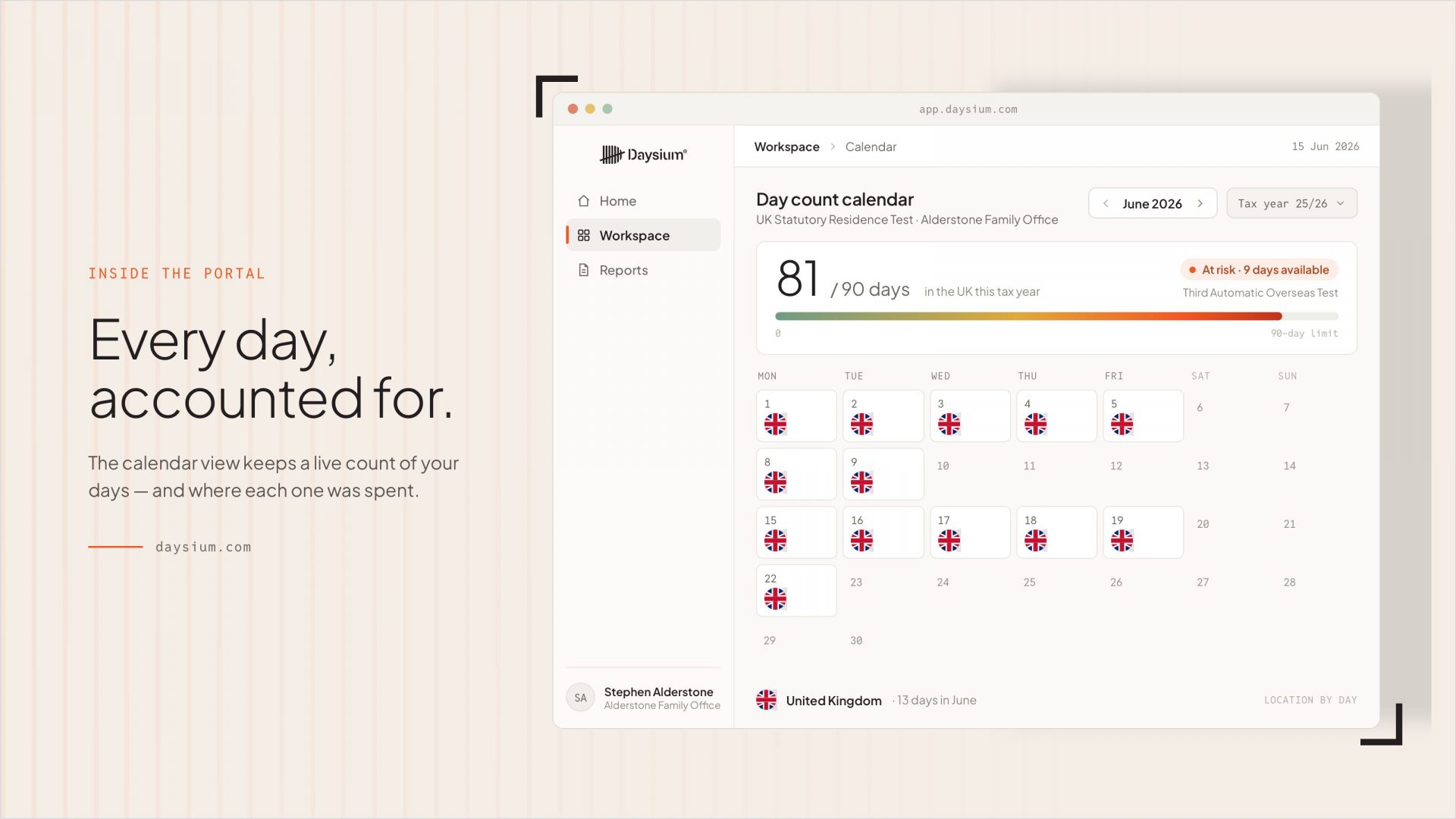
Daysium Mobile automatically logs your days across borders, applies the residence rules for each jurisdiction you've set up, and captures supporting evidence while preserving its metadata. Your advisers, family office or trustees can see the same live position in Daysium Portal, so both records (presence in Monaco, absence from the UK) are built as the year happens, not rebuilt when someone asks.
Start a free trial to see how it all works.