

Most tools that claim to manage tax residency do one thing: count and track days. That is useful. But it is also not enough to successfully navigate a high-stakes tax investigation.
If a tax authority, such as the UK's HMRC, opens an enquiry into your tax residency position, a day count — however accurate — is a claim, not evidence. What protects you is a contemporaneous record: geo-logged, time-stamped, and built at the moment you were there.
Why spreadsheets fall short for UK tax residency
First, let's start with the most common tool people still use to track their day counts for tax residency: spreadsheet.
We get it because we've been there. The below image is our Founder CEO Tim Huelin's spreadsheet for when he was an airline pilot and had to count days.
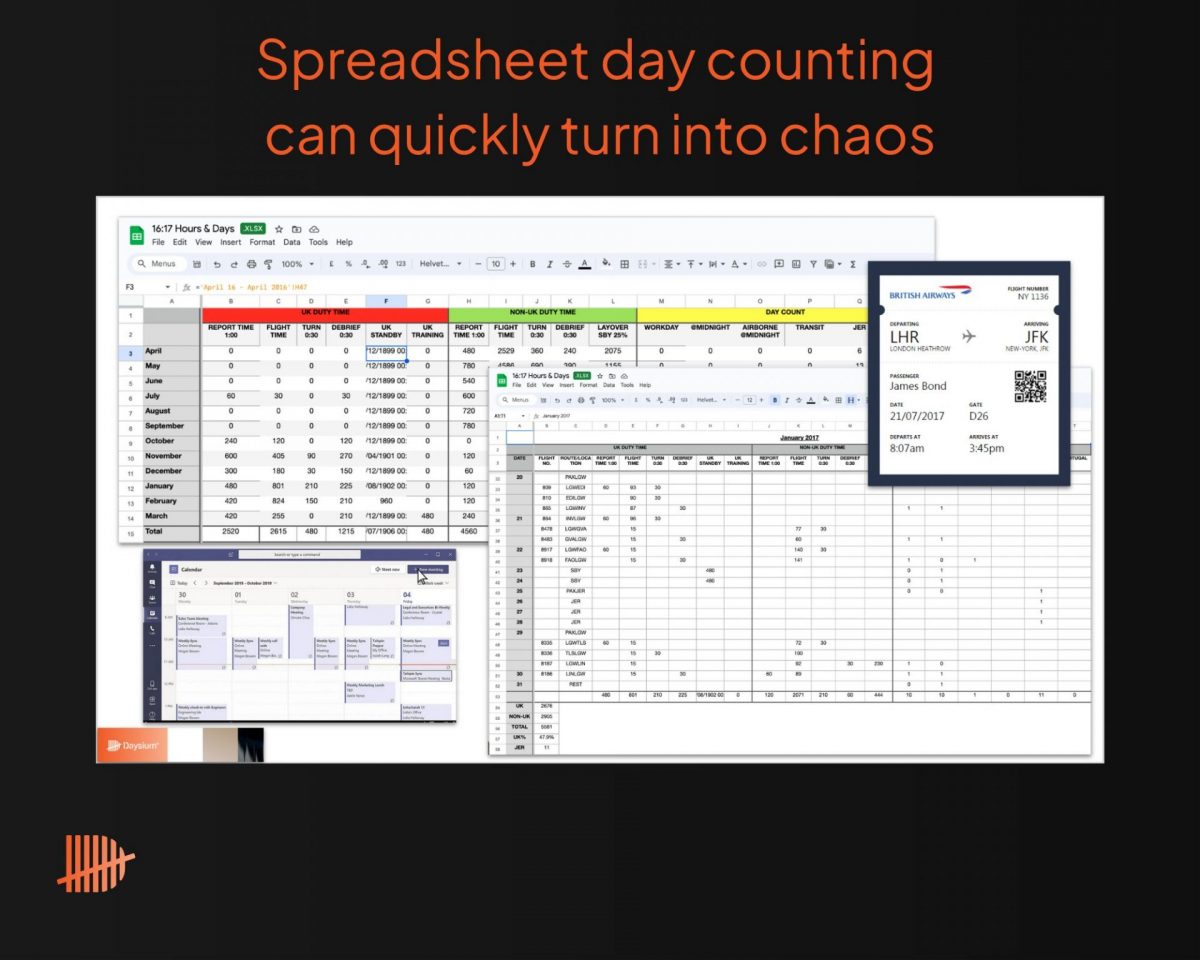
Spreadsheets are familiar, flexible, and free. But they have three fundamental problems that make them difficult to rely on when it matters most.
Memory. A spreadsheet is only as accurate as the person filling it in. Travel happens, life gets busy, and entries get made days or weeks after the fact; if they get made at all. The record is only ever as good as your recollection of it.
The rules. Tax residency rules are complex and the UK Statutory Residence Test is a perfect example of this. Your specific ties, your circumstances, and your presence in prior years can all lead to materially different thresholds. Configuring those correctly in a spreadsheet, and keeping them updated as your situation changes, places the entire compliance burden on you.
Proof. A spreadsheet tells tax authorities what you claim your day counts were. It does not tell them whether you were actually where you say you were. There is no time-stamp proving when each entry was made, and nothing to prevent records from being added or amended after the fact. In a serious enquiry, an inspector will ask how you can demonstrate your records were not put together retrospectively. A spreadsheet has no answer to that question.
How day counting apps improve on spreadsheets
Dedicated day counting apps solve most of these problems. They record your location automatically using GPS data, so you are not relying on memory. The count updates in real time, making it easier to plan ahead and stay within your limits. The better ones alert you when you are approaching a threshold and let you export a record for your advisor.
For someone with a straightforward residency position — one or two countries, clear-cut circumstances, limited financial exposure — a day counting app is a significant improvement on a spreadsheet and may be entirely sufficient.
But for internationally mobile individuals with complex multi-jurisdiction positions and significant assets, most day counting apps still share a limitation that matters considerably in the event of a tax enquiry.
Where most day counting apps still fall short
Most apps record where your device was. That is useful. But it doesn't stop the authorities wondering if you were there with your device. We know from previous enquiries that simple transaction data is often challenged. Courts and investigators have made statements to say that a receipt only shows a payment was made. It does not prove the person under investigation was present to make it.
No evidence layer
A location log tells an inspector where your phone was. A contemporaneous evidence record tells them where you were, with supporting documentation attached at the time it happened. Most apps allow documents to be uploaded at any point. There is nothing to prevent a user uploading records days, weeks, or months after a trip. In an HMRC enquiry, a document with no timestamp tying it to the moment of travel is reconstructed evidence. An inspector can reasonably question it. Furthermore, many apps allow you to add and edit data after initial upload. Daysium doesn’t allow users to do so, ensuring data accuracy and credibility.
No jurisdiction logic
Most apps let you configure your own day count thresholds. Getting those right, and understanding how SRT tests, tie-breakers, and multi-jurisdiction frameworks interact with your specific circumstances, is left entirely to you.
No advisor integration
Most apps treat your advisor as the recipient of an exported PDF. For individuals with professional advisors actively managing their compliance position, that is a file transfer, not a workflow. Daysium integrates advisors from onboarding through to evidence review because for globally mobile individuals with complex financial arrangements, compliance is not a solo exercise.
These are not minor gaps. HMRC's scrutiny of wealthy individuals is intensifying fast: in 2024–25, the number of investigations targeting high-net-worth individuals rose 60%, with £5.2 billion collected in compliance yield from this group in 2023–24 alone. We’re aware of how multi-year residency enquiries can potentially reach up to £250,000 in professional fees before any tax or penalties are considered.
For high-net-worth individuals, where residency enquiries tend toward the more complex end, the financial and reputational stakes are considerably higher. The question is not whether a day counting app is cheaper than Daysium. It is whether it provides the standard of evidence that an enquiry actually requires.
Daysium: The audit-ready day counting app
Daysium was built by a team of tax compliance experts who recognised that globally mobile high-net-worth individuals had no tool built to the standard their situation actually requires. Not a consumer app adapted for complex use. Not a workforce compliance tool repurposed for private clients. Something designed from the ground up for the evidence requirements, jurisdiction logic, and advisory workflows that matter when tax authorities like HMRC come looking.
Daysium records your residency position automatically, using jurisdiction-specific logic built around the actual rules, not thresholds you configure yourself. As you travel, a contemporaneous evidence record is built: geo-logged, time-stamped, and structured to hold up under scrutiny. Your advisors can be given controlled access to that record at any time.
If task authorities ever ask where you were and when, the answer is already there. Not reconstructed. Not estimated. Documented, at the moment it happened.
And the timing matters. HMRC's focus on wealthy individuals is not easing — it is accelerating. Having the right record in place before scrutiny arrives is not caution. It is the standard that people in your position now need to meet.
Frequently asked questions: Daysium pricing and tax residency apps
How much does Daysium cost?
Daysium has different memberships available, depending on your needs. Our Memberships range from £950 for simple strategies to £2,500 commonly used by Private Clients through to +5,000 for complex situations, family offices and trusts. Pricing reflects the level of compliance support, evidence architecture, and jurisdiction logic included .
Is Daysium worth the price?
For high-net-worth individuals with complex multi-jurisdiction positions, Daysium's annual cost is better understood as risk mitigation than software spend. HMRC launched 60% more investigations targeting the wealthy in 2024/25 compared to previous years and a multi-year residency enquiry could reach £250,000 in professional fees before any tax or penalties were considered. The more relevant question is not what Daysium costs, but what a tax enquiry costs if your records do not hold up.
Is Daysium the best app for the 183-day rule and UK SRT compliance?
Daysium is built specifically around UK tax residency frameworks, including the Statutory Residence Test and the 183-day rule. Unlike general day counting apps, Daysium's rulesets encode the actual tax logic, including how ties, circumstances, and prior years interact, and apply it automatically.
Can't my tax advisor just handle this?
Your tax advisor can advise on your residency position and represent you in an enquiry. What they cannot do is build a contemporaneous evidence record on your behalf. That record can only exist if it was captured at the moment you were travelling. Daysium gives your advisor something to work with: a geo-logged, time-stamped record they can stand behind, rather than a spreadsheet they have to defend.
Do I really need this if I already keep travel records?
It depends on how those records were created. Documents uploaded or entered after the fact, however accurate, are reconstructed evidence. In an HMRC enquiry, an inspector can reasonably question whether they reflect what actually happened. Daysium's records are captured at the time of travel, which is precisely what gives them their evidential weight.
Is Daysium right for you?
If you spend time in one or two countries, have a simple residency position, and the financial consequences of a mistake are manageable, a simple day counter might serve you well.
But if you split your time across multiple jurisdictions, hold significant assets, have a residency position that HMRC could challenge, and work with advisors who need to stand behind your records — those tools are not built for your situation. Daysium is.
Most day counting apps available on the market are not tax compliance systems like we are. They were not built for the evidence requirements of a tax residency enquiry, the complexity of UK SRT logic, or the advisory workflows that high-net-worth individuals and their advisors rely on in different tax jurisdictions.
When scrutiny arrives — and increasingly, it is a matter of when, not if — you will have the confidence to state: there is nothing to see here. Everything is in order.