Singapore Company Directors: Why Your Travel Pattern Is a Tax Residency Risk

Singapore's tax residency rules treat company directors differently from other foreign employees with no administrative concessions and stricter obligations for both personal and corporate tax position. Here's what directors need to know.
A sliced picture of the Singapore city centre in the night time.

Singapore has a well-earned reputation for tax clarity. Its territorial system, competitive rates, and extensive double tax treaty network make it one of the most attractive jurisdictions for internationally mobile individuals and the companies they lead. For most professionals working in Singapore, the rules are relatively straightforward, but for Singapore company directors, the situation is different. 

Let’s take a look at how tax residency in Singapore works and what company directors should know to protect their tax position. 

This article is for educational purposes only and does not constitute tax or legal advice. Singapore’s tax residency rules can be complex and depend on individual circumstances. You should always seek guidance from a qualified tax professional in relation to your specific circumstances.

How tax residency works in Singapore

Singapore determines individual tax residency primarily on the basis of physical presence. The standard test is the 183-day rule: if you are present in Singapore for at least 183 days in a calendar year, you are treated as a tax resident for that year of assessment.

Singapore’s tax residents are subject to progressive rates ranging from 0% to 24% (in 2026). They are eligible to claim personal reliefs and deductions. 

If you’re a non-resident in Singapore, you pay a flat tax rate, which in 2026 is 15% of employment income or a resident rate if that produces a higher liability. For directors’ fees and certain other income, non-residents are taxed at 24% regardless of how much time they spend in Singapore.

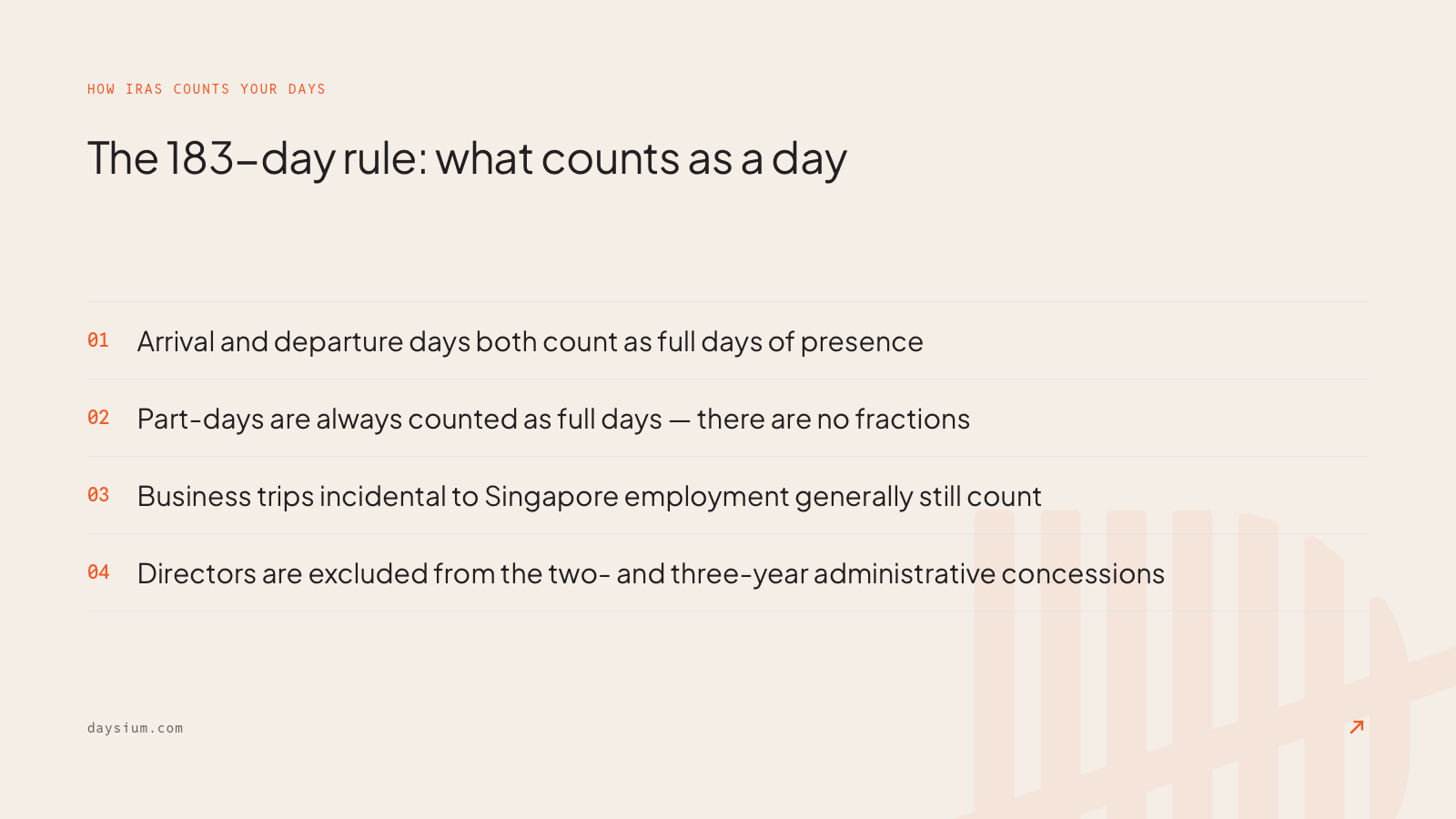
When calculating the 183-day threshold, the Inland Revenue Authority of Singapore (IRAS) counts:

  • Both arrival and departure days count as days of presence.
  • Days partly spent are always full days.
  • Business trips and temporary absences that are incidental to Singapore employment are generally still counted toward the total. 

For foreign employees, IRAS also provides administrative concessions: 

  • A two-year concession for those whose employment straddles two calendar years, and 
  • A three-year concession for those present across three consecutive years. 

These are both available even when 183 days aren’t met in any given year.

For most professionals, this framework is manageable. For company directors, it is more complicated.

Information about how Singapore day counting for tax residency works, especially for Singapore company directors

The director carve-out most people miss

The administrative concessions described above — the two-year and three-year rules that give foreign employees flexibility when their time in Singapore straddles calendar years — explicitly exclude directors of a company.

A director splitting time between Singapore and other jurisdictions is assessed on stricter terms: physical presence is counted day by day, with no concession for straddling calendar years. A senior executive and a board director with near-identical travel patterns can find themselves in very different positions at the point of assessment.

 If you hold a directorship, that distinction matters, and it is worth understanding before you assume the standard rules apply to you.

Two residency risks, one travel pattern

Your personal residency position is only part of the picture. As a Singapore company director, a travel pattern that regularly takes you outside Singapore also has implications for the company’s own tax residency status.

Singapore’s corporate residency rules are built around control and management: where the board exercises de facto control and where strategic decisions are made. In practice, this means where board meetings are held and where decisions are recorded.

Two specific risks are worth understanding:

The 50% board meeting rule

Virtual board meetings are recognised by IRAS, but with a condition: the meeting is only treated as having strategic decisions made in Singapore if at least 50% of directors with authority to make strategic decisions — or the chairman — are physically in Singapore during the meeting. 

On a smaller board, individual presence carries significant weight. A director who is regularly abroad may be shifting this balance without realising it.

Tightened substance requirements from 2025

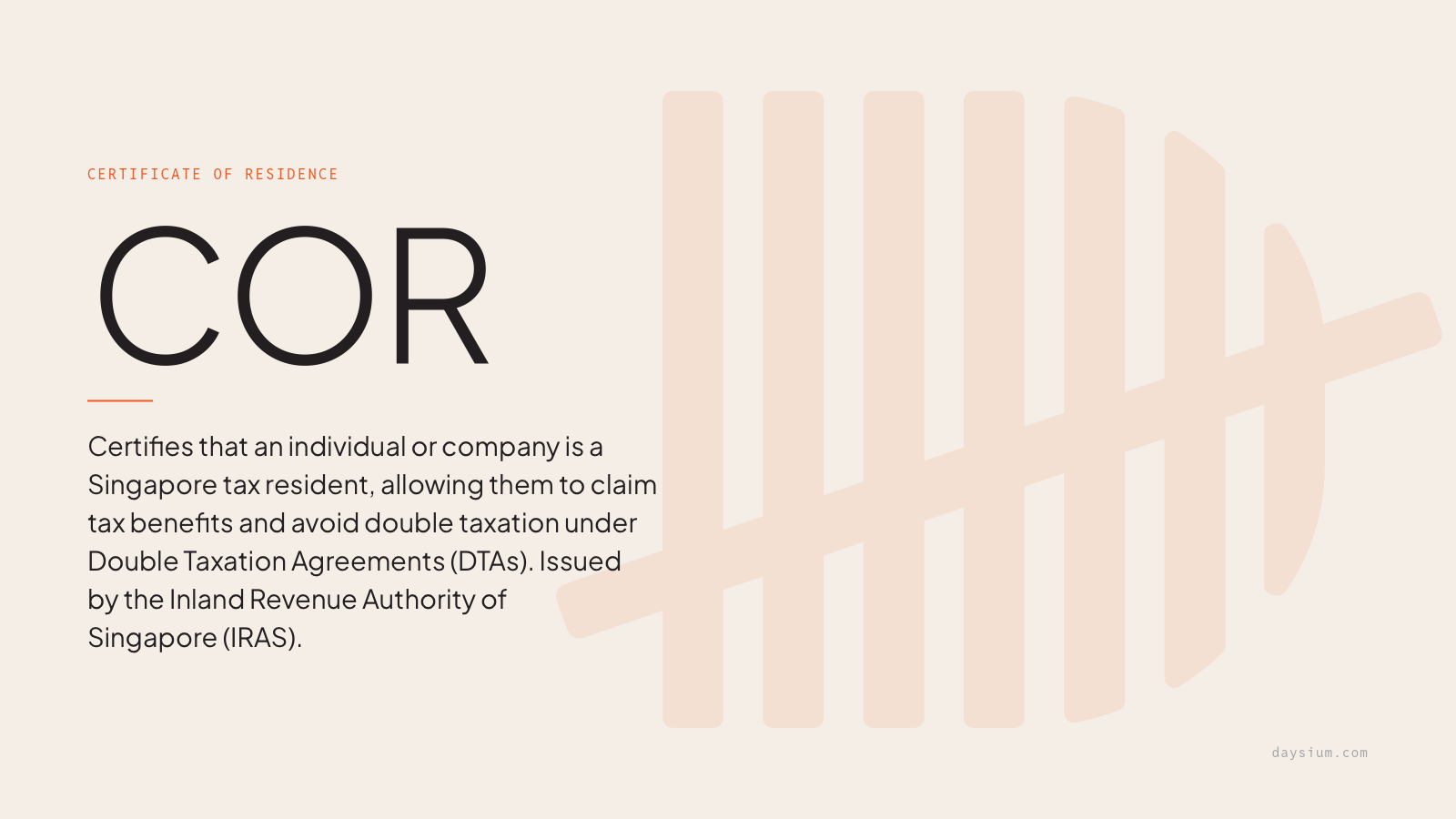
 IRAS has tightened the criteria for foreign-owned holding companies seeking a Certificate of Residence (COR). Merely receiving support or administrative services from a related Singapore company is no longer sufficient. From 2025, a foreign-owned holding company must meet at least one of three conditions: 

  • have an executive director genuinely based in Singapore who is not a nominee,
  • have a key employee (CEO, CFO, or COO) based in Singapore; or 
  • be actively managed by a related Singapore company that makes or reviews strategic decisions on its behalf.


Without this, IRAS can decline to issue the COR, and access to Singapore’s double tax treaty network falls away with it.

Explainer of the Singapore Certificate of Residency and how it works.

What happens when IRAS raises a query

An IRAS query on residency isn’t necessarily an indication of wrongdoing. It is a request for evidence, and the standard it applies is contemporaneous proof, not retrospective reconstruction.

For directors, this means the records you kept during the year in question carry more weight than any summary prepared after the fact. 

  • Both arrival and departure days count as days of physical presence in Singapore. 
  • Part-days count as full days. 
  • Board meeting documentation needs to confirm not just that a meeting took place, but who was physically present and where. 
  • The physical location of each director at the time of the meeting is a fact IRAS may ask you to demonstrate.

The practical implication is straightforward: if you are a Singapore company director who travels frequently, knowing your day count at any given point in the year, and being able to evidence it, is not an administrative nicety. It is the foundation of your ability to respond to scrutiny with confidence.

Some directors manage this through detailed travel diaries and board minutes reviewed at year-end. Others use automated tools that log presence across tax jurisdictions in real time. The method matters less than the outcome: a clear, accurate, and defensible record of where you were and when.

Frequently asked questions

Does the 183-day rule apply differently to Singapore company directors?


Yes. While the 183-day threshold itself applies, the administrative concessions IRAS offers to foreign employees — including the two-year and three-year concessions for those whose employment straddles calendar years — explicitly exclude directors of a company. Directors must meet the day-count threshold on a year-by-year basis without access to those concessions.

Can a Singapore company lose its tax residency if its directors travel frequently?

It can be at risk. Singapore corporate residency is based on where control and management are exercised. This is typically the location of board meetings and strategic decision-making. If directors are frequently outside Singapore, this can affect whether the company qualifies as a Singapore tax resident and whether it can obtain or retain a Certificate of Residence for double tax treaty purposes.

What is a Certificate of Residence, and why does it matter?


A Certificate of Residence is issued by IRAS to confirm that a company is a Singapore tax resident for the purpose of accessing double tax treaty benefits. Without a valid COR, a company cannot claim relief from withholding taxes and other levies in treaty partner jurisdictions. From 2025, IRAS has tightened the substance requirements for COR eligibility, particularly for foreign-owned holding companies.

How are directors’ fees taxed if a director is not a Singapore tax resident?


Non-resident directors are generally taxed on directors’ fees at a flat rate of 24%, regardless of how many days they spend in Singapore. Unlike employment income, directors’ fees are taxable in Singapore irrespective of physical presence, and the location of the board meeting is not determinative. This is a further reason why residency status matters: resident directors are taxed at progressive rates and have access to personal reliefs, which can make a material difference to overall liability.

Do virtual board meetings count for Singapore corporate residency purposes?


Yes, but conditionally. IRAS recognises virtual board meetings, but only treats them as Singapore-based if at least 50% of the directors with authority to make strategic decisions — or the chairman — are physically in Singapore at the time of the meeting. Directors who are frequently abroad may affect this balance, particularly on smaller boards.

What records does a Singapore company director need to keep?


Directors should maintain contemporaneous, day-by-day records of physical presence across jurisdictions. Both arrival and departure days count as days of presence in Singapore, and part-days are counted as full days. Board meeting documentation should confirm the physical location of each director present. Records created at the time carry significantly more weight with IRAS than reconstructions prepared after the fact.


Singapore company directors: securing your tax position

Singapore remains one of the most attractive jurisdictions for internationally mobile directors and the companies they lead. But its tax residency rules impose certain restrictions on Singapore’s company directors, and the day counting requirements are precise. IRAS expects real substance, real presence, and the evidence to support both.

For directors who travel frequently, that precision deserves attention. The residency position of both the individual and the company can turn on facts that are straightforward to establish in advance and significantly harder to reconstruct under pressure. Understanding where you stand and keeping records that reflect it are the starting points.

If you want to benefit from automated day counting that lets you view your thresholds in the palm of your hand, try Daysium for free.

Begin your free trial

Discover how to be tax compliant with Daysium

Created in partnership with industry experts, tackle the complex challenges of day counting and tax record-keeping.