The Gap Between Reviews Is Where the Risk Lives

The tax residency advice was never the weak link. The gap between it and the next review was. Here's why that matters and how to remedy it without micromanagement.
A black and white image of an advisor walking to a meeting.

Most advisors don’t miss a client’s tax residency risk because they weren’t paying attention. They miss it because of when they were paying attention. The reality is that between scheduled reviews, an advisor has no reliable, real-time way to know where any individual client actually stands relative to their day count thresholds. 

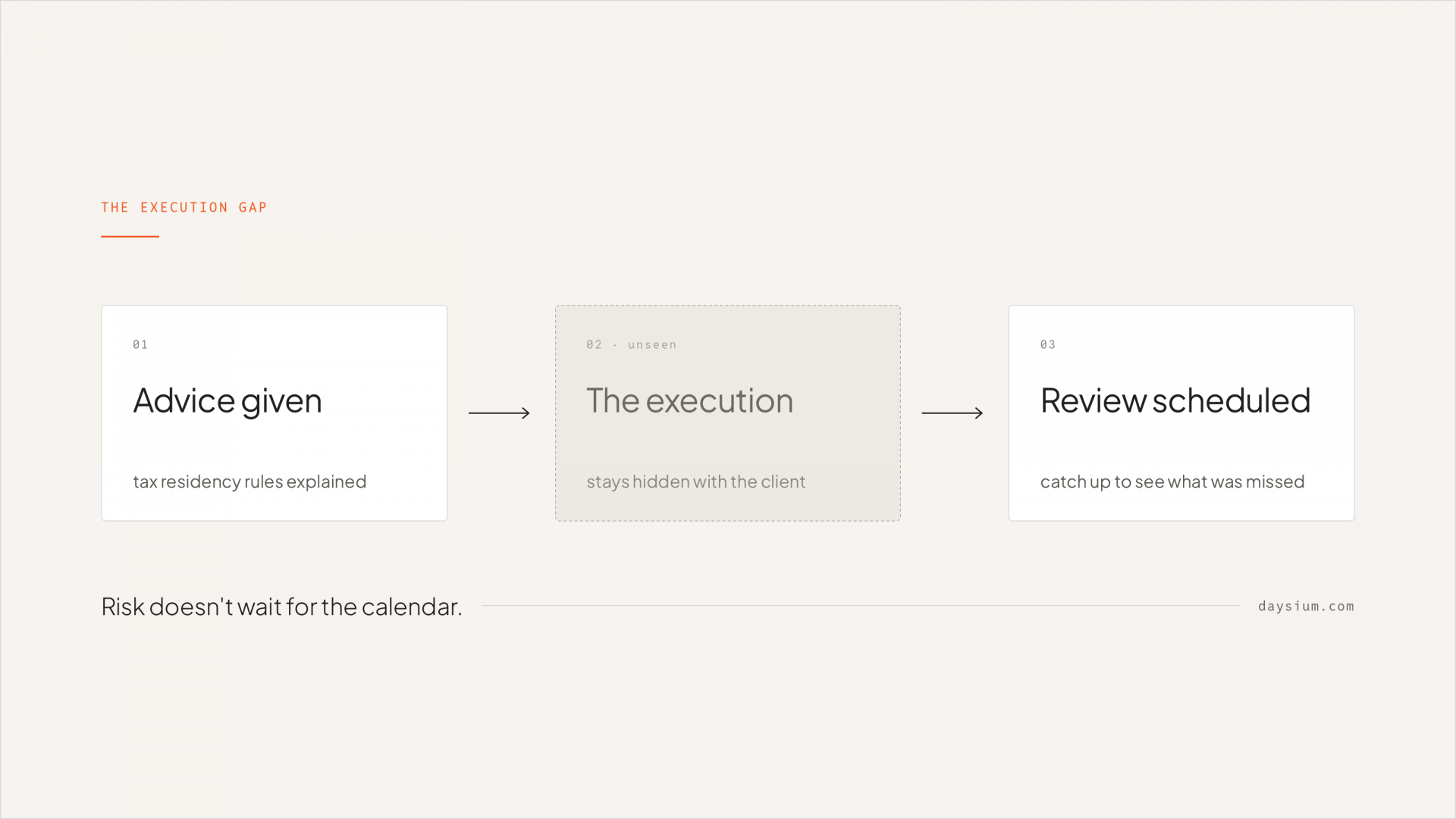
The tax residency advice is sound; the rules are explained and understood. Yet, a problem remains. The execution and review remain on the client’s shoulders, subject to a review cadence both parties must agree upon. It doesn’t matter if you’re asking the right questions as a tax advisor if the conversation only occurs on a pre-set schedule, and not when risks are beginning to surface. 

This isn’t a case for closer supervision of clients. At Daysium, we believe it’s the opposite. The instinct to leave clients room to manage their own travel and records is the right one — nobody wants an advisor whose primary value-add is chasing down flight confirmations. But that boundary has a cost that rarely gets named directly: it means visibility into where things stand is gated entirely by timing, not by risk.

No one wants more micromanagement

Three stages of tax advisor and client relationship: advice - execution - review.

Financial and tax advisors are not, and should not be, in the business of tracking clients day by day. That’s a correct professional boundary, not a gap in diligence. Clients don’t want it, advisors don’t want to do it, and it would fundamentally change what an advisory relationship is for the worse.

But the absence of real-time oversight has always meant something else, too. Between the point at which tax residency advice is given and the point at which a review happens, an advisor is structurally unable to see whether that advice is still holding. Not “unlikely to know” but actually unable to know, short of asking, which is the very thing the professional boundary discourages.

This is the real tension underneath the advice-and-execution conversation the industry is already having. It’s less “clients don’t keep good records” and more: the mechanism for finding out where a client stands has only ever been a scheduled event, and risk doesn’t wait for the calendar.

Why the gap surfaces at the worst possible time

A client’s position can shift meaningfully in the space between two reviews. All you need is a delayed flight, an unplanned trip home, or a family circumstance that pulls them back more often than expected. This is a reality of travel for globally mobile high-net-worth individuals (HNWIs). None of this reflects carelessness. It reflects the reality that travel patterns are live, and reviews are periodic.

The result is that advisors learn about a threshold breach or a close call only after it’s too late to do anything about it. Either the client mentions it directly, or the next scheduled review catches it. By this point, the year, or the quarter, may already be compromised and the firefighting begins. 

At the level of a single client, this is a gap and a risk that carries weight to the client in question. However, for advisors with a book of clients, the blind spot compounds. An advisor with sixty globally mobile clients has no way of knowing, on any given week, which three or four are drifting toward a threshold. Every client tends to get roughly the same attention, regardless of how close they actually are to a problem. The clients who need a call this month get the same cadence as the ones who don’t.


What changes when the advisor already knows

The instinct to solve this by asking or reviewing more often overlooks where the real leverage lies. More frequent check-ins still depend on the client remembering, reconstructing, or being asked the right question at the right moment. It’s more of the same mechanism, not a different one.

The alternative isn’t tighter oversight of the client. It’s visibility without constant face-to-face involvement. Advisors need a way to see where a client’s day count stands relative to their thresholds, without being the one doing the counting, chasing, or reminding. The client’s relationship with their own records doesn’t change. What changes is that the advisor isn’t finding out for the first time in the room.

Changing advisory conversations

That distinction has a direct, practical effect on what a review meeting actually is. Without visibility going in, the first part of most reviews is spent reconstructing what’s happened since the last one. You’re establishing the day count before any real conversation about strategy can start. 

With visibility going in, that reconstruction is already done. The meeting opens at “here’s what I’m seeing, and here’s what I’d suggest,” instead of “let’s work out where you are.” The advisor’s time — the high-value part of the relationship — is spent on the part only the advisor can do.

This also lands against a backdrop where the standards expected of advisers themselves are tightening. The UK’s HMRC has introduced mandatory registration for tax advisers interacting with HMRC on behalf of clients. They’ve also established new minimum conduct standards and sanctions for firms that fail to meet them. The new regime concerns advisers’ own professional conduct, not how clients keep their day-count records. The direction of travel is consistent: the margin for informal process is narrowing on both sides of the advisory relationship, not just on the client’s side.

The missing half of the advisory infrastructure

Advisors already have real infrastructure for the tax residency advice itself. The execution-and-visibility half of the relationship has never had an equivalent. It has largely run on trust and the review calendar.

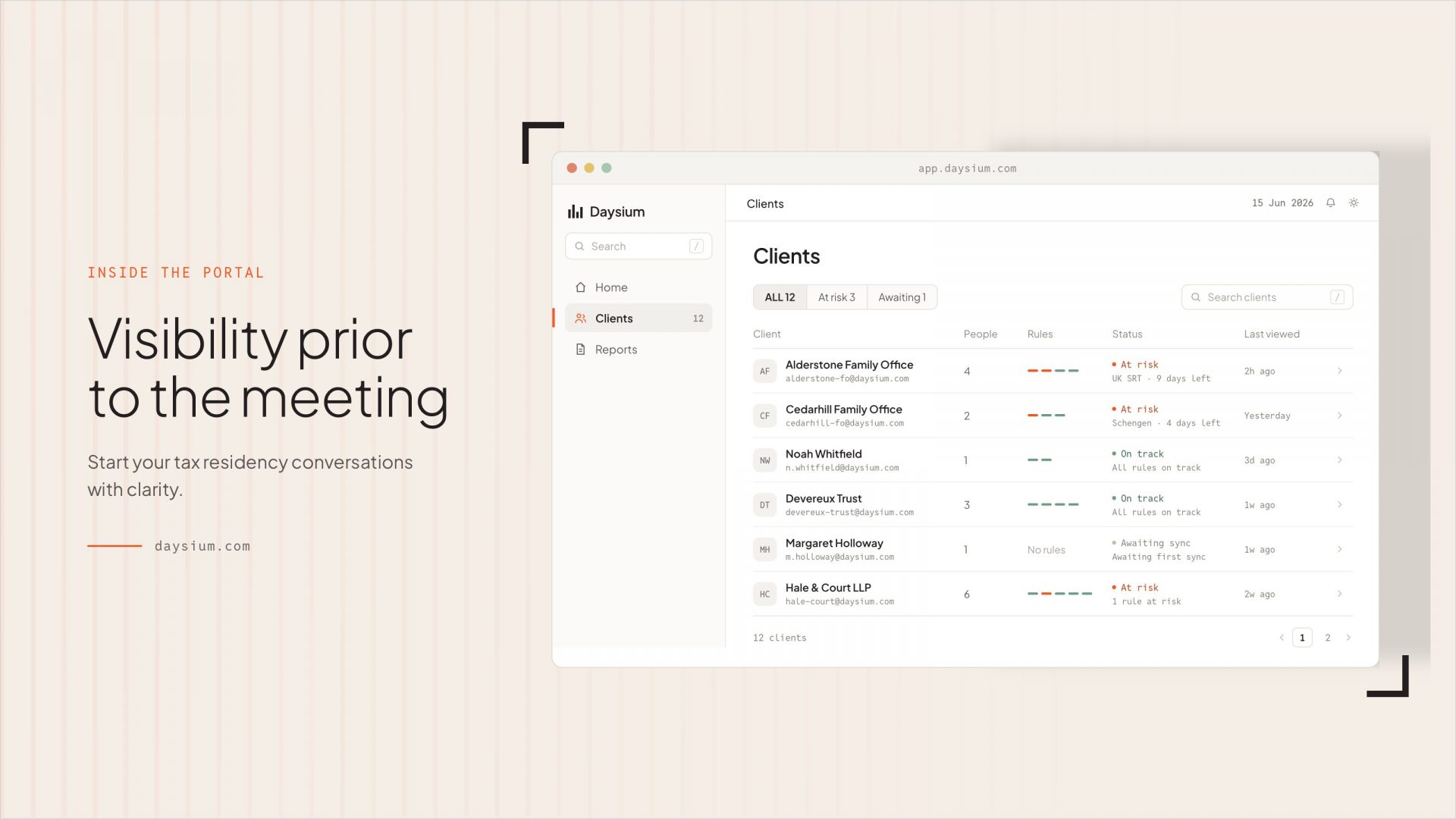
An image showing the Daysium Portal: a view of client day counts and thresholds.

This is where a tool like Daysium sits. Advisors help set the relevant rules and thresholds for each client based on the specific tax residency jurisdictions that apply to them. The client logs and evidences their day count as they go, building a contemporaneous record rather than a reconstructed one. And the advisor gets a portfolio-level view of where every client in their book actually stands — not their location, but their exposure against the thresholds that matter to them.

Nothing about the advisor’s role changes. They’re not monitoring clients more closely, and they’re not more involved in clients’ day-to-day travel than before. What changes is that the blind spot between reviews closes, and the review itself starts from a position of knowing rather than asking.

The advice was not the issue; execution was

Good advice has never been the weak link. The weak link has been the space between advice being given and advice being checked — a space that, by design, advisors have never been able to see into without asking. Closing that gap was never about watching clients more closely. It was about being able to see the book clearly enough that watching individually was never the answer in the first place.

Want to see how Daysium fits into your firm’s advisory strategy? Book a call with the team

Discover how to be tax compliant with Daysium

Created in partnership with industry experts, tackle the complex challenges of day counting and tax record-keeping.