What Happens to Tax Residency Evidence When a Family Office Principal Dies?
05 Aug 2026
When a family office principal dies, the record proving their UK (non-) tax residency often sits locked on a single device. That's a genuine governance gap. Our article looks at why it matters for inheritance tax, and what family offices can do about it before it becomes urgent.
Most tax residency evidence sits on a person’s digital devices, especially their phone. When a person dies, entry to these devices becomes limited. While the immediate focus is hardly ever on administrative tasks, access to evidence around tax residency can be an extremely relevant question to solve for globally mobile principals with UK links. This is due to the UK’s long-term residence rules and how certain worldwide assets may fall under the UK’s inheritance tax (IHT) rules long after a person has moved out. So, knowing how to gain entry to the data becomes something family offices must now consider as part of their succession plans. As one family office manager put it in a recent client meeting:
“If the residency records are just sitting on their phone, it becomes very hard to prove anything.”
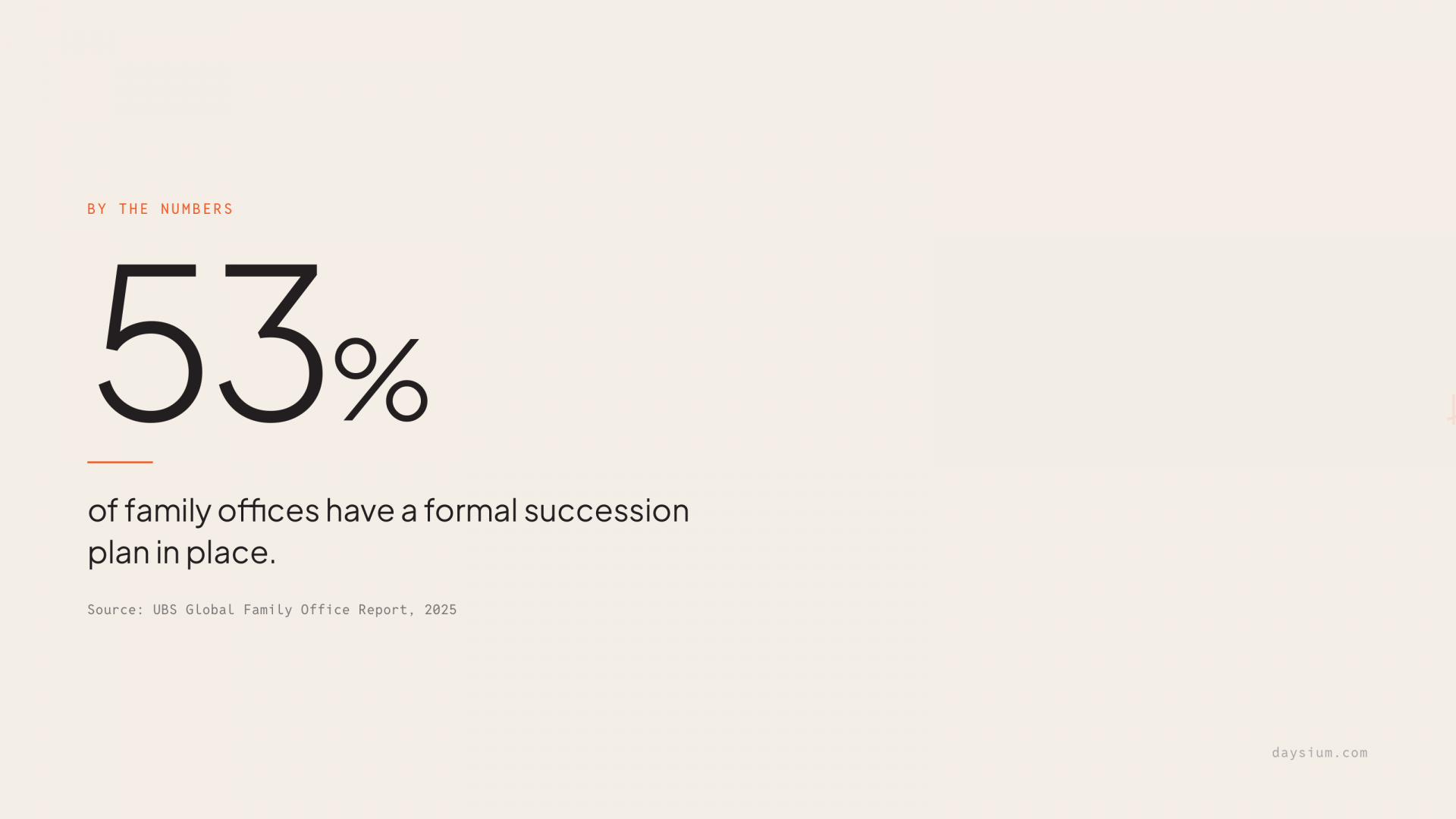
Although family offices have started to pay more attention to what happens after the death of a principal, there are still obvious gaps to fill. JPMorgan’s Global Family Office Report highlighted that over-reliance on individual providers ranks as a top-tier continuity risk, on par with lack of succession planning itself.
It’s time to change that for tax residency evidence. This article covers what happens to tax residency evidence when a principal dies, why it matters, and how family offices can better manage it.
The following is a generalised look and is not to be considered as official tax or legal advice. We always recommend connecting with a qualified tax advisor or lawyer when dealing with tax residency questions.
How is tax residency normally determined for an estate?
When someone dies, working out their UK tax residency isn’t just about looking at their current status. The executor needs to consider both current and past tax residency as part of their duty to administer the estate.
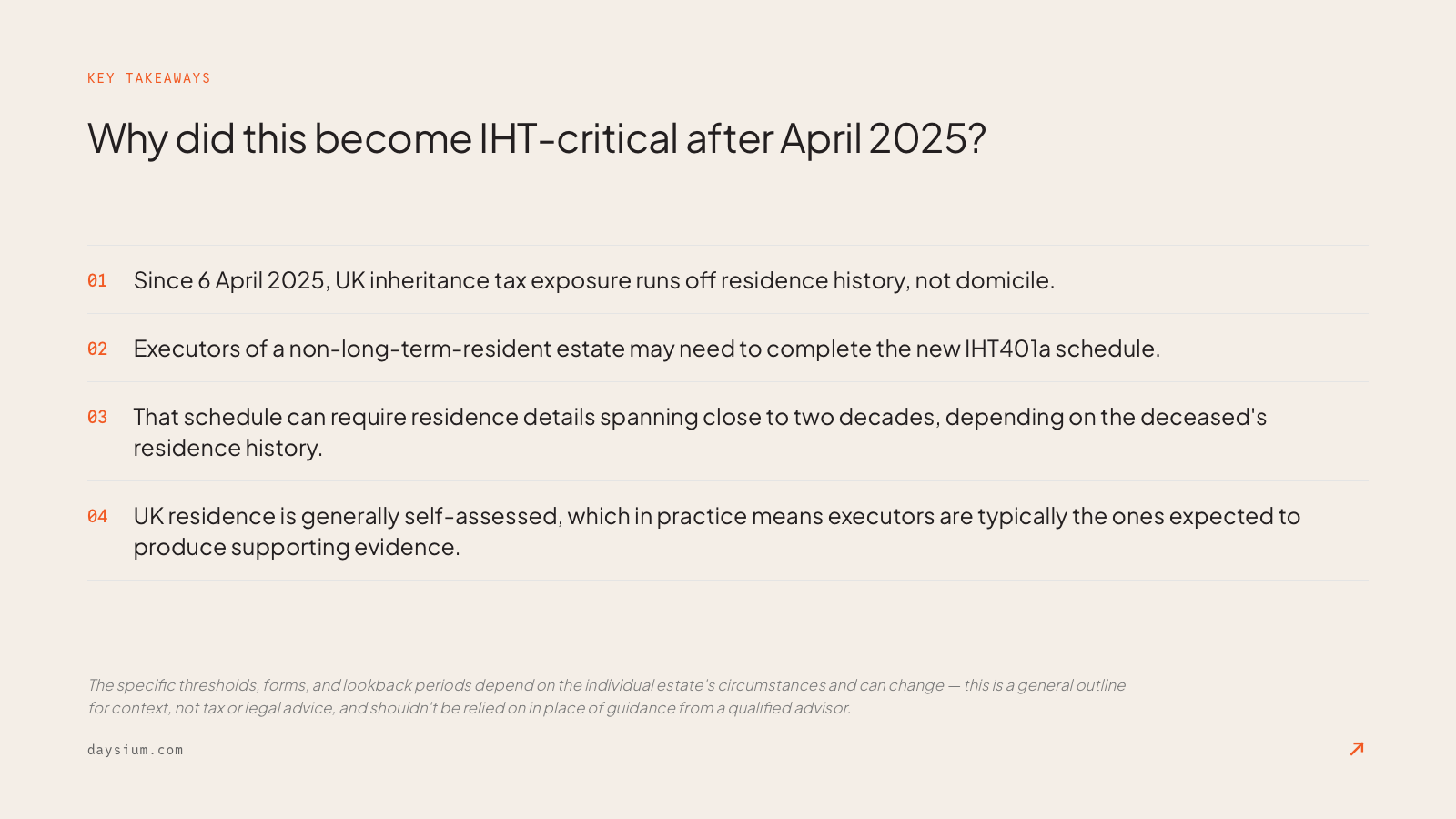
The personal representative (executor or administrator) is responsible for establishing the deceased’s residence history. Residence is generally self-assessed, and that doesn’t change on death.
Historically, this mattered mainly for domicile, which offered a single, relatively stable status. Since 6 April 2025, however, it also determines long-term resident (LTR) status. This is based on a rolling count of UK-resident tax years, similar in spirit to the old 15-of-20-years deemed domicile test.
What’s more, split-year treatment may apply to the year of death, but not consistently across every tax provision. So the final period often needs its own separate residency analysis, not just a continuation of the prior year’s status.
Procedurally, the PR reports the estate to HMRC via IHT400, with IHT401a required in many cases for non-LTR estates — HMRC can query any of it, particularly where offshore assets are significant, or the residence pattern is complex.
In other words: even in the most straightforward case, residency after death isn’t a formality the executor rubber-stamps. It’s an active determination they have to build a case for, using whatever evidence exists.
Why is tax residency evidence different from other digital assets?
Most “digital legacy” advice is about accounts, photos, and subscriptions — things that matter to a family but carry no regulatory weight. Tax residency evidence sits in a different category:
It’s evidentiary, not sentimental — it’s the primary proof an executor needs to support (or defend) the estate’s inheritance tax position.
It’s time-sensitive — probate and HMRC deadlines don’t pause for a reconstruction effort.
It’s hard to substitute — once the contemporaneous record is gone, everything else is a weaker, secondary version of it.
What happens if the record is locked on the principal's phone?
If the primary record isn’t accessible, the executor doesn’t get a clean restart. They fall back on secondary evidence, pieced together after the fact:
Passport entry and exit stamps
Employer records and work permits
Old tax returns and tax residence certificates
Electoral roll entries
Property ownership records
Statutory declarations from family or advisors willing to attest to where the principal was on specific days
None of this is as strong as a record created at the time, and all of it takes longer to assemble than the original would have. At the same time, HMRC scrutiny and probate deadlines keep running. There’s also a harder conversation buried in this for the family office itself: if it was best placed to hold this record and didn’t, that’s a difficult position to explain to the family afterwards.
How is access to someone else's phone normally established?
The default answer, in most families and most family offices, is informal: someone knows the passcode, or has it written down somewhere. That’s not a formal access route — it’s a workaround, and it comes with more open questions than most people assume.
What formal access tends to look like, where it exists:
Legacy contact tools — Apple’s Legacy Contact and Google’s Inactive Account Manager let someone nominate, in advance, a contact who can request specific data after death, using an access key plus a death certificate. These have to be set up before the event — there’s no way to add one retroactively.
Grant of probate or court order — without a pre-designated legacy contact, providers generally ask for some combination of a death certificate, proof of authority, and a grant of probate (or in some cases a court order) before releasing anything. Even then, it’s often a limited data export rather than full account access. Exact requirements vary by provider and change over time.
Lasting Power of Attorney — for incapacity rather than death, a Property and Financial Affairs LPA is generally the route by which an attorney manages financial matters, but whether it extends to unlocking a phone or a personal device depends on the provider’s own terms and, in some cases, how the LPA itself is drafted. It isn’t automatic.
Practical friction points worth being aware of:
Using someone else’s password without proper authority raises real legal questions in the UK, including under the Computer Misuse Act 1990. This is genuinely uncertain territory, and not something to rely on family judgment for. It’s a reason to get this sorted in advance, not a question to try to answer in the moment.
Provider terms of service typically don’t permit sharing login credentials, separately from whatever a will or LPA says — the contract sits between the platform and the individual, not the estate.
Biometric locks (fingerprint, face ID) generally can’t be reproduced or transferred after death or incapacity the way a written passcode could be.
None of the formal routes are fast. Legacy-contact requests, probate-backed requests, and court orders all take time — time the estate often doesn’t have against an HMRC or probate deadline.
None of the above is legal advice, and the exact position depends on the provider, the documents in place, and the specifics of the situation. Questions like these are always worth checking with a solicitor rather than assuming.
What should family office administrators do now?
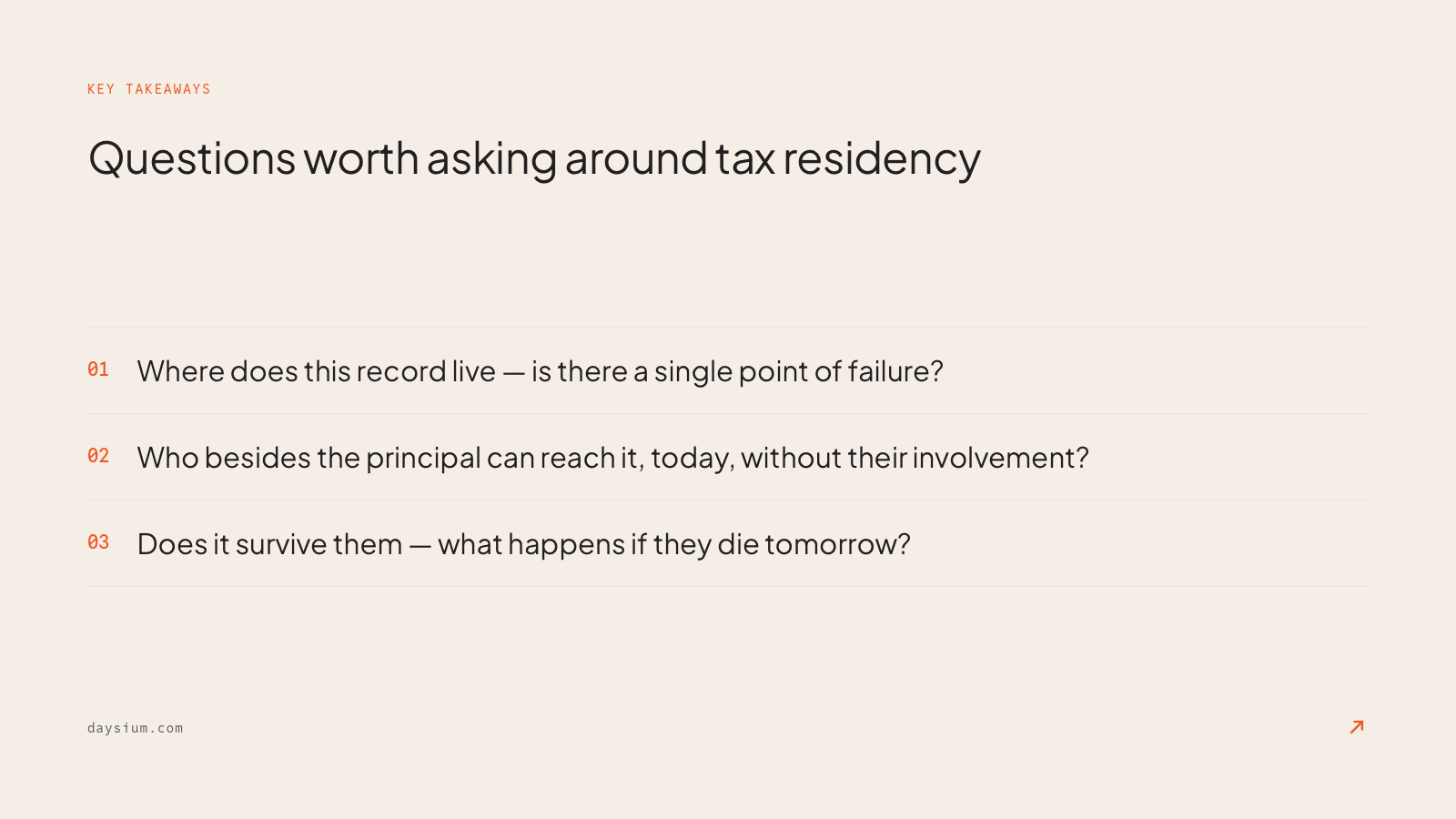
Family offices need to consider tax residency evidence as part of succession planning, rather than leaving it as an informal, administrative task for family members to sort out. Tax residency evidence is a governance issue.
If principals are only managing their tax residency separately, and especially if they aren’t using formal, secure methods to count days and store evidence, it’s worth looking at solutions before it becomes urgent.
This doesn’t require a difficult overhaul, just a deliberate decision that the family’s residency record is held with the same attention the office already gives to financial records, trust documents, and governance papers.
This is also, increasingly, what dedicated tools in this space are built to solve. Daysium’s Portal, for instance, gives family offices a desktop view of a principal’s UK day counts. It doesn’t provide access to their location history — just the day-count position itself, held independently of any one device. Day to day, that’s useful for planning travel and staying ahead of SRT thresholds. At the point where a principal dies or loses capacity, the same independence is what keeps the office out of a reconstruction exercise in the first place.
If you’re not sure where this record sits for your own principals, that’s worth a short conversation before it becomes an urgent one. Book a call with Daysium to talk through how this works in practice.
Discover how to be tax compliant with Daysium
Created in partnership with industry experts, tackle the complex challenges of day counting and tax record-keeping.
Family office technology solutions are a strategic tool to increase value. From automation and data integrity to proactive compliance, digitalisation is helping family offices operate smarter and more strategically. Discover the benefits, risks, and why tools like Daysium are becoming essential for modern, audit-ready tax residency management.
Family offices manage wealth, safeguard reputations, cross-border structures, and tax compliance. Today, bulletproof tax residency records are essential to defend against audits, satisfy CRS/FATCA reporting, and support trusts and holding companies. With growing scrutiny in Europe and beyond, family offices that automate day counting, maintain strong evidence, and centralise compliance files can plan with confidence and protect the family’s legacy.
In the evolving world of family office planning, tax residency drift has emerged as a silent risk. As HNW families live and operate globally, even a few untracked days in a tax jurisdiction can trigger serious tax exposure. This article explores how to detect, prevent, and manage the risks with strategic, tech-enabled solutions.
Monaco may offer tax-free living, but tax residency rules don’t stop at the border. This guide breaks down why Monaco Family Offices must go beyond local paperwork to manage global day counts to protect their clients from dual tax residency, audits, and unexpected liabilities.