Where client record-keeping risks actually hide: A practical guide for advisors
15 Apr 2026
Most tax residency positions are technically sound. The vulnerability lies in the records that would need to support them under scrutiny. This guide helps advisors identify where client record-keeping risks are most likely to emerge, and what to do about.
For many internationally mobile individuals, day counting and record-keeping become quiet administrative tasks that sit outside the advisory relationship they have with their tax advisors. As an advisor, you tell your clients to keep records, and they nod along, fully intending to do so. What this means in practice is that you’re dealing with the most typical client record-keeping risks: reliance on memory, calendar entries and retrospectively constructed evidence.
By the time an advisor reviews a client’s travel history, the quality of the underlying records may already be on shaky ground. If the system behind them was weak, the position may be harder to support.
The stakes have risen considerably: according to a May 2025 National Audit Office report, the average yield per closed HMRC investigation into a wealthy individual has grown from £34,106 in 2018/19 to £93,800 in 2023/24. Crucially, the same report found that taxpayer error and carelessness, rather than deliberate evasion, accounted for a growing share of that gap. The problem, increasingly, is process fragility rather than bad intent.
The purpose of this guide is simple: to help advisors identify where record-keeping risk is most likely to emerge across their client base. With a clearer framework for spotting gaps early, advisors can encourage stronger processes before those records are ever needed. And ensure you and your clients can confidently know that if questioned, the compliance position is evidenced.
Put simply, “There’s nothing to see here, everything is in order.”
The client profiles most likely to develop record-keeping gaps
Not every globally mobile individual carries the same level of client record-keeping risks. The more complex the lifestyle and travel patterns, the more difficult it becomes to maintain reliable records without a clear system.
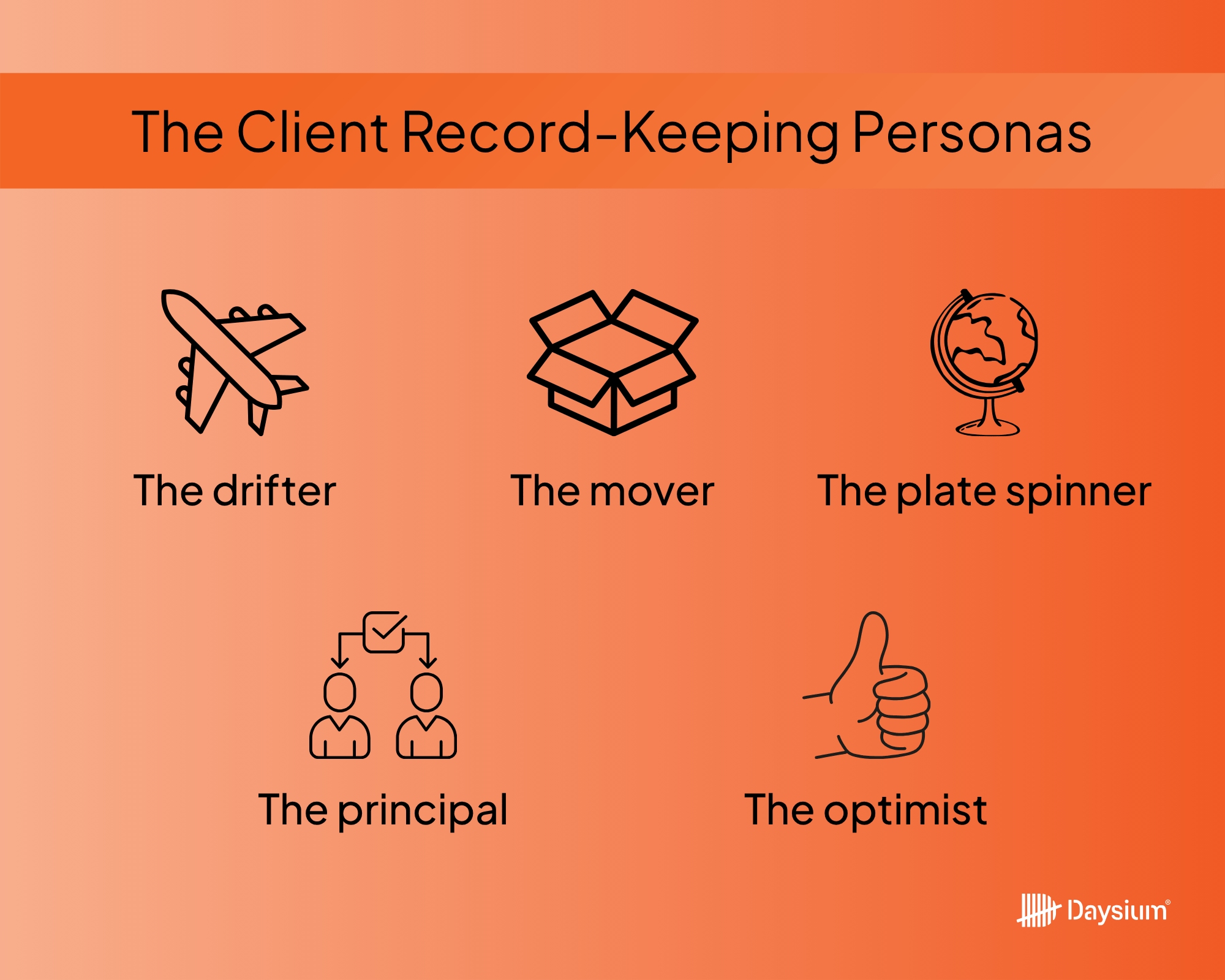
We’ve recognised five common client personas:
The drifter
The frequent traveller with irregular patterns.
Clients who travel constantly for business or lifestyle reasons rarely follow predictable routines. Flights change, trips are extended, and travel can occur with little notice. Over time, relying on memory or occasional calendar notes becomes increasingly unreliable.
The mover
The person is in mid-relocation.
During periods of transition, such as when establishing new homes, changing work arrangements, adjusting residency strategy, their travel patterns fluctuate and records that once seemed manageable become fragmented across calendars, emails, and travel confirmations.
The plate spinner
The client who manages multiple jurisdictions.
High-net-worth individuals (HNWIs) who divide their time carefully across several countries often have the highest awareness of residency rules and the weakest record-keeping infrastructure. Counting days across multiple locations can quickly become complicated, even for disciplined individuals.
The principal
The people with delegated travel arrangements.
Many private clients rely on assistants, family office teams, or travel coordinators to organise their movements. This can result in records scattered across several systems. Their flight confirmations are in one inbox, calendar entries in another, and travel notes stored elsewhere with no single consolidated view.
The optimist
The individual who assumes their records are sufficient.
They may have emails, boarding passes, or travel apps that appear to document their movements. Yet these records were rarely created with tax evidence in mind. When viewed collectively, they may lack the clarity and continuity needed to support a residency position under scrutiny.
None of these situations necessarily indicates non-compliance. They simply reflect the reality of modern global mobility and personal lifestyle choices.
Signs of client record-keeping risks in advisory conversations
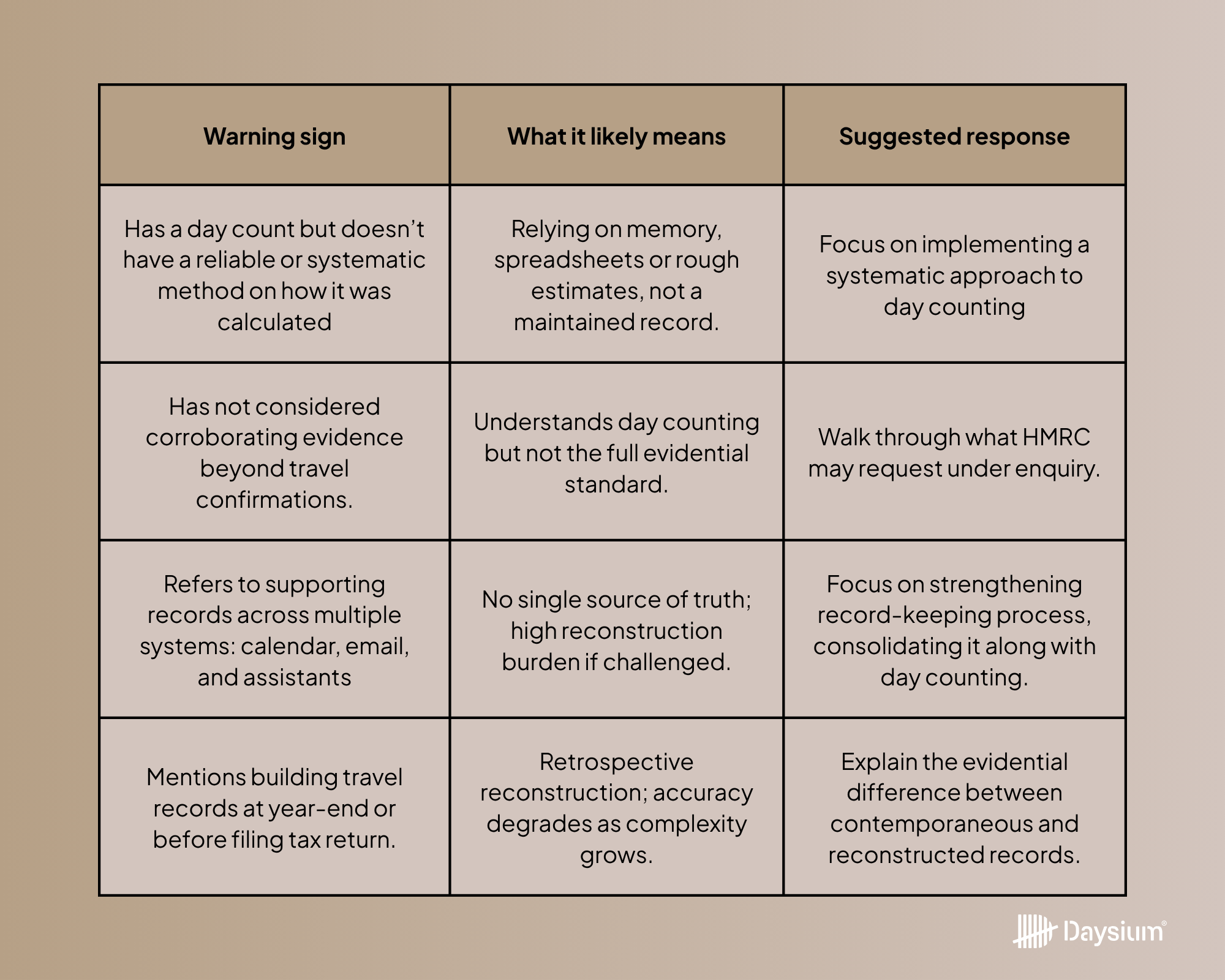
So, how to spot your client type and their specific risk profile? Advisors often encounter subtle signals that a client’s record-keeping process may be weaker than expected. These rarely appear as obvious problems, but instead, they tend to surface during routine discussions about travel or tax residency planning.
The chart below details the typical client record-keeping risks, what they mean and the suggested response:
Questions worth asking during client reviews
When discussing tax residency compliance, a few questions can reveal risks in the client’s chosen day-counting and record-keeping process. We recommend weaving these naturally into existing conversations you’re having about travel patterns or tax residency positions.
“How do you currently keep track of your tax residency day counts?”
A client who describes a specific system, such as an app, a weekly spreadsheet, or a log maintained by their PA, is in a materially different position from one who says, “I could check back through my diary.”
“Where do supporting day count records sit, in an inbox or cardboard box?”
Multiple systems without a consolidating view are a red flag, regardless of how organised the client believes they are. Evidence that is reconstructed later is always different to one that is created at the time of the travel event.
“If HMRC opened an enquiry tomorrow, how quickly could you produce a complete day count history for the last three years?”
This question bypasses the theoretical and asks clients to consider their practical exposure. Most advisors find the answer more hesitant than expected.
“Do you capture tax residency evidence as you go, or gather it when you need it?”
Contemporaneous capture and retrospective assembly are not equivalent evidentially. The answer usually reveals which camp the client is in without them realising it.
“Who else is involved in managing your tax residency compliance records?”
For clients with delegated travel arrangements, this question often surfaces the fragmentation issue that no one has previously acknowledged.
Bridging the gap between advice and process
Advisors operate within a clear professional boundary. Tax residency strategy, threshold analysis, and compliance structuring are appropriately advisory work. The day-to-day maintenance of travel records is a client responsibility.
For many years, this arrangement worked reasonably well when travel patterns were simpler. Today, that assumption is increasingly strained. Clients move between jurisdictions more often and global information sharing has expanded.
HMRC now receives data on tens of millions of offshore financial accounts annually under the Common Reporting Standard, covering residents across more than 100 jurisdictions.
The burden of proof continues to rest with the taxpayer, as illustrated by our case study in which an individual sought to prove non-tax residency in Ireland, and the courts questioned the strength of the presented records. It is a useful case to have in mind when discussing contemporaneous record-keeping with clients.
What advisors often need is not control over the client’s records, but confidence that a reliable process exists. When clients operate a structured system for logging travel and maintaining evidence, both parties can focus on strategy rather than reconstructing past movements.
Technology is beginning to support that structure. Digital tools designed for residency record-keeping help clients maintain contemporaneous records while preserving the advisor’s role as strategist rather than administrator.
A practical next step
For clients who may have gaps in their current approach, the Day Count Confidence Check is a short, structured assessment that takes less than five minutes. The private assessment covers the core areas for day counting and record-keeping:
How days are counted
How evidence is captured
What are the gaps in the process
What is advisor visibility
How do the records hold up under scrutiny
The tool is free to use and provides you and your clients with a clear baseline on which to build a tax residency strategy. Your excellent compliance advice should be supported by a robust framework that reduces the typical client record-keeping risks that weaken the underlying strategy. Ultimately, this guarantees that both you and your clients can trust that the chosen approach is working as intended.
Receiving a letter from HMRC is rarely the beginning of the story. By the time it lands, they already know more than most taxpayers expect. We sat down with Daysium Founding Partner and the Founder of UK’s Contentious Tax Group, Sarah Scala, to unravel what a tax inquiry looks like, and why what you do before it matters most.
The Temporary Repatriation Facility gives former remittance basis users a window to pay a reduced rate on pre-April 2025 foreign income and gains, but only for a three-year window that closes in 2028. For globally mobile individuals, the strength of your historical tax residency records is vital to withstand HMRC scrutiny.
As an HNWI and globally mobile individual, you’re likely to come across HMRC nudge letters. But what are they, why they’re sent, who might receive one, and what are the practical steps to take with a tax advisor to prevent escalation?
HMRC tax investigations into individuals can be complex, time-consuming and emotionally draining, particularly for high-net-worth and globally mobile individuals. This article explores whether investigations are getting longer, why the wealthy face greater scrutiny, and how strong compliance records and automation can significantly reduce their impact.