When Tax Residency Plans Change: Leaving the UAE

When tax residency plans change, the risks are not always obvious. With insight from Scott Homewood at Trident Tax, we explore what families should consider when leaving the UAE and reassessing their position.
A sliced and stylised image of the UAE city skyline.

Tax residency plans always consider many moving parts. Decisions about where to live are shaped by business interests, family life, long-term wealth planning, and lifestyle priorities. Tax residency plans change rather slowly, and relocation decisions rarely happen overnight. But sometimes the unexpected happens. 

Political developments, regional instability, family priorities, or changes in personal circumstances can force decisions that were never part of the original strategy. When that happens, individuals may find themselves reconsidering where they live far sooner than expected.

The current situation affecting parts of the Middle East offers a poignant example. It highlights an important reality for internationally mobile families: tax residency strategies are built for stability, but life does not always follow that path.

When circumstances change quickly, the question is no longer simply where you intended to live, but how those changes interact with the tax frameworks governing where you have been and where you may go next.

We spoke with Daysium Founding Partners at Trident Tax to provide clarity for anyone navigating the current situation and considering their options. Scott Homewood told us they’ve seen a marked shift in sentiment from private bankers, asset managers and advisers with close relationships to internationally mobile families in the UAE. 

“Many of their clients – particularly British nationals and non‑doms (under the old UK tax rules) who have recently left the UK – are deeply concerned about the regional conflict and are weighing the possibility of returning to the UK at short notice,” Scott said.

The current situation: when geopolitical events disrupt tax residency plans

Recent events in the Middle East have prompted many internationally mobile families based in the United Arab Emirates (UAE) to reassess their position.

Following the outbreak of conflict involving the US, Israel, and Iran in late February 2026, regional stability assumptions have been challenged. For some individuals and families, this has raised the question of whether remaining in the UAE continues to be the right residency choice.

For many people, the UAE has long served as an effective base, offering a favourable tax environment, strong infrastructure, and a global lifestyle. But geopolitical uncertainty has changed how those advantages are weighed.

Some families may decide to remain where they are. Others may consider relocating to another jurisdiction, either temporarily or more permanently. 

For British nationals in particular, a return to the UK may become part of that conversation. And while a move from one country to another can be organised relatively quickly logistically, the consequences to your tax strategy may be harder to control. 

Deciding whether to leave

The decision to stay or relocate is always personal and shaped by each family’s circumstances. What matters from a tax perspective is recognising that relocation decisions rarely exist in isolation. 

Tax residency rules often consider a much wider set of factors than where someone currently lives. These may include:

  • When a person originally left another country
  • Whether non-residence has been maintained correctly
  • What activity took place during the period abroad
  • How quickly someone returns after leaving

In other words, what appears to be a straightforward move can trigger a range of technical questions.

This is particularly relevant for individuals who structured their affairs to become non-residents in the UK. In those cases, scrutiny does not end when someone leaves the country but continues throughout the period abroad. 

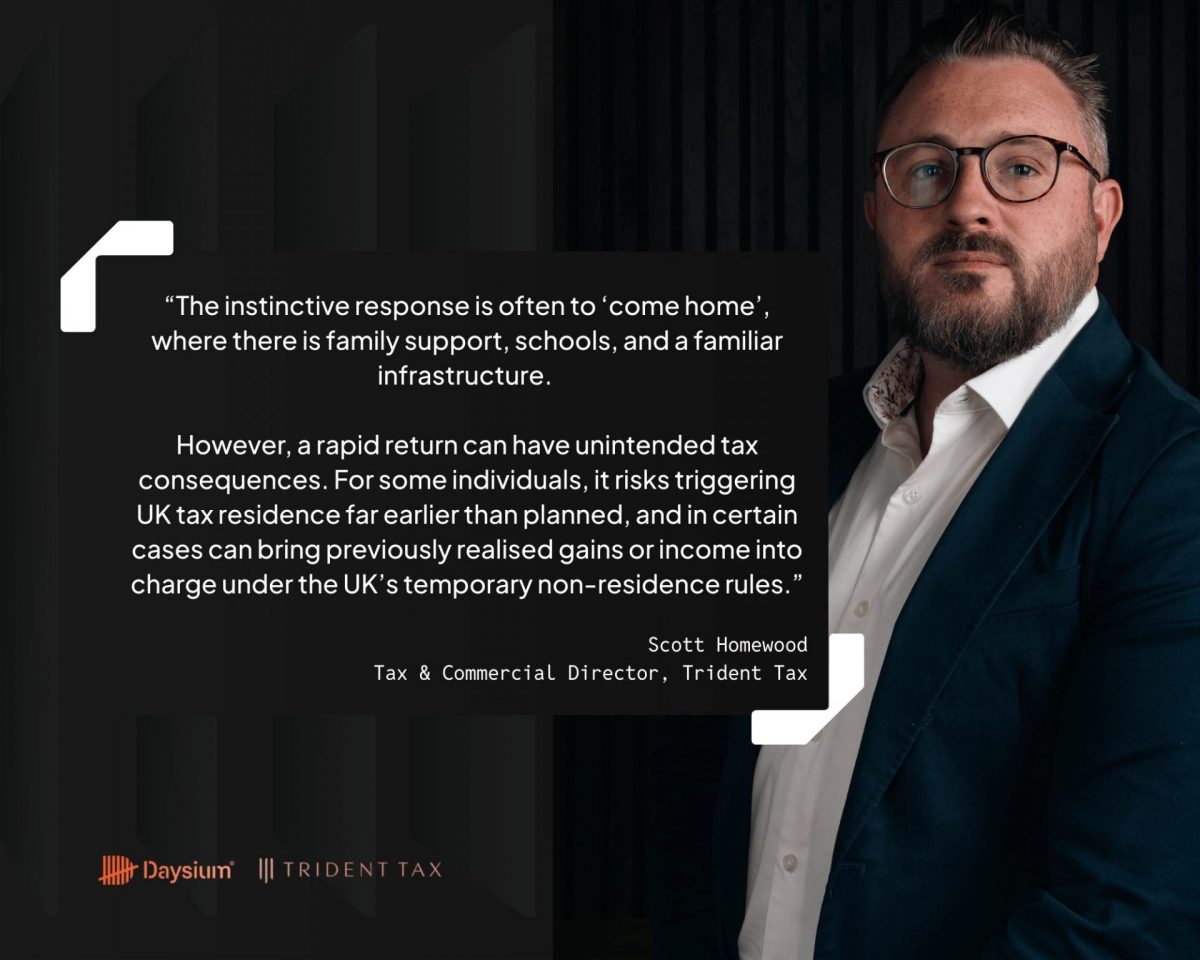
A quote by Scott Homewood from Trident Tax on deciding whether to leave the UAE and return to the UK.

The risk many returning UK expats overlook

One of the more common misunderstandings in this area is assuming that once non-UK residence has been established, the position is settled.

In reality, tax frameworks often span multiple tax years and can interact with events that occurred while someone lived abroad. For example, individuals who left the UK may have sold a business or realised investment gains. If a return to the UK occurs sooner than expected, those earlier events may need careful review under the UK’s temporary non-residence provisions.

This does not mean a return is necessarily problematic. It simply illustrates that residency planning often extends beyond the initial move abroad and may need to be revisited when circumstances change.

What to review when tax residency plans change

When circumstances shift quickly, attention naturally focuses on practical relocation issues such as travel arrangements, schooling, accommodation, and business continuity.

Those considerations are understandably important. At the same time, a relocation decision can raise several questions around tax positions that are worth reviewing carefully with professional advisers.

Reassessing the existing tax residency position

A useful starting point is often the original residency position itself. For individuals with UK connections, tax residence is determined under the Statutory Residence Test (SRT). It considers factors including days spent in the UK, work patterns, accommodation availability, and family ties.

It is not uncommon for individuals to assume they have “left the UK” simply because they now live elsewhere. In practice, the test is more nuanced and applies on a year-by-year basis. 

Considering how day count limits may change

Unexpected relocation also affects day counts, which remain a central element of tax residency frameworks. Even a temporary return to the UK could bring you closer to your limit of available day counts before you trigger tax residency. 

While certain exceptional-circumstances provisions exist in some situations, they are often interpreted narrowly and typically apply only within defined limits. 

Reporting by the Financial Times mid-March suggested government officials in UAE are considering temporary leniency in day counting requirements as a result of the conflict.  Officials are reluctant to consider blanket statements but instead are saying cases would be looked at on a case-by-case basis. The newspaper reported later how advisors and experts in the UK are expecting less leniency from HMRC

Reviewing wider governance and business arrangements

Relocation can also have implications for businesses. For entrepreneurs and business owners, where management decisions are made and where strategic control of a company sits are important. Changes in where directors operate or where key decisions take place can alter how structures are viewed from a tax perspective.

Evaluating alternative jurisdictions carefully

When reconsidering their base, individuals may naturally explore other jurisdictions. For many expats considering leaving the UAE, Europe may be the most obvious option. 

However, each option comes with its own legal, tax, and practical considerations. Relocation decisions must therefore be considered alongside immigration, business, and family factors rather than solely on tax grounds.

Scott echoed this sentiment, stating that “British nationals face an additional complexity. Securing residence elsewhere post‑Brexit is rarely straightforward. Immigration requirements limit the ability to regularise a relocation retrospectively, which means these decisions need to be approached carefully.”

“All that said, returning to the UK is not necessarily disadvantageous. For those who meet the conditions, the four‑year Foreign Income and Gains (FIG) regime can provide a highly favourable framework – but only if the individual positions themselves correctly before any move is made.”


The value of robust records when circumstances change

Periods of uncertainty often highlight weaknesses in record-keeping. When relocation decisions unfold over time, you have more time to organise and review documentation. When circumstances change quickly, finding supporting evidence can simply add to the stress. 

The reality is that tax residence is not determined solely by intention. It is assessed through evidence. That evidence may include travel records, accommodation use, work patterns, family arrangements, and, in the case of businesses, documentation showing where decisions were made.

Maintaining clear, contemporaneous records is particularly valuable. They allow tax advisers to accurately review a position and determine the potential tax implications of relocation. 

When relocation decisions are taken quickly, whether due to geopolitical developments or family priorities, having a structured record of movements and activities can significantly reduce uncertainty.

As Scott summarised, “The key message is that speed should not come at the expense of careful planning.”

Closing Thoughts

The current developments affecting parts of the Middle East illustrate an important point about international tax planning. Geopolitical developments, family priorities, business opportunities, and personal safety considerations can all change the assumptions on which original strategies were built.

When tax residency plans change, the key issue is not simply where someone decides to live next. It is how that decision interacts with the tax frameworks that apply across multiple jurisdictions and over several tax years.

For internationally mobile individuals and families, unexpected change does not necessarily create problems. But it can expose areas where assumptions need to be revisited. Clarity, supported by accurate records and informed professional advice, remains one of the most valuable tools when tax residency plans change.

Discover how to be tax compliant with Daysium

Created in partnership with industry experts, tackle the complex challenges of day counting and tax record-keeping.