Tax Residency Record-Keeping: Why “Keep Records” Is No Longer Enough

Tax residency record-keeping has evolved. For advisors managing globally mobile clients, it is no longer enough to count days and store documents. In a more scrutinised compliance environment, defensibility depends on whether the evidence tells a coherent, contemporaneous story that supports the residency position.
A picture of old filing cabinet to showcase tax residency record-keeping.

Tax advisors give excellent residency advice. Daily, they carefully walk clients through systems such as the UK’s Statutory Residence Test. They explain thresholds, ties, exceptional circumstances, and workdays. They model scenarios. They stress the importance of discipline. And then, almost as a footnote, comes the familiar instruction to the client: “Make sure you keep records.” 

Clients nod. Of course they will. The advice is sound. The intention is good. But in 2026, that instruction, on its own, is no longer sufficient for modern tax residency record-keeping. The gap between advice and evidence is where tax residency positions quietly weaken, and where advisors often find themselves drawn back in.


Key Takeaways for Advisors

  • Tax residency record-keeping is no longer an administrative afterthought but is part of the defensibility of your advice.
  • When clients operate informal systems, advisors inherit process risk, even where the technical position is correct.
  • In modern enquiries, structure and narration carry weight alongside the underlying day count.
  • Firms that embed structured record-keeping processes differentiate themselves through clarity, governance, and reduced enquiry friction.

A Common Example of Record-Keeping Advice

Consider a client who has relocated away from the UK (an increasingly common occurrence after the end of the non-dom era). They now live abroad but return regularly for board meetings, business interests, and to visit friends and family. Their advisor has carefully mapped out the thresholds required to maintain non-resident status. The client understands how many days they can spend in the UK and what ties matter.

The instruction is clear: count days and keep records.

Months pass. Travel continues. The advisor checks in periodically to ask if all is under control. “Yes, yes, things are good,” says the client. 

Then one day, an HMRC letter arrives asking the client to clarify their non-resident claim for a particular tax year. Nothing accusatory. Just a request for supporting evidence.

The advisor asks for documentation. The client pauses and states, “It may take a little while. My assistant will need to pull everything together.

What they produce, after a while, is familiar:

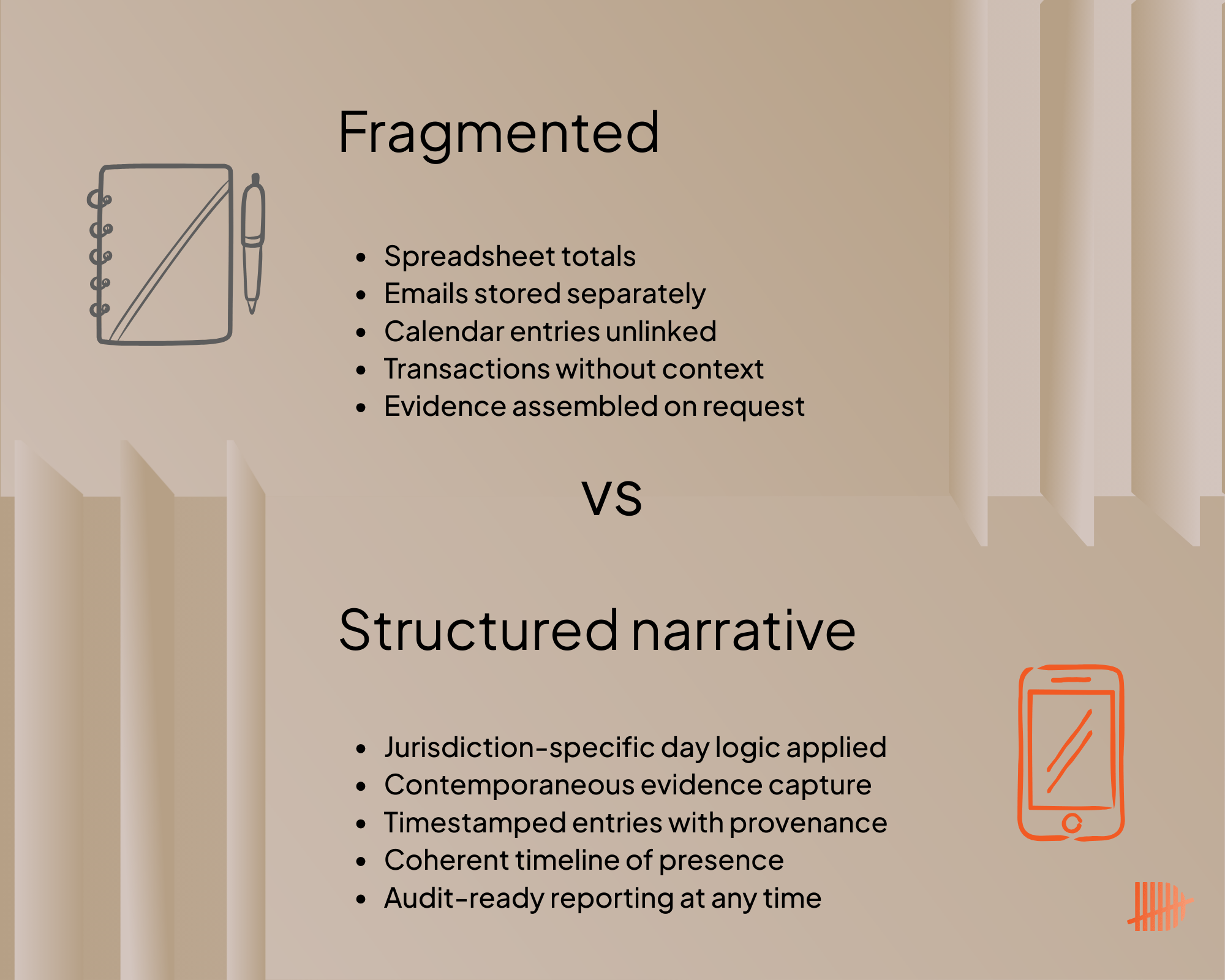
  • A spreadsheet of day counts.
  • Boarding passes from somewhere in the email archives.
  • Handwritten calendar entries showing meetings.
  • Bank transactions showing restaurant receipts.

Nothing improper. Nothing reckless. And nothing that implies wrongdoing, negligence or breach of day count thresholds. 

Yet there is something these records also don’t show, and that’s structure and a clear narrative. And these matter because record-keeping in the modern world has ceased to be purely administrative. You need narration to support your position.

A Tax Residency Position Is Not Just a Number

Most clients believe residency is defended by a day count. But in enquiries, the question is rarely straightforward: “How many days did you spend here?” 

Tax authorities will ask that, sure. But they will follow it up with: “Can you show us, coherently and credibly, that your narrative holds together?

HMRC’s own guidance on residency evidence makes clear that authorities consider the weight and quality of the documentation together, not a single document in isolation.

A spreadsheet can show totals.

An enquiry asks for sequence, corroboration, and consistency.

The difference is subtle but important.

A day count number can be correct and still be difficult to defend if the supporting record lacks structure.

Tax Residency Record-Keeping Expectations Have Changed

The modern tax environment is defined by three structural realities:

1. The burden of proof rests with the taxpayer

Across many jurisdictions, the responsibility to evidence a non-resident position lies with the individual. That doesn’t just mean having documents, but also the ability to produce them coherently, often on tight deadlines.

2. Contemporaneous evidence carries weight

Tribunals and tax authorities consistently place greater weight on documentation maintained at the time events occurred, rather than on documentation reconstructed under enquiry pressure. As Daysium Founding Partner Richard Paul of Nyman Libson Paul recently explained:

“You can’t prove a spreadsheet wasn’t altered. You need provenance, timestamps. HMRC might ask for original emails, not PDFs. That level of doubt needs to be dispelled.”

3. Data cross-checking is routine

Travel records, financial transactions, property ties and third-party reporting create an expanding data perimeter around internationally mobile individuals. None of this implies wrongdoing. But it does raise the evidential standard. What was once ‘good enough’ administrative record-keeping increasingly looks fragile under scrutiny.

Tax Residency Record-Keeping as Narrative, Not Paperwork

A list of fragmented and structured tax residency record-keeping examples.

The shift advisors need to recognise is this: tax residency record keeping is no longer about document storage. It is about narrative. A defensible residency position tells a clear story:

  • Where the client was.
  • When they were there.
  • What independent evidence supports that presence.
  • How the rules were applied consistently.
  • Why the overall position is coherent.

A day count produces a number. Record-keeping produces the story that defends that number.

When evidence is captured systematically, over time, with timestamps and clear categorisation, the story becomes far easier to follow, and far harder to challenge. That difference is not cosmetic. It directly affects the length, intensity, and stress of enquiries.

The Real Advisor Issue: You Inherit the Process Risk

Here is the uncomfortable part. You can give technically excellent advice. But if the client’s tax residency record-keeping process is informal, you may still find yourself:

  • Reviewing spreadsheets you did not design.
  • Reconciling gaps between travel and transactions.
  • Asking clients for documents that should already exist in one place.
  • Defending a technically correct position built on a weak evidential base.

The issue isn’t that clients ignore advice. It’s that “keep records” is not a process. It’s an instruction without a framework that ensures the story holds together. Advice needs evidential support that reinforces the story behind the day count.

Why Reconstructed Records Are a Risk

Many clients believe they can assemble documentation if required. In theory, that’s true. In practice, three problems arise:

  • Time lag. 
Retrieving documents from inboxes, assistants, travel platforms and banks takes weeks, not hours.
  • Inconsistency. 
Transactions prove spending, not physical presence. Boarding passes prove booking, not arrival. Calendar entries show intention, not location.
  • Credibility perception. 
A body of evidence built under enquiry pressure can appear curated rather than maintained.

None of these invalidates the underlying tax position. But they weaken its presentation. And residency disputes are often decided on cumulative credibility rather than a single decisive document.

What Forward-Thinking Advisors Recognise

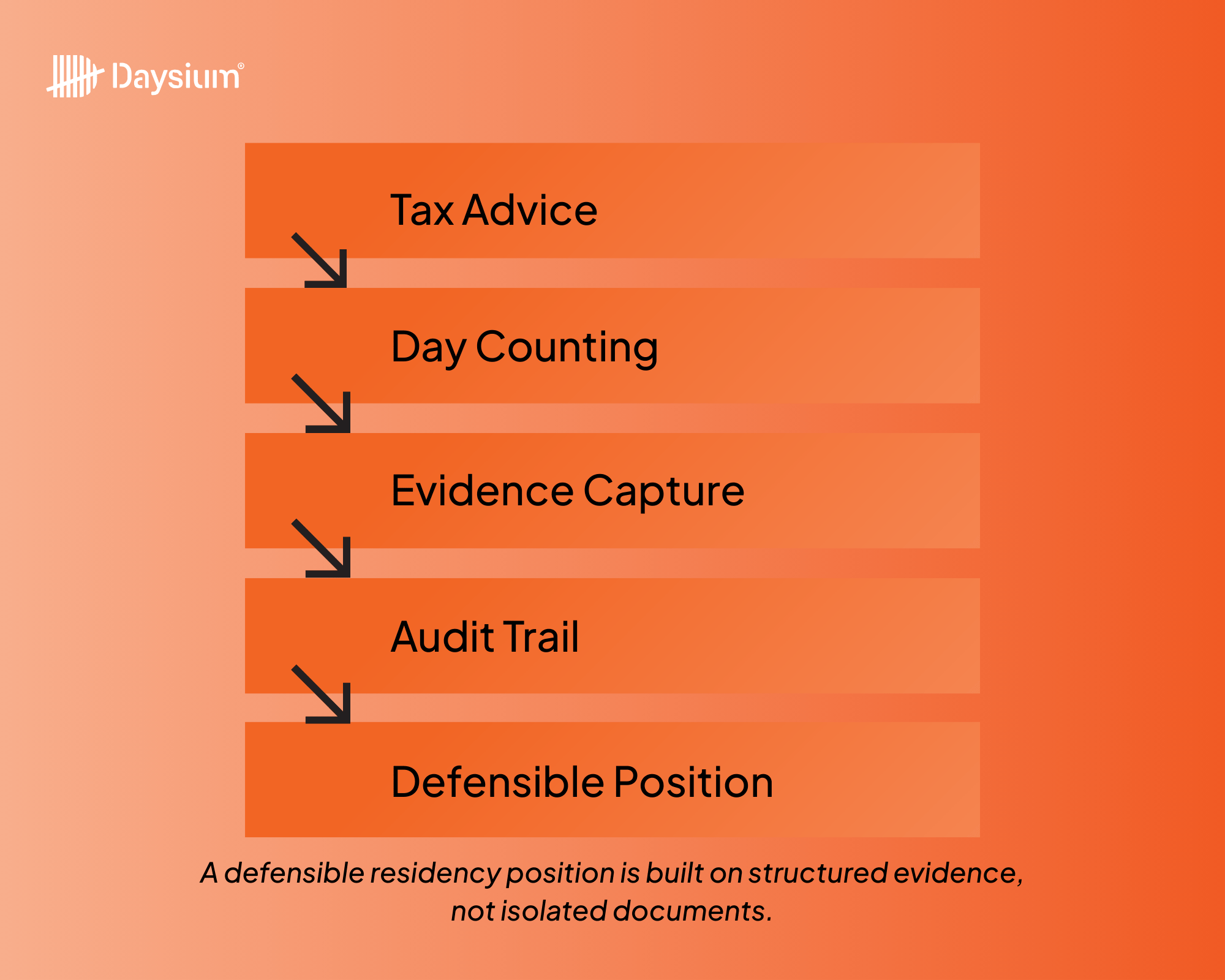
The firms that are evolving fastest are reframing day counting and record-keeping as a defined compliance workflow rather than a casual administrative task. They understand that modern residency management requires:

  • Ongoing visibility of day thresholds.
  • Contemporaneous evidence capture.
  • Secure, shareable reporting when required.
  • Clear audit trails.

In other words: advice supported by a structured evidential narrative. Not because clients are incapable but because the compliance environment now demands more structure and storytelling.

A list of the five record-keeping steps to better tax-residency and day counting process.

Protecting Advisory Value in a More Scrutinised World

For tax advisors building a reputation in cross-border work, this is not a minor operational detail. It is a positioning issue. Clients expect clarity, authorities expect evidence, and advisors sit between the two.

If your advice is strong but the client’s process is weak, the weakest link defines the experience. If both are strong, the enquiry, if it ever comes, becomes shorter, calmer, and more predictable.

That distinction matters for client retention, firm reputation, time allocation, and stress levels during peak periods.

Adding narration to record-keeping

“Keep records” used to be a sufficient shorthand for tax residency record-keeping. In 2026, it isn’t. Advisors who stand out are the ones who can say: “Here’s the residency strategy. Here’s the process that supports it. And here’s the evidence trail we’ll have if anyone asks.

That shift, from informal record-keeping to structured evidential narrative, is what transforms residency advice from technically correct to operationally defensible. And increasingly, that’s what sophisticated globally mobile clients expect.

If you’d like to discuss how to strengthen how your clients keep records for tax residency, get in touch with our team. 

Book a call for a confidential meeting.

Discover how to be tax compliant with Daysium

Created in partnership with industry experts, tackle the complex challenges of day counting and tax record-keeping.