Why Spreadsheet Day Counting Is a Liability in 2026 (and What Advisors Should Offer Instead)
05 Jan 2026
Spreadsheet day counting feels familiar, but it often collapses under tax residency enquiries. We examine the hidden risks of spreadsheets and why advisors are increasingly recommending a professional, evidence-led alternative.
Tax advisors give excellent residency and relocation advice. Clients understand (at least theoretically) that day counting matters for tax residency compliance. They’ve seen the headlines, they’ve heard about increased scrutiny, and they know that one misstep can be expensive.
And yet, when it comes to how they should actually do day counting day-to-day, most clients still end up in the same place: spreadsheet day counting.
Not because they’re careless. But because spreadsheets are familiar, they feel ‘good enough’, and crucially, because there’s often no clear, repeatable process an advisor can recommend beyond keeping records. The result is a compliance gap: strong advice at the top, weak execution underneath.
However, tax technology is evolving, and technology is finally solving many of these outdated frameworks. What’s more, people’s appetite for digital tools seems to be growing. Take the UK’s Her Majesty’s Revenue & Customs (HMRC) tax app, which had over 4.2 million downloads in 2025, growing 20% in usage from the year before.
And spreadsheets are also falling out of favour in the world of Family Offices. Simple’s Family Office Software & Technology Report 2025, which Daysium contributed to, found that only 0-25% of potential new clients use spreadsheets for primary reporting. This had almost halved, falling from over 50% the year before.
So, why is 2026 the time to stop recommending spreadsheets and ensure your clients have a better way to manage their day counting and record-keeping for tax residency? Let’s take a closer look.
Why is Spreadsheet Day Counting Risky for Tax Residency?
Spreadsheet day counting relies on manual entry, lacks contemporaneous evidence, provides no reliable audit trail, and does not embed jurisdiction-specific tax rules. In tax residency enquiries, this often leads to credibility gaps, prolonged investigations, and increased advisor involvement, even where the underlying tax position is correct.
The Spreadsheet Day Counting Problem Isn’t That It’s Old-Fashioned
Spreadsheets are structurally misaligned with what residency enquiries demand today.
A residency position is rarely defended by a single day count number. Not only do many tax jurisdictions consider additional ties to a country beyond physical presence, but even physical presence must be evidenced beyond mere statements of ‘I was there’.
In the UK, HMRC expects individuals to keep records and supporting documents when applying the Statutory Residence Test (SRT). When considering whether a person has a home in the UK or abroad, HMRC expects documentation such as:
utility bills
home security arrangements
linked credit cards and bank statements
However, as they state online, the provided list is not exhaustive. Instead, they “will consider the weight and quality of all the evidence as, taken together, a number of pieces of evidence may be sufficiently strong enough to demonstrate their presence in a particular home.”
What Does a Spreadsheet Show & Lack?
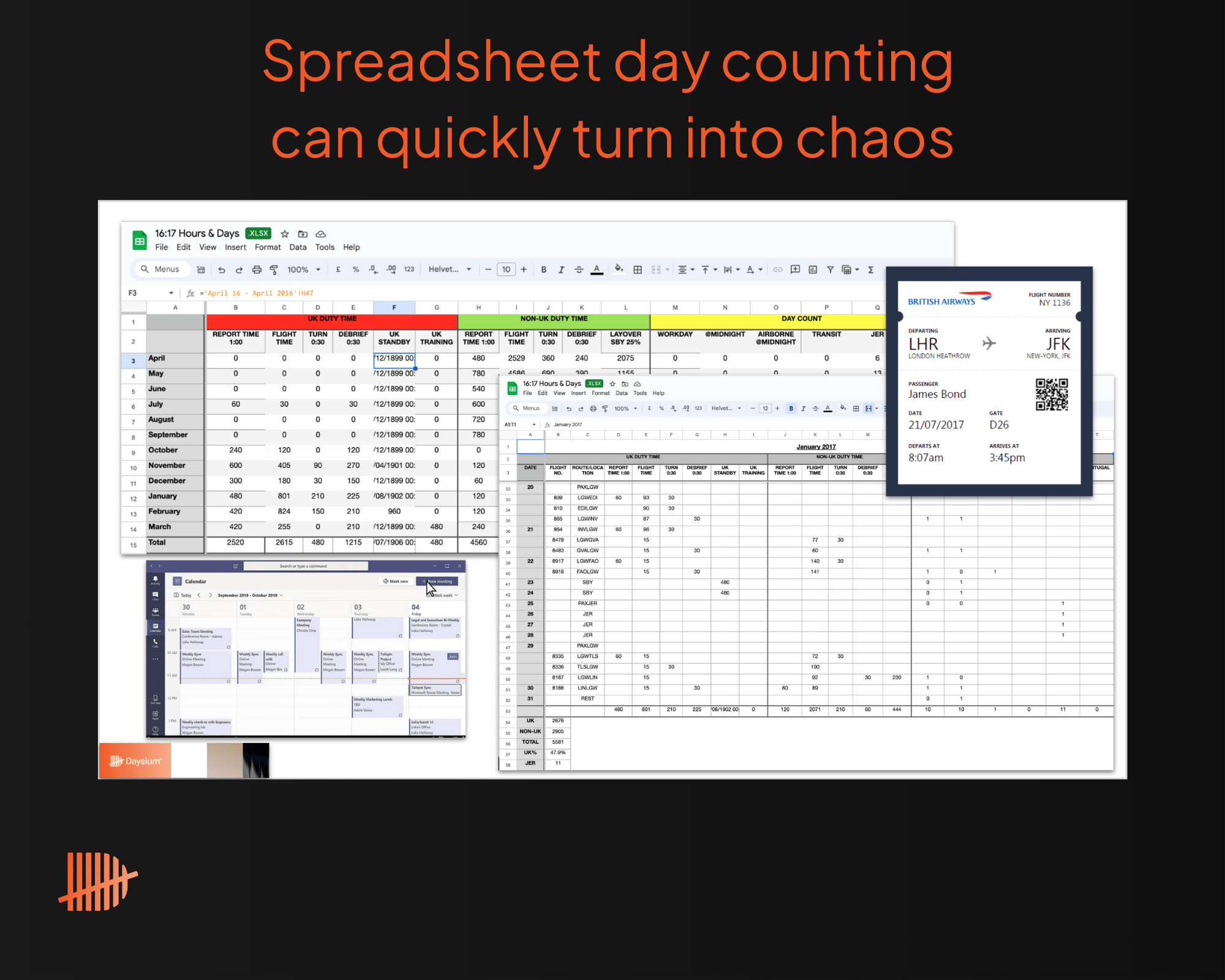
A spreadsheet can store a list of dates. These can be marked as a specific type, like work day or transit day, manually, and the days tallied together.
But this limited information struggles with the realities of 2026 compliance:
evidence must be contemporaneous, not reconstructed later
records must be consistent, even when the client’s travel patterns might not be
day counting must reflect the right rules, not generic assumptions or day counts
the final story must be auditable and defensible, not just plausible
In other words, a spreadsheet might be a log, but it is rarely a compliance system.
Why Spreadsheets Break Down in Residency Disputes
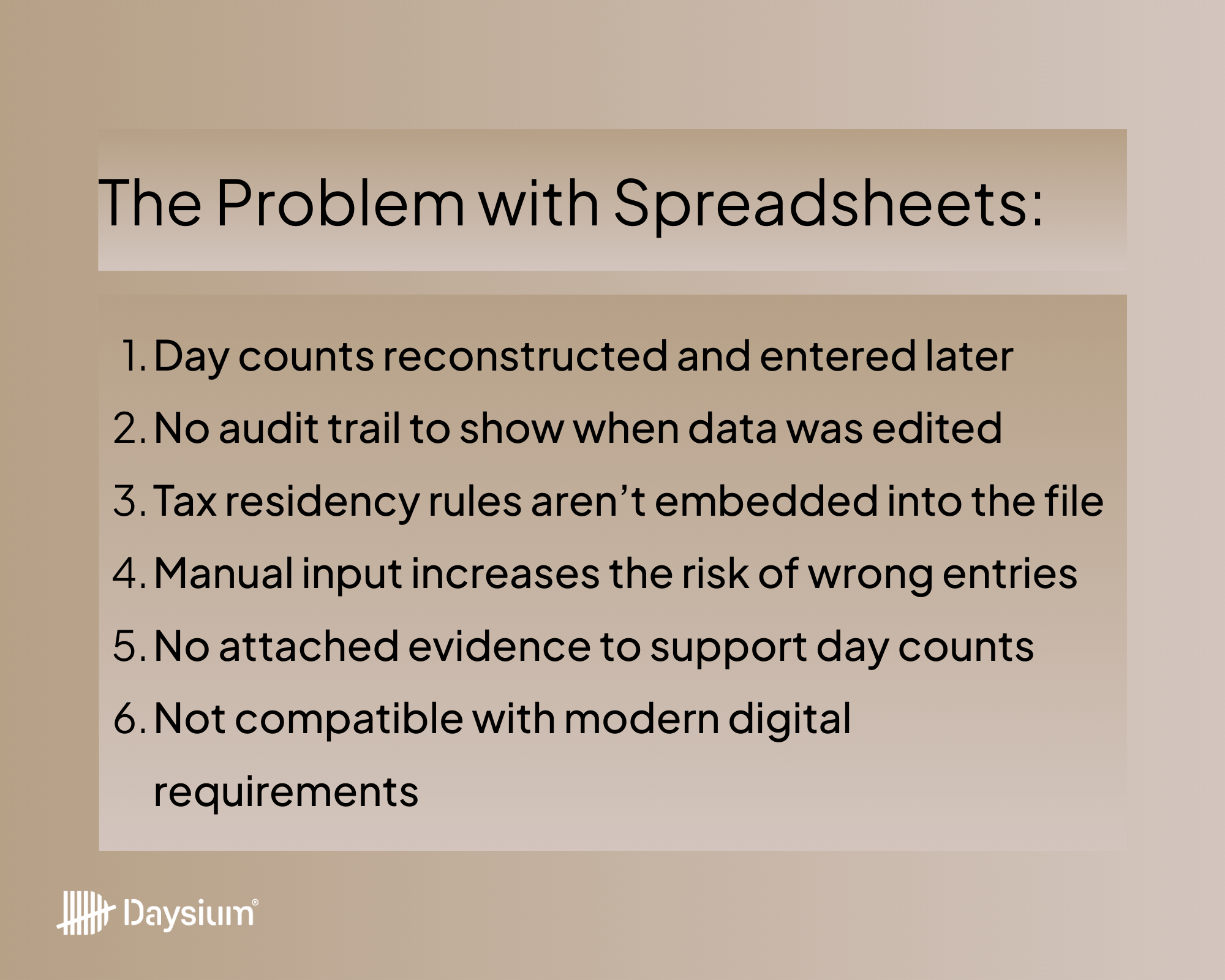
Spreadsheets are manual, which increases the risk of errors and data gaps, which are often specifically what the tax authorities are looking for in a dispute. The reality is that it always falls to the individual to prove they were or weren’t a tax resident. This manual, error-prone nature has six main problems that advisors and clients need to understand:
1) They’re Not Contemporaneous (and That Matters)
The single biggest practical failure mode with spreadsheet day counting is timing.
Clients don’t update them daily. They update them when they remember, which often happens in batches, and after travel. These files are filled (mostly) when a tax return is due, or when an advisor asks. That introduces two risks:
accuracy risk: the client’s memory becomes the record
credibility risk: it looks ‘made for the enquiry’, rather than maintained as a regular habit
HMRC’s own guidance emphasises that it considers the weight and quality of evidence “taken together.” That’s a subtle but essential point: credibility is cumulative. Evidence that is consistent, timely, and coherent tends to carry more weight than a patched-together trail built under pressure.
Spreadsheets are simply not built to encourage contemporaneous capture, especially when the client is busy, travelling, and living across jurisdictions.
2) They Have No Reliable Audit Trail
When a client edits a spreadsheet, most of the time, there is no clean, user-friendly audit trail that answers basic questions like:
When was this entry added?
Was it changed later?
Who changed it?
What was it before?
And even when version history exists, it’s rarely maintained in a disciplined way by individual clients. In an enquiry, the ability to show that records were maintained consistently and not curated later can be as important as the underlying numbers.
A day count without an audit trail is a day count that invites follow-up questions.
3) They Don’t Embed the Rules
Most clients don’t struggle to understand that they must count days. They struggle to consistently apply:
the right day-count rules
the correct definitions (workdays, transit days, exceptional days, ties, etc.)
the right jurisdictional logic (especially when multiple regimes are in play)
No matter how well you’ve explained the rules and gotten the nods that everything is clear, the clients don’t have this logic built into the spreadsheet. When they’re entering dates, the spreadsheet shows a simple day count. It won’t prompt the client to realise when thresholds are approaching or that a particular date might not actually count.
So the spreadsheet becomes a confidence trick: it looks precise, while small gaps in day counts or supporting evidence might build up in the background.
4) Spreadsheet Error Rates Are Not a Theory But a Known Risk
Even outside tax, spreadsheet error research is remarkably consistent: errors are common, hard to detect, and increasingly likely as models grow.
Ray Panko’s research highlights a practical reality: even small cell-level error rates become significant in any spreadsheet of moderate size, and “bottom line” errors become highly likely as complexity increases.
In tax residency compliance, the “bottom line” error can be catastrophic: one incorrect tally or misclassified day can push a client over a threshold. The spreadsheet doesn’t need to be bad to become dangerous. All it takes is a single human error.
5) They Are Weak on Evidential Value
One of the most significant issues with spreadsheet day counting is that it only shows the day count the client entered based on memory and records. It doesn’t actually show any of what happened.
When HMRC asks for support, clients typically scramble for:
travel confirmations, tickets, boarding passes
bank/credit card statements
mobile records
calendar entries
accommodation documents
And even where a client can produce transactions, transactions don’t always prove presence. The evidential burden tends to grow when a timeline looks inconsistent, leaving advisors and clients stuck in a cycle of clarifying questions and document requests.
6) They Don’t Match the Modern Data Environment
HMRC has spent the last decade improving its ability to cross-check taxpayer narratives against third-party data. Connect is a prime example of this direction of travel.
In late 2025, reporting based on HMRC disclosures, Connect generated billions in additional annual yield, with the most recent year cited at approximately £4.6bn, and the system was described as operating at a massive scale and as widely used within HMRC.
The exact mechanics of any enquiry will vary, but the strategic implication for advisors is stable: the data perimeter around clients has expanded. A spreadsheet that can’t be supported with coherent evidence is increasingly likely to create prolonged back-and-forth, even when the underlying position is correct.
The Real Advisor Issue: You’re Being Asked to Defend the Spreadsheet
This is the uncomfortable part.
You can deliver excellent advice, but if the client’s process is weak, you may still find yourself:
spending a lot of time validating a spreadsheet you didn’t create
asking the client for evidence that should already exist
trying to reconcile messy entries with travel and transaction trails
defending an outcome that is technically correct but practically fragile
That’s why the pain point in the advisor world isn’t ‘day counting is hard’. It’s that there’s no clear operational system to recommend. So clients default to the spreadsheet day counting and hope for the best.
What Advisors Should Offer Instead: a Professional Compliance Process
The opportunity in 2026 is to stop treating day counting as a casual admin task and start treating it as a defined, repeatable compliance workflow.
At a minimum, a defensible process needs to do four things well:
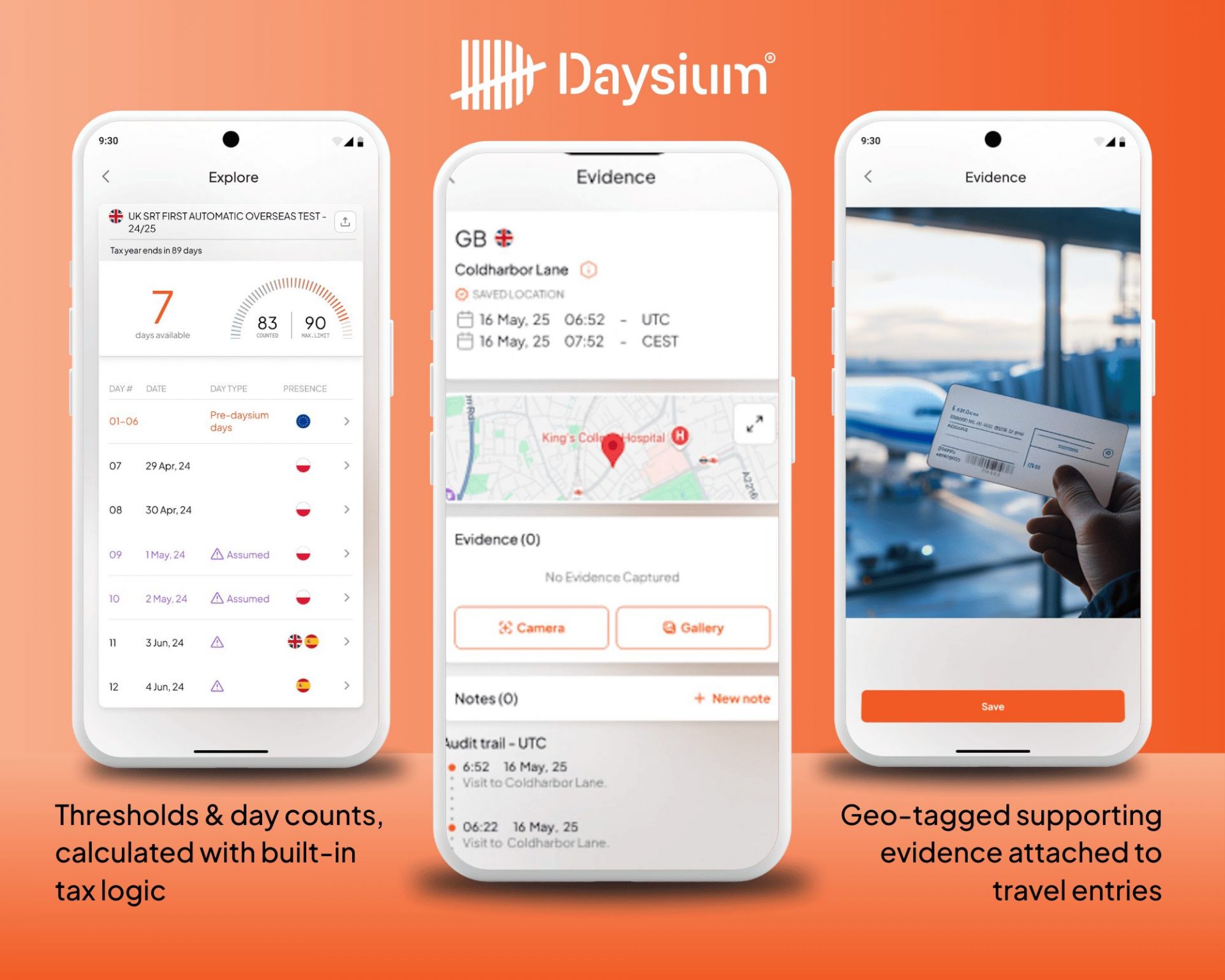
Capture days automatically (or with minimal friction)
Attach supporting evidence as the year progresses
Apply rules consistently, based on the advisor’s guidance
Produce shareable reports that are secure and audit-friendly
This is where Daysium fits. We’re not trying to introduce tech for the sake of tech into the compliance process. Instead, we’re acting as the missing execution layer that turns your excellent tax residency advice into a system that clients can follow to strengthen their tax position.
Your advice remains the core. Daysium strengthens how that advice is implemented:
A clearer client process: instead of “keep records”, the client follows an actual workflow they can understand and sustain.
Fewer ugly surprises: real-time visibility and structured evidence reduce the chance of end-of-year panic.
Better client experience: clients feel looked after because they can see what they’re doing and why.
Peace of mind for you as well: you’re no longer anchored to a spreadsheet you didn’t design, update, or trust.
This also aligns with the broader direction of compliance: the UK is continuing to push digital record-keeping through programmes like Making Tax Digital, reinforcing the expectation that taxpayers keep records in more structured, systematic ways.
Sarah Scala, Founder of the Contentious Tax Group and Daysium Founding Partner, said that in regard to tax liabilities during enquiries, she would:
“Be confident to put forward arguments that the use of the [Daysium] app was itself a means of taking reasonable care to pay the correct amount of tax.“
Closing Thought: The Spreadsheet Isn’t the Enemy, But the Absence of Process Is
Clients use spreadsheet day counting because they’re trying to do the right thing with the tools they have.
In 2026, the tax advisory firms that stand out are the ones that can say:
“Here’s the advice.”
“Here’s the process.”
“Here’s how we’ll review it together.”
“And here’s the evidence trail we’ll have if anyone asks.”
That’s the value package Daysium unlocks for tax advisors: advice + execution + defensibility, delivered in a way that creates peace of mind for clients and reduces avoidable stress for advisory teams.
If you’re interested in elevating how residency compliance is delivered for your clients and for your firm, we’d welcome a conversation about becoming a Daysium partner.
Tax residency record-keeping has evolved. For advisors managing globally mobile clients, it is no longer enough to count days and store documents. In a more scrutinised compliance environment, defensibility depends on whether the evidence tells a coherent, contemporaneous story that supports the residency position.
HMRC tax investigations into individuals can be complex, time-consuming and emotionally draining, particularly for high-net-worth and globally mobile individuals. This article explores whether investigations are getting longer, why the wealthy face greater scrutiny, and how strong compliance records and automation can significantly reduce their impact.
European programmes are tightening or closing, non-EU hubs like the UAE and Saudi Arabia are rising, and tax authorities are paying closer attention to how and where globally mobile individuals spend their time. For HNWIs, success now depends on strategic planning, accurate day counting, and defensible residency records, not just qualifying investment.
The end of the non-dom regime in the UK led to three core themes: increased relocation, UAE as a favoured destination, and behavioural changes around the underlying reasons to leave. Let’s look at what has happened and what you need to know if you’re considering leaving the UK.