HMRC Nudge Letters: A Quick Explainer

As an HNWI and globally mobile individual, you’re likely to come across HMRC nudge letters. But what are they, why they’re sent, who might receive one, and what are the practical steps to take with a tax advisor to prevent escalation?

A letter from the tax authority isn’t what any of us hopes to receive. But for many high-net-worth individuals (HNWIs), nudge letters are becoming increasingly common. But what are they?

Nudge letters are not a sign of a formal tax investigation. They’re sent by His Majesty’s Revenue & Customs (HMRC) in the UK to engage the recipient in a compliance conversation, and to gauge whether a formal investigation may be warranted. But this informal nature doesn’t mean you shouldn’t take them seriously. It’s vital you understand the scope of these letters and take adequate steps when responding to one to avoid complicating matters further. 

Please note that the below isn’t tax advice. You should always turn to a qualified professional if you receive a nudge letter. This article will only help you get an overview of what these letters are, who might receive them, and give you an actionable framework for dealing with them together with your tax advisor.

What Is an HMRC Nudge Letter?

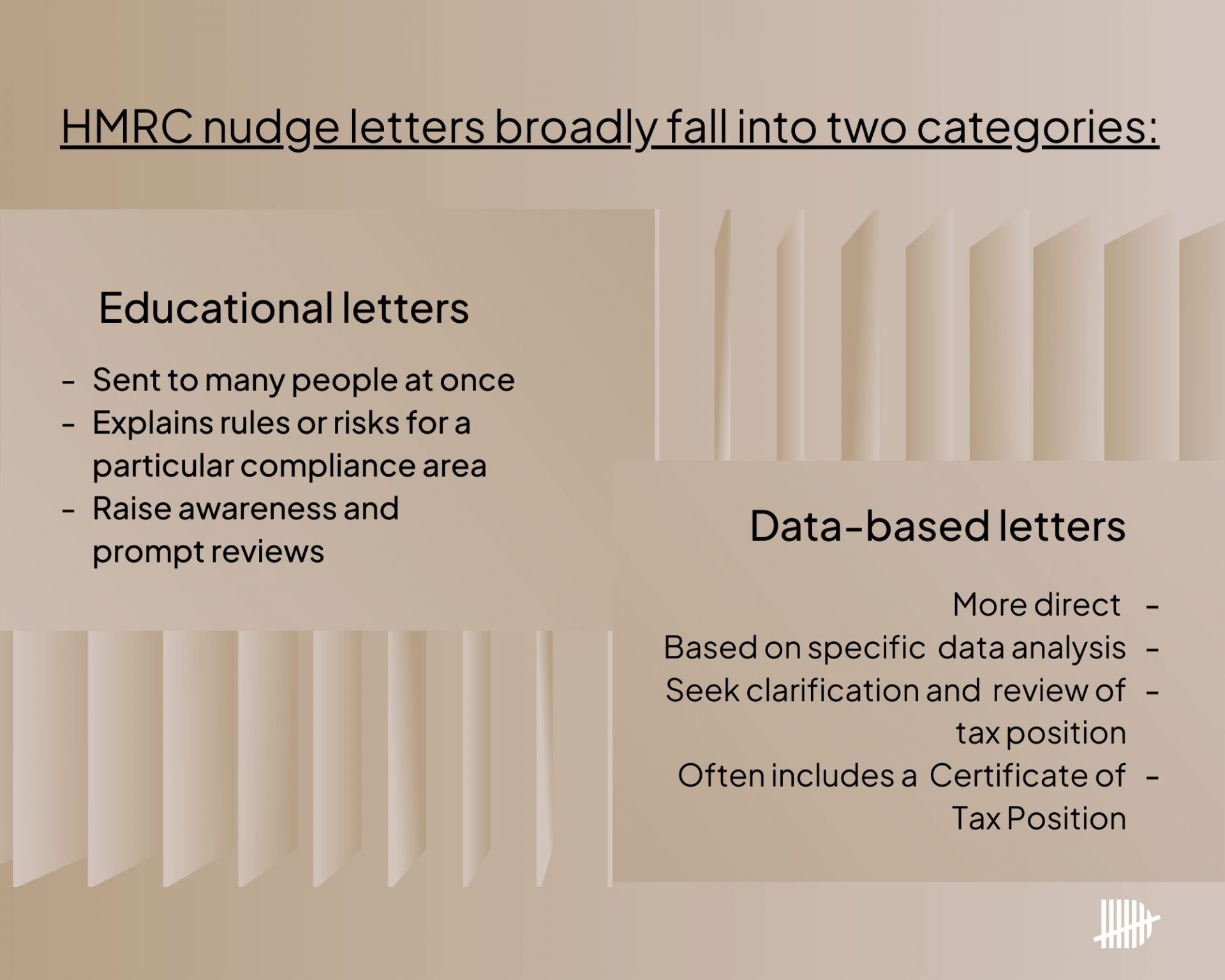
Outlines two types of HMRC nudge letters: educational letters and data-based letters

A nudge letter is an informal compliance communication sent by HMRC. It is not a statutory enquiry, and it does not carry the same legal status as a formal tax investigation.

Instead, nudge letters are designed to prompt behaviour. They typically encourage recipients to review a specific aspect of their tax return. The letter may, for example, request clarification of your tax residency status or seek a review of a specific disclosure you made. 

While these letters can be distressing to receive, they don’t mean HMRC accuses you of wrongdoing. These letters may be sent in bulk to people who fit a certain profile that HMRC wants to prompt to review their tax position. HMRC has openly acknowledged the use of nudge letters as part of its broader compliance strategy. They are cost-effective, data-driven, and often used as a precursor to deeper action if concerns are not addressed.

These letters may also be more specifically targeted. The intent behind these letters is HMRC’s belief that there may be a risk of inaccuracy, omission, or misalignment between what has been reported and the information it already holds. The UK tax authority does acknowledge that any discrepancies they mention in nudge letters may have a reasonable explanation.

In other words, the letter reflects uncertainty, not guilt.

Who Can Receive a Nudge Letter?

While nudge letters can be sent to a wide range of taxpayers, specific profiles are more likely to attract them.

They are common among:

  • High-net-worth individuals
  • Globally mobile individuals
  • UK non-doms and former non-doms
  • Individuals with offshore income, gains, or trusts
  • Those with complex or changing tax residency positions

As we mentioned earlier, HMRC may send the letters as a compliance reminder to people in a specific target group. 

For example, in recent years, HMRC sent nudge letters to individuals who indicated in their tax returns that they were temporarily non-UK residents. Below is what Thomas Wallace, Director of Tax Investigations at WTT, wrote at the time: 


Why Might You Receive a Nudge Letter?

Although anyone could receive these letters, nudge letters are typically triggered by data, patterns and perceived inconsistencies. 

Common reasons include:

  • Third-party data doesn’t align with your tax return. This could include reports HMRC has requested from foreign banks, for example.
  • Belief in unclaimed income. Again, HMRC might believe your income is lower than their analysis estimates based on various data analytics.
  • High risk-profile. HMRC profiles taxpayers, and you may fall into a specific high-risk group, such as landlords or those with foreign income.

Tax authorities everywhere, not just the UK, use AI and data analytics tools to check social media accounts, bank accounts, and even flight logs to profile taxpayers and assess their perceived risk of non-compliance. Having strong records to back up things like your tax residency position is essential.

When Do You Have to Respond to a Nudge Letter?

HMRC will specify what part of your compliance it would like you to review or clarify. The letter often includes a Certificate of Tax Position, which they will ask you to complete and return.

You’re typically given a 30- or 60-day response window from the date of the letter. You’ll likely receive a follow-up query if you don’t respond within the time frame. Please note that you can request an extension of the response deadline. 

What Should You Do If You Receive a Nudge Letter?

How you respond to a nudge letter can significantly influence what happens next. While the letter is informal, it should be treated seriously.

Don’t ignore it

The first thing you must avoid is setting the letter aside and forgetting about it. Like with many things in life, ignoring a nudge letter rarely makes the issue disappear. HMRC monitors engagement, and non-response can increase the likelihood of escalation to a formal enquiry.

Don’t rush to reply

Equally, a hurried or poorly considered response can create problems. Inconsistent explanations, incomplete information, or speculative replies may raise more questions than they answer.

This is especially true if your letter includes a Certificate of Tax Position. This asks for a formal declaration of your tax position, and a positive declaration could put you at risk of making a false (even if unintended) declaration. Making a false declaration is a criminal offence. 

Always consult a qualified tax advisor if you’ve been sent a Certificate of Tax Position

Review your position with a tax advisor

Before responding, contact your tax advisor to review the letter in detail. If you don’t have a tax advisor, you can contact one of Daysium’s Founding Partners

Together with your qualified tax advisor, you can take a structured look at the area HMRC is enquiring about. This could involve reviewing your tax residency position and the day counts to support it, as well as offshore income and gains. Essentially, you want to review any of the areas HMRC is enquiring about.

Early advice from a tax advisor experienced in HMRC enquiries can help you frame an appropriate response, decide whether action is needed, and reduce the risk of the matter escalating.

Handled well, a nudge letter can be resolved quietly. Handled poorly, it can become the starting point of a lengthy and intrusive investigation.


Frequently Asked Questions

Is a nudge letter the same as a tax investigation?


No. A nudge letter is informal and not a statutory enquiry. However, it can lead to a formal investigation if concerns remain unresolved.

Do I have to respond to a nudge letter?


There is no legal obligation to respond, but ignoring it can increase the risk of escalation. Always consult a qualified tax advisor to consider your options and craft a response.

Can a nudge letter turn into a full enquiry?


Yes. If HMRC is not satisfied after sending a nudge letter, it may open a formal compliance check or investigation. This can happen if you avoid responding or if HMRC isn’t satisfied with your responses.

Do other countries’ tax authorities send nudge letters?

While the term ‘nudge letters’ is specific to the UK, many other countries’ authorities use similar informal, educational compliance letters and checks. Since many countries exchange financial information, these types of data-initiated checks are common for people living global lives.

A Nudge Letter Is a Signal — Not a Verdict

HMRC nudge letters are part of a broader shift towards data-led compliance and early intervention. For HNWIs and globally mobile individuals, they are increasingly a feature of the tax compliance landscape you must navigate.

Crucially, a nudge letter is not an accusation. It is an opportunity to clarify your position before matters become more formal, but only if it is handled correctly.

If you receive one, the most effective next step is to speak with an advisor who regularly handles HMRC enquiries and understands how these letters fit into the wider investigatory process. Early, informed guidance can often prevent a simple nudge from turning into something far more disruptive.

Speak to an advisor.

Discover how to be tax compliant with Daysium

Created in partnership with industry experts, tackle the complex challenges of day counting and tax record-keeping.